
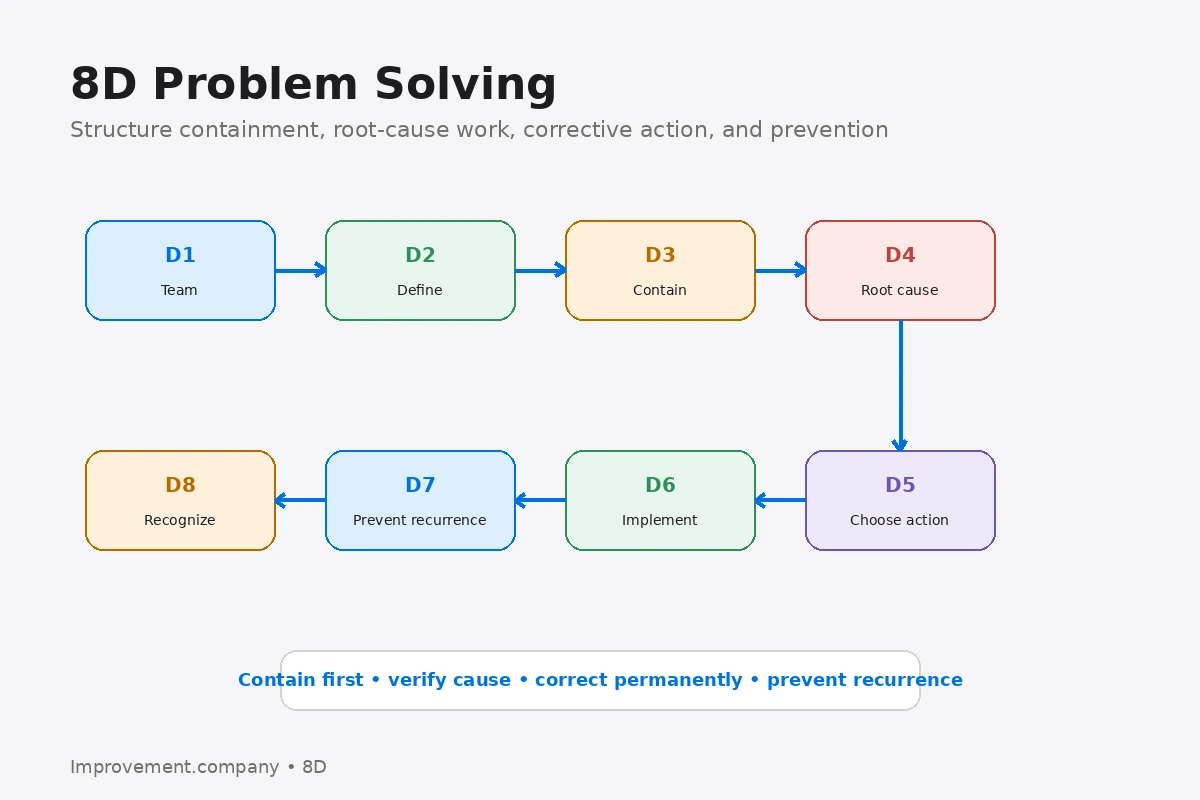
8D is a structured problem-solving method used for significant, recurring or customer-facing problems that require coordinated corrective action. The name refers to eight disciplines, although many organizations also include an initial planning step before the formal sequence begins.
The method is especially common in automotive and manufacturing quality systems because it separates immediate containment from deeper corrective action and requires verification before closure.
D1: Establish the team
The problem should be assigned to people with the knowledge and authority needed to solve it.
A cross-functional team may include operations, quality, engineering, maintenance, supply chain or other specialists depending on the issue.
The team should be large enough to cover the relevant knowledge without becoming difficult to coordinate.
D2: Describe the problem
The problem needs a precise description.
Useful information includes what is wrong, where it occurs, when it occurs, the size of the gap and what should have happened instead.
Methods such as 5W1H or Is/Is Not analysis can help sharpen the definition.
A weak problem statement usually produces weak cause analysis.
D3: Implement containment
Containment protects the customer or downstream process while the permanent cause is still being investigated.
Examples may include additional inspection, segregation, temporary parameter controls or controlled sorting.
Containment should be clearly identified as temporary.
It reduces immediate risk but does not prove that the cause has been removed.
D4: Identify and verify root causes
The team then investigates why the problem occurred and why the existing system failed to prevent or detect it.
5 Whys, fishbone diagrams, process analysis, data stratification and technical testing may all support this discipline.
Potential causes should be verified with evidence rather than selected by opinion.
D5: Choose permanent corrective actions
A permanent corrective action should address the verified causal mechanism.
The team should consider whether the proposed action creates new safety, quality, cost or operational risks.
Where possible, prevention is stronger than relying only on additional inspection.
D6: Implement and validate
The corrective action is implemented and the result is checked against the original problem.
The team should verify that the defect, failure or recurrence has been reduced or eliminated under relevant conditions.
If the problem continues, the analysis or action may need revision.
D7: Prevent recurrence elsewhere
The learning may apply beyond the original location.
Similar equipment, products, suppliers, processes or documents should be reviewed for the same risk.
FMEA, Standard Work, maintenance plans, design standards and training may also need updates.
This discipline turns a local fix into organizational learning.
D8: Recognize the team and close
The final discipline confirms completion and recognizes the people who contributed.
Recognition is not merely ceremonial. It reinforces disciplined problem solving and makes the learning visible.
Common mistakes
The most common 8D failure is treating containment as permanent corrective action.
Another is closing the report as soon as actions are completed without verifying effectiveness.
A third is forcing minor issues into a full 8D when a simpler method would be faster and more appropriate.
8D works best when the problem genuinely requires structured cross-functional investigation, documented corrective action and prevention of recurrence.
How 8D connects to the wider improvement system
8D becomes stronger when its disciplines are connected to other problem-solving methods rather than treated as a stand-alone form. Root Cause Analysis strengthens the causal investigation, Pareto Analysis helps focus attention on the most significant contributors, and Toyota Problem Solving reinforces the discipline of grasping the situation, testing countermeasures, and checking results.
Related application
This topic also connects with Containment Action. Use that method when the improvement requires the related operating or management discipline.