
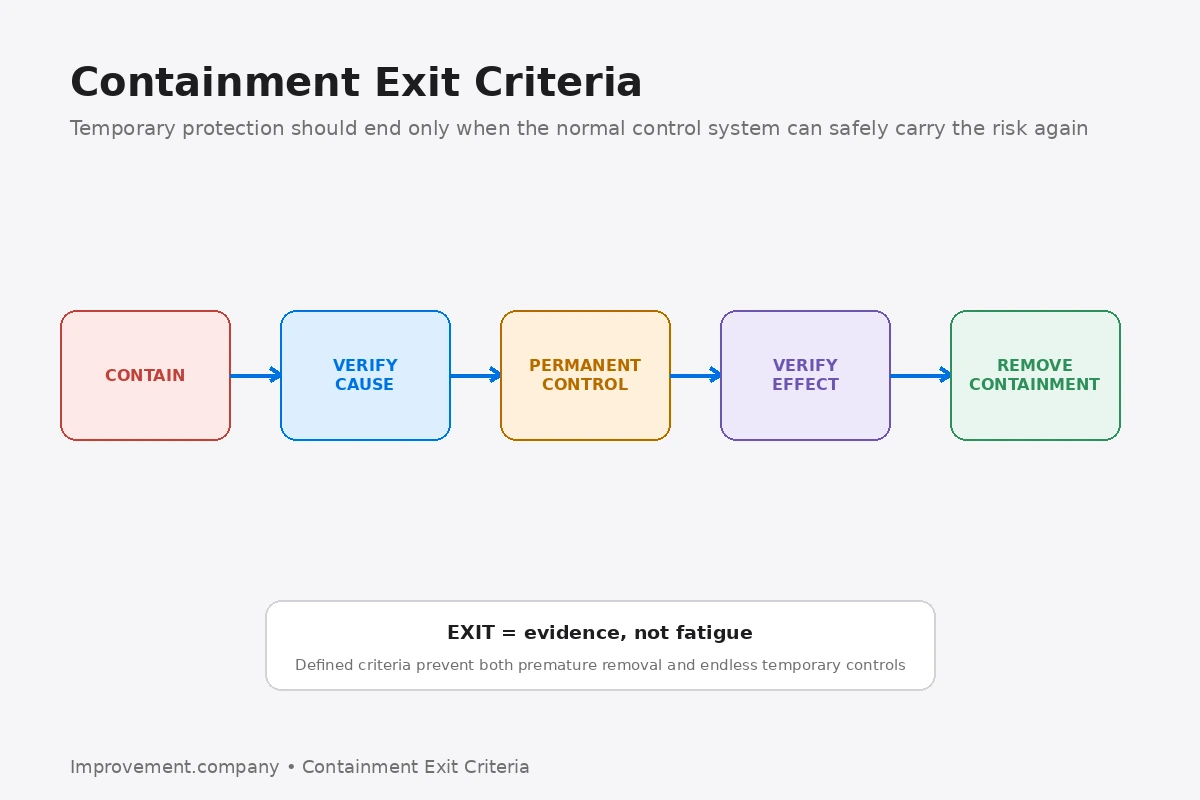
Containment Exit Criteria define the evidence required before temporary protective controls can be removed.
Containment may include sorting, extra inspection, shipment hold, temporary process checks, or alternate routing.
Containment Action helps protect the customer and process while the underlying problem is being investigated.
The question eventually becomes what must be true before this temporary protection is no longer needed.
Define exit criteria when containment starts
Do not wait until everyone is tired of the containment activity.
Define in advance what evidence will support removal.
Possible criteria include a verified cause, permanent countermeasure installed, standard updated, defined period with no recurrence, or acceptable capability or test result.
Require verified cause where appropriate
Cause Verification helps confirm that the suspected cause actually changes the problem.
Removing containment before cause is understood can expose the customer to the same risk again.
The required evidence should be proportional to the problem severity.
Confirm the permanent control
The permanent countermeasure should control the verified cause.
Countermeasure Management helps connect causes with actions, owners, due dates, and follow-up.
Do not remove containment because an action was merely scheduled.
Verify implementation quality
Confirm that the change is installed, affected people know the new method, required documentation is current, and monitoring is active.
Action Closure Criteria helps define objective evidence before implementation actions are considered complete.
Verify effectiveness
Improvement Effectiveness Review helps determine whether the implemented change actually improved the process and whether the result is holding.
Possible evidence includes no recurrence for a defined period, defect rate returned to normal, process condition stable, or customer protection no longer required.
Define who can authorize removal
The person performing containment may not have authority to remove it.
Possible approval may come from quality, the process owner, a customer representative, or a cross-functional review.
Make the decision right explicit.
Remove temporary controls deliberately
When containment ends, stop the extra activity, update status, communicate the decision, and preserve learning.
Do not leave unnecessary inspection in place forever.
Common mistakes
Removing containment because it is expensive, defining no exit criteria, treating corrective-action installation as proof of effectiveness, allowing the person doing the containment to remove it unilaterally, keeping temporary controls forever, and failing to communicate that normal control has resumed are common mistakes.
Practical sequence
- define containment.
- define exit criteria immediately.
- verify the problem cause.
- implement permanent control.
- verify implementation evidence.
- update standards and training.
- verify process effectiveness.
- obtain required authorization.
- remove temporary controls.
- monitor for recurrence.
The practical lesson
Containment Exit Criteria prevent temporary protection from being removed too early or left in place forever.
Containment should end only when evidence shows the normal control system can safely carry the risk again.