
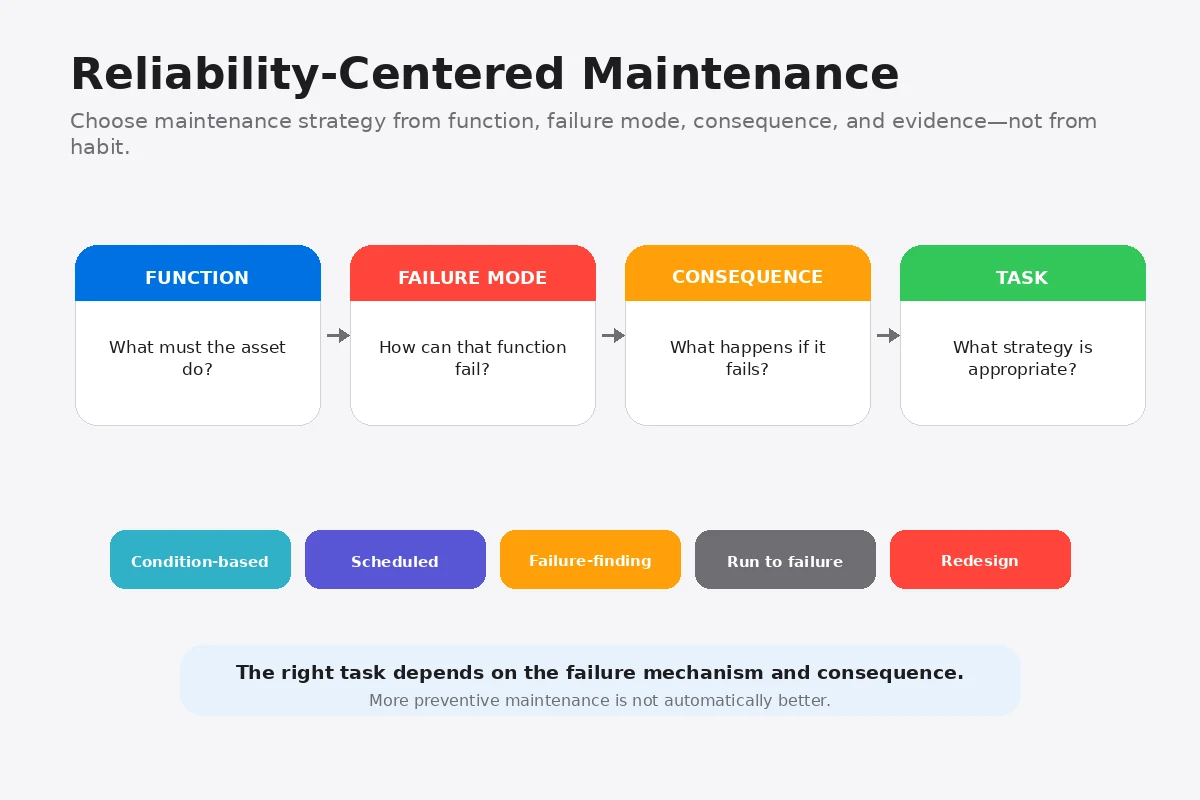
Reliability-Centered Maintenance, or RCM, is a structured method for deciding what maintenance should be performed to preserve required equipment functions.
Its core idea is important: not every asset needs the same maintenance strategy, and not every failure should be prevented in the same way.
Maintenance should be selected based on function, failure mode, consequence, detectability, and evidence.
Start with function, not the maintenance task
Traditional maintenance programs sometimes begin by asking, “What preventive maintenance should we perform on this equipment?”
RCM begins earlier.
What function must the asset perform?
What performance standard is required?
How can the asset fail to meet that function?
This shifts the conversation from maintaining components to preserving required system performance.
Functional failure and failure mode
A functional failure occurs when an asset can no longer meet the required function or performance standard.
A failure mode is the specific way that failure can occur.
For example, a pump may be required to deliver a minimum flow at a defined pressure.
Functional failure: the pump cannot maintain required flow.
Possible failure modes:
- bearing failure;
- impeller wear;
- blocked suction;
- seal degradation;
- motor electrical failure;
- incorrect valve position.
Different failure modes may require different maintenance responses.
Failure consequences matter
RCM considers what happens if the failure occurs.
Consequences can include:
- safety or environmental impact;
- loss of production;
- quality problems;
- equipment damage;
- customer disruption;
- increased operating cost;
- little or no operational effect.
The consequence helps determine how much effort should be invested in prevention, detection, redesign, or contingency planning.
Possible maintenance strategies
RCM does not automatically lead to more preventive maintenance.
Depending on the failure mode, the best strategy might be:
Condition-based maintenance
Monitor a condition that provides useful warning before functional failure, such as vibration, temperature, oil condition, thickness, or electrical signature.
Scheduled restoration
Restore the item at a defined interval when age-related deterioration is understood.
Scheduled replacement
Replace a component at a defined interval when evidence supports age-based failure behavior.
Failure-finding task
Test a hidden protective function to confirm that it will work when needed.
Run to failure
Allow the failure to occur when the consequence is acceptable and replacement or repair after failure is economically reasonable.
Redesign
Change the equipment or system when no maintenance task can adequately control an unacceptable failure consequence.
Why “more PM” is not always better
Preventive maintenance itself can create risk.
Opening equipment, disturbing connections, replacing components unnecessarily, or performing intrusive work too frequently can introduce defects.
RCM asks whether a proposed task is technically appropriate and worth doing.
If a failure is random and there is no detectable deterioration pattern, replacing the component every six months may add cost without meaningfully reducing risk.
Example
Consider an electric motor driving a critical process fan.
A calendar-based strategy might replace bearings annually.
An RCM analysis would ask:
What happens if the motor fails?
Is bearing failure age-related?
Can deterioration be detected with vibration or temperature monitoring?
How much warning time is available?
Would condition monitoring provide a better balance of risk and cost?
The resulting strategy might use vibration monitoring plus lubrication control rather than annual bearing replacement.
RCM and FMEA
RCM and FMEA are related but not identical.
FMEA helps teams identify failure modes, effects, and risks. RCM uses similar failure-mode thinking but focuses specifically on selecting an appropriate maintenance or risk-management strategy to preserve function.
FMEA can provide useful input to an RCM analysis.
Common mistakes
One mistake is applying full RCM analysis to every asset. The effort should be proportional to criticality and consequence.
Another is choosing tasks based only on historical habit.
A third is assuming time-based preventive maintenance is always safer than condition-based or run-to-failure strategies.
A fourth is conducting the analysis without operations knowledge. Operators often understand how failure develops and how performance changes before a breakdown.
The practical objective
RCM is not a paperwork exercise.
The objective is to create a defensible maintenance strategy in which each task has a clear reason.
For each important failure mode, the team should be able to explain:
what function is at risk, how the function can fail, what the consequence is, and why the selected maintenance strategy is technically appropriate.
That is the value of RCM: maintenance effort becomes connected to reliability risk rather than tradition.
Related application
This topic also connects with Failure-Finding Tasks. Use that method when the improvement requires the related operating or management discipline.
Related application
This topic also connects with Weibull Analysis. Use that method when the improvement requires the related operating or management discipline.
Related application
This topic also connects with Reliability Block Diagram. Use that method when the improvement requires the related operating or management discipline.