
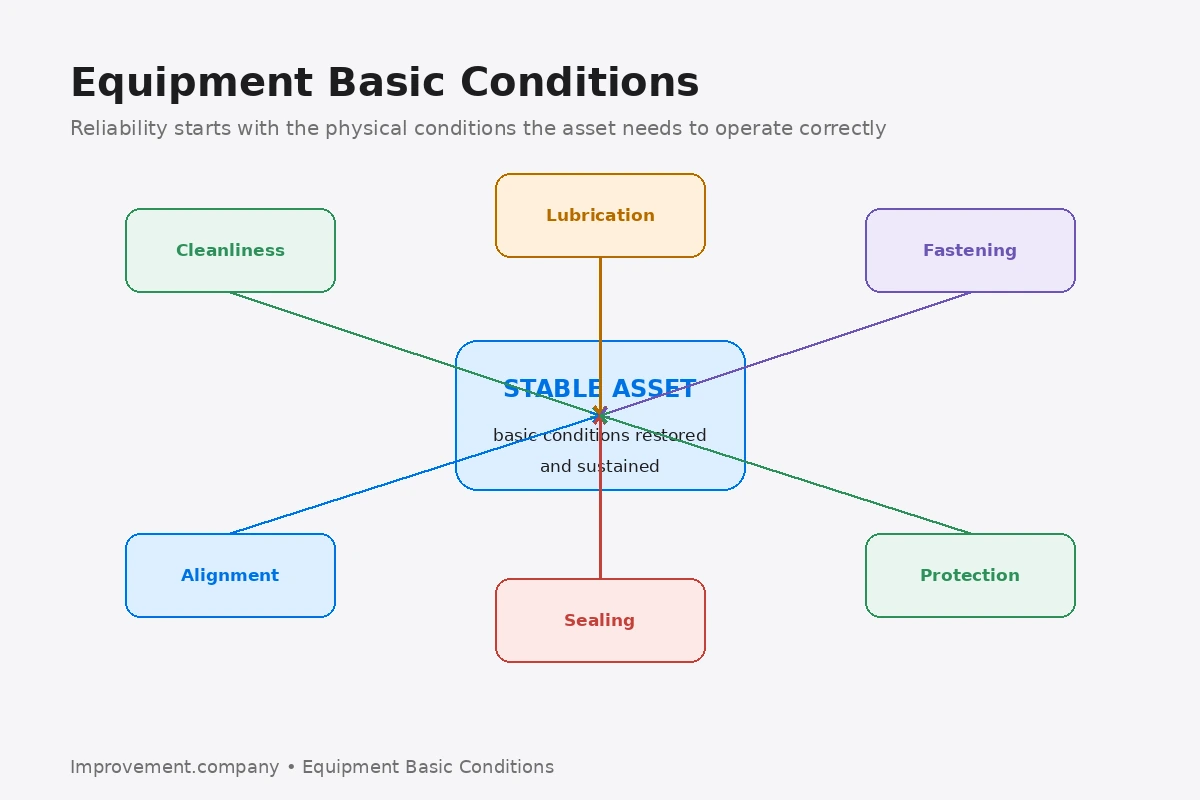
Equipment Basic Conditions are the fundamental physical conditions required for an asset to operate reliably.
Typical basics include cleanliness, correct lubrication, secure fastening, alignment, sealing, guarding, and protection.
The idea is simple: advanced reliability methods cannot compensate for poor basic equipment condition.
Start with abnormality visibility
Dirt, leaks, looseness, and damage can hide early failure signs.
Autonomous Maintenance emphasizes cleaning and inspection so abnormalities become easier to detect.
Cleaning is not cosmetic when it supports condition awareness.
Restore fastening condition
Loose bolts, terminals, guards, and couplings can create vibration, heat, misalignment, and safety risk.
Correct fastening practices should include proper hardware and torque where required.
Restore lubrication condition
Poor lubrication may involve the wrong lubricant, contamination, too much, too little, or blocked delivery.
Lubrication Management provides a structured approach to selecting, applying, controlling, and verifying lubrication.
Restore alignment and fit
Misalignment can create bearing load, seal wear, coupling damage, vibration, and energy loss.
Precision Maintenance helps ensure equipment is restored to accurate technical condition during maintenance work.
Eliminate leaks and contamination sources
A leak should not become a permanent operating condition.
Maintenance Defect Elimination helps identify and remove defects before they develop into larger failures.
Temporary containment should lead to permanent correction.
Protect the restored condition
After restoration, define how the condition will be maintained.
Possible controls include inspection, cleaning standard, lubrication route, torque check, and visual mark.
The objective is not repeated restoration. The objective is preventing deterioration from returning.
Use basic-condition checks before advanced analysis
If an asset has loose foundations, dirty sensors, contaminated oil, or misalignment, advanced diagnostics may identify symptoms without fixing the underlying basics.
Restore obvious technical defects first.
Define ownership for the basics
Basic conditions often fall between operations and maintenance unless ownership is explicit.
Operators may own routine cleaning, inspection, and simple abnormality detection, while maintenance owns technical correction such as alignment, fastening repair, lubrication-system defects, or sealing work.
Clear ownership prevents small abnormalities from remaining visible but unresolved.
Common mistakes
Treating cleaning as housekeeping only, accepting chronic leaks, lubricating without control, repeatedly tightening loose components without finding why they loosen, performing advanced condition monitoring on poorly maintained assets, and restoring basic conditions without defining how they will be sustained are common mistakes.
Practical sequence
- clean and expose the asset.
- identify basic-condition defects.
- correct fastening problems.
- restore lubrication.
- correct alignment and fit.
- eliminate leaks.
- restore guards and protection.
- verify the technical condition.
- define recurring basic-condition checks.
- eliminate causes of repeated deterioration.
The practical lesson
Equipment Basic Conditions are the foundation of reliability. Before optimizing maintenance technology, restore the physical conditions the machine needs to operate correctly.