
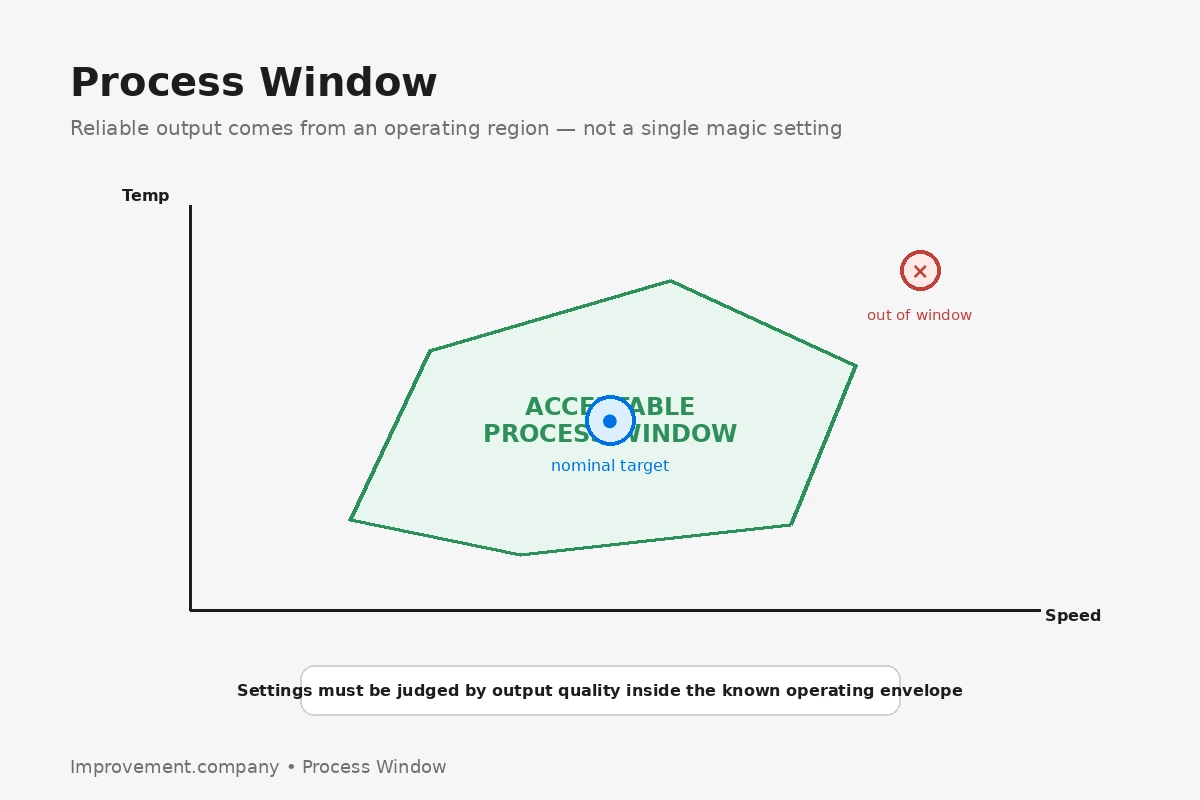
A Process Window defines the range of process conditions within which acceptable output can be produced reliably.
A process may depend on several interacting variables such as temperature, pressure, speed, time, concentration, and flow.
The objective is not to identify one ideal number. The objective is to understand the operating region that consistently produces acceptable performance.
Start with critical parameters
Critical Process Parameters helps identify which settings or conditions materially affect important output characteristics.
Not every adjustable parameter belongs in the process window. Focus on the few variables that matter.
Separate target from allowable range
A process may have a nominal target, normal operating band, and upper and lower limits.
The nominal value is where the process is normally centered. The broader window identifies where acceptable output can still be produced.
Centerlining helps define and maintain preferred operating settings.
Understand interactions
Two settings may each be acceptable individually but create poor output in combination.
For example, higher speed may require different temperature, or lower pressure may require longer dwell time.
A useful process window reflects these interactions where evidence shows they matter.
Build the window from evidence
Useful sources include controlled trials, historical data, engineering studies, and process capability work.
Design of Experiments can be useful when several factors interact and the operating region must be understood systematically.
Do not invent a window from opinion alone.
Connect the window with output requirements
The window should be linked to measurable output such as strength, dimension, defect rate, cure condition, or yield.
A process setting is only acceptable if the resulting output meets the required condition.
Define reaction rules
If the process moves outside the window, define immediate action, product disposition, escalation, and restart criteria.
Process Control Strategy helps connect process limits with detection and response.
Keep the window controlled
Changes in material, equipment, tooling, or method may change the valid operating window.
Management of Change can help govern significant process changes that may alter the known operating envelope.
Common mistakes
Using only a single nominal value, assuming each parameter acts independently, defining limits without output evidence, confusing equipment capability with product acceptability, operating outside the window without reaction rules, and failing to update the window after process changes are common mistakes.
Practical sequence
- identify critical process parameters.
- define output requirements.
- collect process and output data.
- identify acceptable operating regions.
- evaluate important interactions.
- define nominal settings.
- define operating limits.
- define reaction rules.
- control changes.
- update the window as process knowledge improves.
The practical lesson
A Process Window turns process knowledge into an operating envelope. Reliable production depends on understanding the range that works, not only the single number written on the setup sheet.