
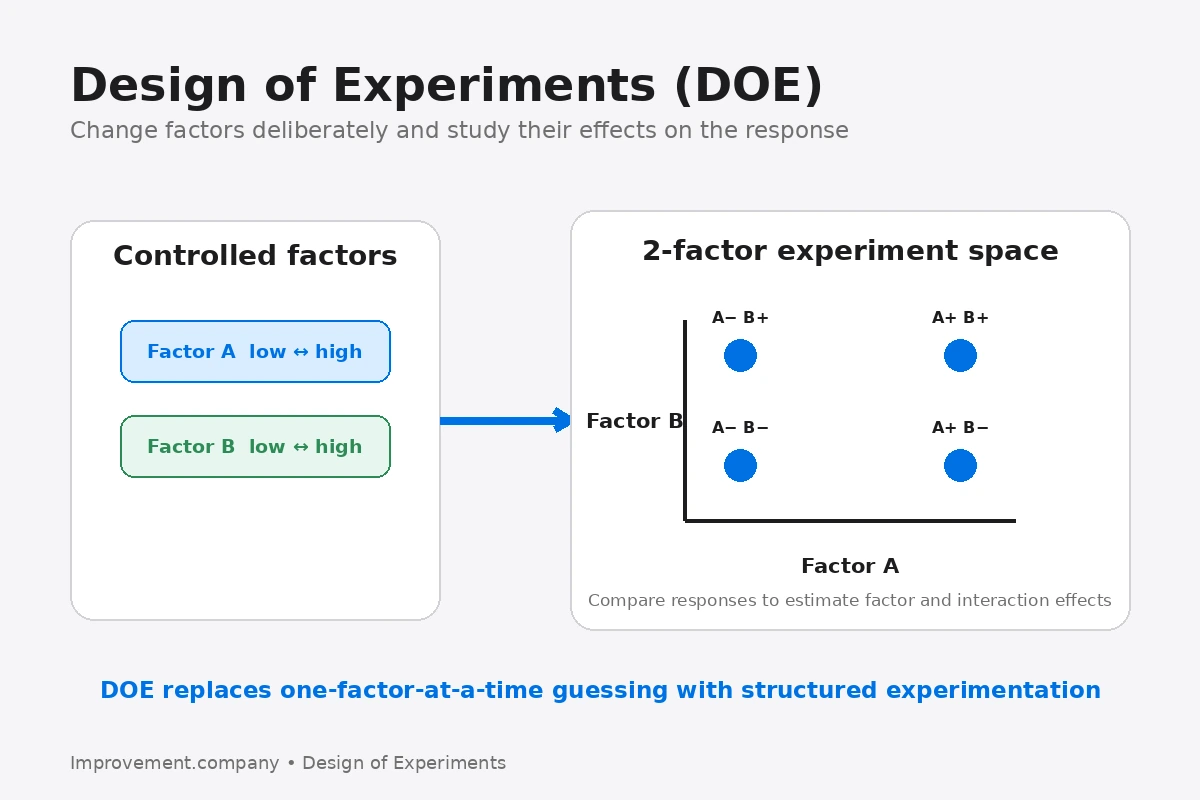
Design of Experiments, usually called DOE, is a structured statistical approach for changing process factors deliberately and learning how those factors affect an output.
Instead of adjusting one factor at a time, DOE can study multiple factors together.
That makes it possible to detect interactions that one-factor-at-a-time testing may miss.
Why DOE is useful
Processes often have several possible drivers.
For example, weld strength might be influenced by:
- current;
- pressure;
- weld time;
- electrode condition;
- material thickness.
Changing one factor at a time can require many trials and may hide interactions.
DOE creates a planned set of experimental combinations so the team can extract more information from fewer, better-structured trials.
Start with the response
The response is the output the experiment is trying to understand or improve.
Examples include:
- strength;
- dimensional error;
- cycle time;
- yield;
- surface roughness;
- defect rate.
The response must be measured reliably.
If the measurement system is weak, the experiment may produce misleading conclusions. Gage R&R can help evaluate measurement capability before the experiment.
Select factors and levels
A factor is an input or condition the team intentionally changes.
A level is a chosen setting for that factor.
For example:
Factor: temperature.
Levels: 180°C and 200°C.
The selected range should be meaningful and safe.
If the levels are too close together, the experiment may not reveal an effect.
If they are unrealistic, the findings may not help production.
Main effects and interactions
A main effect describes how changing one factor changes the response on average.
An interaction occurs when the effect of one factor depends on the level of another factor.
For example, increasing pressure may improve quality at low temperature but make quality worse at high temperature.
That interaction can be invisible in one-factor-at-a-time testing.
Randomization and replication
Randomization helps reduce bias from time-related or uncontrolled conditions.
Replication helps estimate experimental error.
Blocking can be used when known nuisance factors, such as machine, batch, or day, cannot be eliminated.
These design choices are part of the experiment, not optional statistical decoration.
Full and fractional factorial designs
A full factorial experiment tests every combination of selected factor levels.
A fractional factorial uses a carefully selected subset.
Fractional designs can be useful when many factors need screening and a full design would require too many runs.
The tradeoff is that some effects may be confounded.
DOE in DMAIC
DOE is commonly used in the Analyze and Improve phases of DMAIC.
The team may use simpler tools first to narrow possible causes.
Then DOE can test causal relationships and identify improved settings.
The method is especially useful when several controllable inputs may interact.
Confirm the result
A statistically significant effect is not automatically operationally important.
After identifying improved settings, run confirmation trials.
Check:
- actual process performance;
- variation;
- practicality;
- cost;
- safety;
- robustness.
Then update the Control Plan and Standard Work if the setting becomes part of the normal process.
Common mistakes
Running experiments without a clear response, changing factors outside practical ranges, ignoring interactions, failing to randomize, using too few repetitions, and optimizing a statistical result that is not operationally meaningful are common mistakes.
Practical sequence
- Define the problem and response.
- Verify the measurement system.
- Select controllable factors.
- Choose factor levels.
- Select the experimental design.
- Randomize the run order.
- conduct the experiment.
- analyze effects and interactions.
- identify practical settings.
- confirm the result in the real process.
- standardize and control the improved condition.
The practical lesson
DOE turns process adjustment into structured learning.
It is most valuable when the team needs to understand several possible drivers and how they work together.