
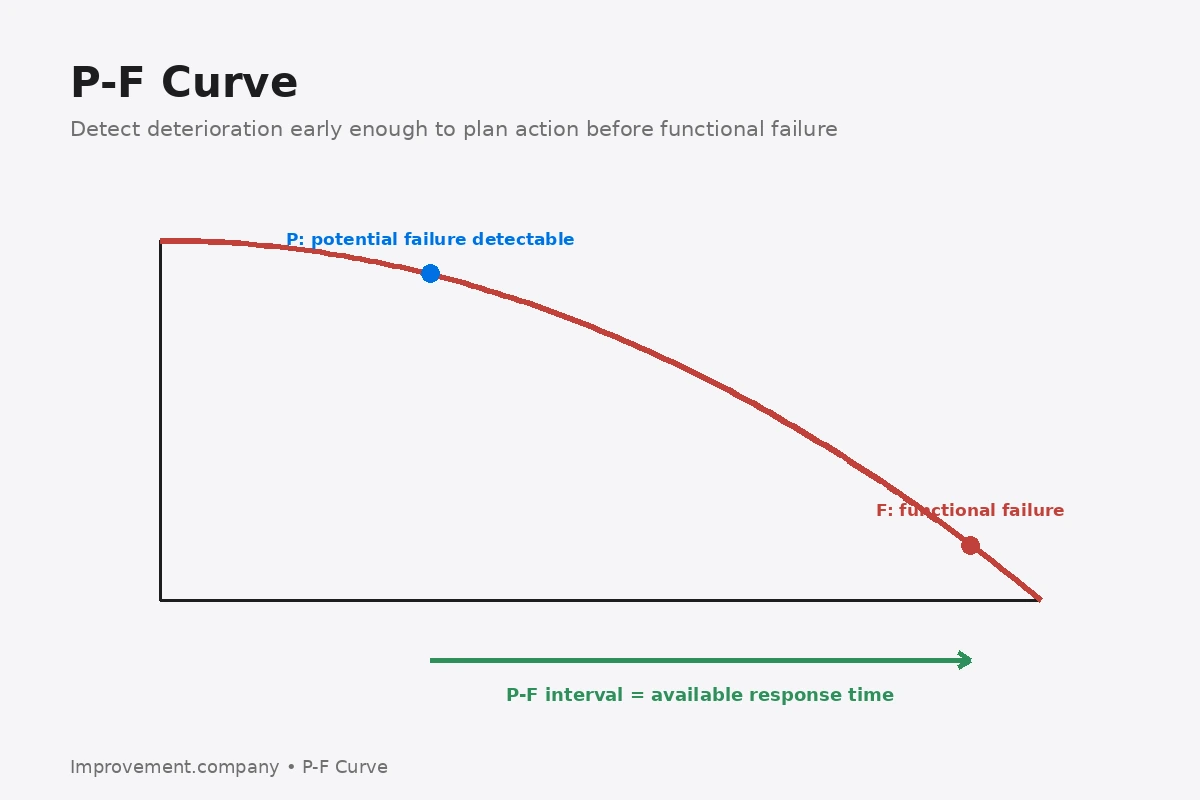
The P-F Curve is a reliability concept that describes the time between the point when a developing failure can first be detected and the point when the asset can no longer perform its required function.
The two points are:
- P: Potential failure becomes detectable.
- F: Functional failure occurs.
The interval between them is the P-F interval.
Understand potential failure
Potential failure is not the same as functional failure.
At the P point, the asset may still operate normally from the user’s perspective.
However, a detectable condition has appeared.
Examples include:
- vibration increases;
- lubricant contamination rises;
- temperature begins drifting;
- insulation condition deteriorates;
- wear debris appears.
Predictive Maintenance uses condition information to detect deterioration before functional failure.
Define functional failure
Functional failure occurs when the asset can no longer meet the required performance standard.
Examples include:
- pump cannot deliver required flow;
- motor cannot run;
- compressor cannot maintain pressure;
- machine cannot hold required accuracy.
Reliability-Centered Maintenance emphasizes required functions and functional failures as the basis for selecting maintenance policy.
Use the P-F interval to set monitoring frequency
A condition-monitoring task must be performed often enough to detect deterioration with enough time remaining to act.
If the likely P-F interval is three months, checking once per year is not useful.
The exact monitoring interval depends on:
- failure mode;
- detectability;
- consequence;
- variability;
- response time.
The interval should provide multiple opportunities to detect the condition before F.
Match the technique to the failure mode
Different technologies detect different physical changes.
Examples include:
- vibration analysis;
- oil analysis;
- thermography;
- ultrasound;
- electrical testing;
- process-performance monitoring.
The selected method should detect the specific failure mode early enough to matter.
Plan the response after detection
Finding a potential failure creates a decision.
The organization may need to:
- increase monitoring;
- order parts;
- schedule repair;
- reduce load;
- prepare contingency.
Maintenance Planning and Scheduling helps convert detected deterioration into executable planned work before functional failure forces emergency work.
Do not assume every failure has a useful P-F interval
Some failures occur:
- suddenly;
- randomly;
- without practical detectable warning.
In those cases, condition monitoring may not be the correct maintenance policy.
Failure-Finding may be more appropriate for hidden protective functions, while redesign or run-to-failure may be appropriate for other cases depending on consequence.
Update the curve from field evidence
Initial P-F estimates may be uncertain.
Use actual history to improve:
- detection thresholds;
- monitoring interval;
- response time;
- spare strategy.
The curve should become more realistic as the organization learns.
Common mistakes
Treating P and F as fixed universal points, monitoring less frequently than the likely P-F interval allows, using a technology that does not detect the actual failure mode, finding deterioration without planning a response, assuming every failure provides an early warning, and never updating the interval from field experience are common mistakes.
Practical sequence
- define the required function.
- identify the failure mode.
- determine whether deterioration is detectable.
- identify the likely P point.
- estimate the P-F interval.
- select the monitoring technique.
- set an appropriate monitoring interval.
- define response actions.
- capture actual failure history.
- refine the monitoring strategy over time.
The practical lesson
The P-F Curve connects detection with action time.
Condition monitoring creates value only when it finds deterioration early enough for the organization to respond before functional failure.