
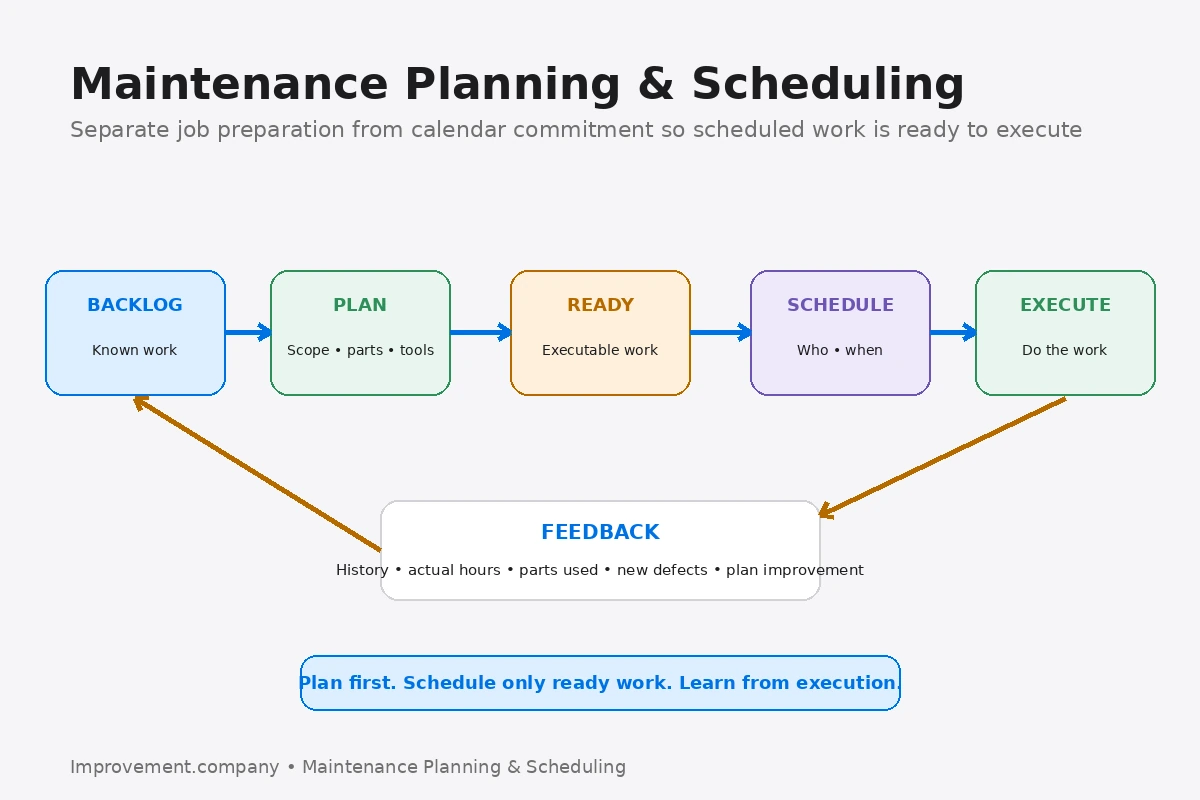
Maintenance planning and scheduling are related disciplines used to prepare work before execution and coordinate when that work will be performed.
They are not the same thing.
Planning asks how the job should be done. Scheduling asks when the prepared job should be done and with which available resources.
Both improve the effectiveness of planned maintenance.
What planning does
A planner prepares the work so technicians are not forced to solve basic logistics after the equipment is already available.
A job plan may include:
- job scope;
- safety requirements;
- labor skills;
- estimated hours;
- tools;
- parts;
- procedures;
- drawings;
- permits;
- access requirements;
- expected condition.
The goal is not perfect prediction.
The goal is to remove avoidable delay.
What scheduling does
Scheduling selects planned work for a defined time period based on:
- available labor;
- equipment access;
- production priorities;
- job readiness;
- criticality;
- dependencies.
A schedule should contain work that is ready to execute.
Scheduling jobs that lack parts, permits, or scope creates false plans.
Emergency work reduces schedule stability
Breakdowns and urgent work will sometimes disrupt the schedule.
But when emergency work dominates every week, the system has a reliability problem.
Breakdown Analysis can help eliminate recurring failures.
Asset Criticality Analysis can help prioritize maintenance effort based on consequence.
Build a ready backlog
A useful backlog contains approved work that has been identified but not yet completed.
The backlog should distinguish between:
- work awaiting planning;
- planned and ready work;
- scheduled work;
- deferred work.
A large backlog is not automatically bad.
An unmanaged backlog is.
Weekly scheduling
Many organizations use a weekly scheduling cycle.
A typical process may:
- review available labor;
- select ready work;
- coordinate equipment access;
- balance preventive and corrective work;
- publish the schedule;
- execute;
- review schedule compliance and reasons for break-in work.
The exact cadence should fit the operation.
Protect wrench time carefully
Planning should increase the proportion of technician time spent on value-adding maintenance execution.
But “wrench time” should not be used to pressure technicians into unsafe shortcuts.
The bigger opportunity is removing waiting, searching, missing parts, unclear scope, and avoidable travel.
Connect planning to Planned Maintenance
Planned Maintenance defines the broader strategy for maintaining equipment deliberately rather than reacting only after failure.
Planning and scheduling turn that strategy into executable work.
Predictive findings, PM tasks, corrective work, and improvement actions all need a path into the planning system.
Learn from completed work
The job plan should improve over time.
After execution, capture:
- actual labor hours;
- unexpected steps;
- parts consumed;
- access problems;
- additional safety requirements;
- condition found.
This makes future work easier to plan.
Common mistakes
Treating planning as clerical work, scheduling jobs that are not ready, allowing emergency work to consume all capacity, measuring schedule compliance without understanding break-in work, and failing to update job plans after execution are common mistakes.
Practical sequence
- identify required maintenance work.
- approve and prioritize the request.
- plan scope, labor, parts, tools, and safety.
- confirm job readiness.
- build a ready backlog.
- schedule work against available capacity.
- coordinate with operations.
- execute the work.
- capture feedback.
- improve the plan and reliability strategy.
The practical lesson
Maintenance planning and scheduling reduce avoidable delay before the technician starts the job.
Better preparation creates more time for actual maintenance and more predictable equipment care.
Related application
This topic also connects with Maintenance Backlog Management. Use that method when the improvement requires the related operating or management discipline.
Related application
This topic also connects with Shutdown and Turnaround Planning. Use that method when the improvement requires the related operating or management discipline.
Related application
This topic also connects with PM Compliance and Schedule Compliance. Use that method when the improvement requires the related operating or management discipline.
Related application
This topic also connects with Maintenance Job Kitting. Use that method when the improvement requires the related operating or management discipline.
Related application
This topic also connects with Maintenance Work Order Quality. Use that method when the improvement requires the related operating or management discipline.
Related application
This topic also connects with Maintenance Schedule Breakers. Use that method when the improvement requires the related operating or management discipline.
Related application
This topic also connects with Planned vs Unplanned Maintenance Ratio. Use that method when the improvement requires the related operating or management discipline.
Related application
This topic also connects with Maintenance Planning Quality Review. Use that method when the improvement requires the related operating or management discipline.
Related application
This topic also connects with Maintenance Execution Feedback Loop. Use that method when the improvement requires the related operating or management discipline.