
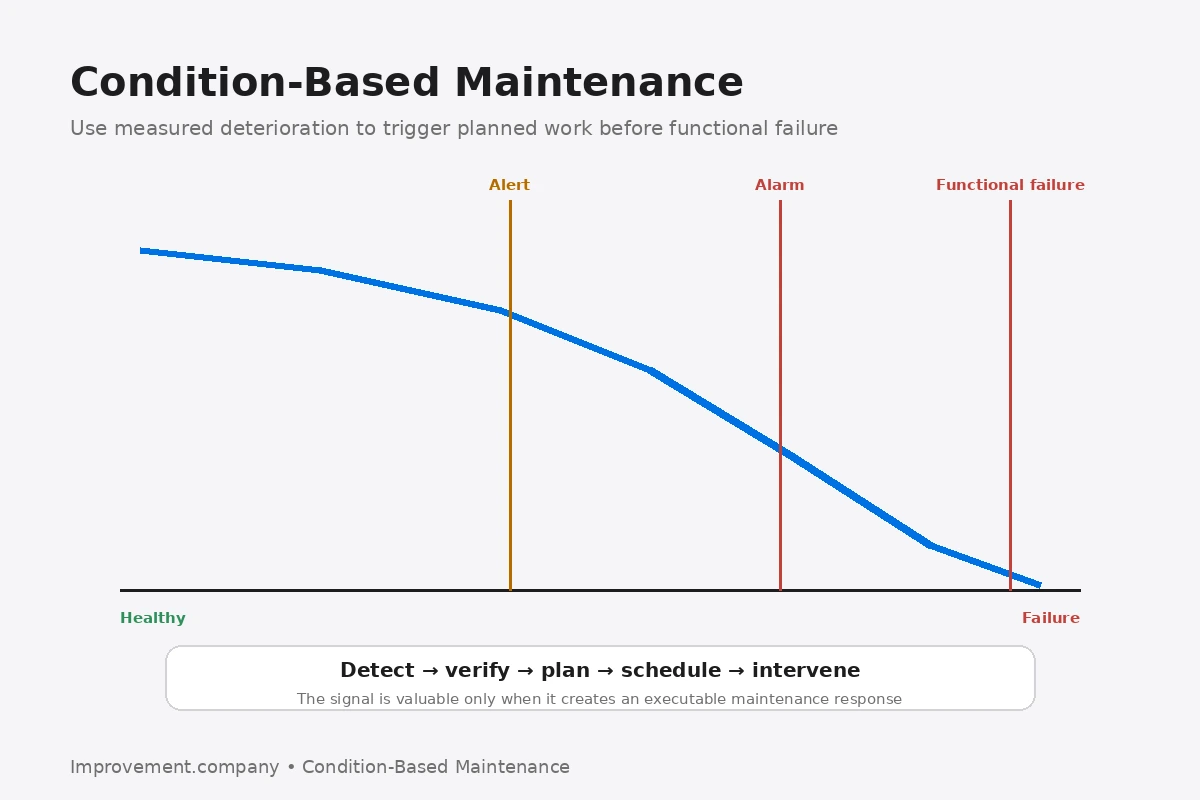
Condition-Based Maintenance, or CBM, is a maintenance strategy in which work is initiated when measured asset condition indicates that intervention is needed.
The objective is to act before functional failure while avoiding unnecessary fixed-interval maintenance.
Start with a detectable failure mechanism
CBM works best when deterioration can be observed before failure.
Examples include bearing wear, contamination, misalignment, insulation degradation, and filter restriction.
P-F Curve helps explain the interval between the point where deterioration becomes detectable and the point of functional failure.
If no useful condition signal exists, another maintenance strategy may be more appropriate.
Select the right condition indicator
Possible indicators include vibration, temperature, oil condition, pressure, current, thickness, and visual condition.
The indicator should connect to the actual failure mechanism.
Do not collect data simply because a sensor is available.
Define the measurement method
Condition data may come from an online sensor, route-based measurement, inspection, or functional test.
Predictive Maintenance often uses advanced analysis to forecast deterioration.
CBM is broader: it can use simple thresholds or inspection findings to trigger work.
Define trigger criteria
A condition limit should state when action is required.
Possible levels include normal, alert, alarm, and immediate action.
The trigger should reflect failure consequence, deterioration rate, and planning lead time.
Convert the signal into planned work
A condition alert should create a controlled work-management response.
Maintenance Planning and Scheduling helps convert detected need into scope, parts, labor, and schedule.
CBM is not successful if alarms remain unconverted into executable maintenance work.
Verify the finding
False alarms can waste maintenance capacity.
Where practical, confirm sensor quality, repeatability, physical evidence, and trend.
A single abnormal reading may require validation before a major intervention.
Learn from removed components
After maintenance, compare predicted condition, actual condition found, and remaining life estimate.
This improves future trigger levels and diagnostic confidence.
Common mistakes
Monitoring assets with no detectable deterioration pattern, selecting indicators unrelated to the failure mechanism, setting arbitrary alarm limits, collecting more data than the organization can interpret, generating alarms without planning work, and failing to compare predictions with actual findings are common mistakes.
Practical sequence
- identify important failure mechanisms.
- confirm deterioration can be detected.
- select a meaningful condition indicator.
- define measurement method.
- define trigger levels.
- collect and trend condition data.
- verify abnormal findings.
- create planned maintenance work.
- inspect the actual condition after intervention.
- refine limits using experience.
The practical lesson
Condition-Based Maintenance connects maintenance timing with equipment condition. The value comes from acting on meaningful deterioration signals, not from collecting more sensor data.