
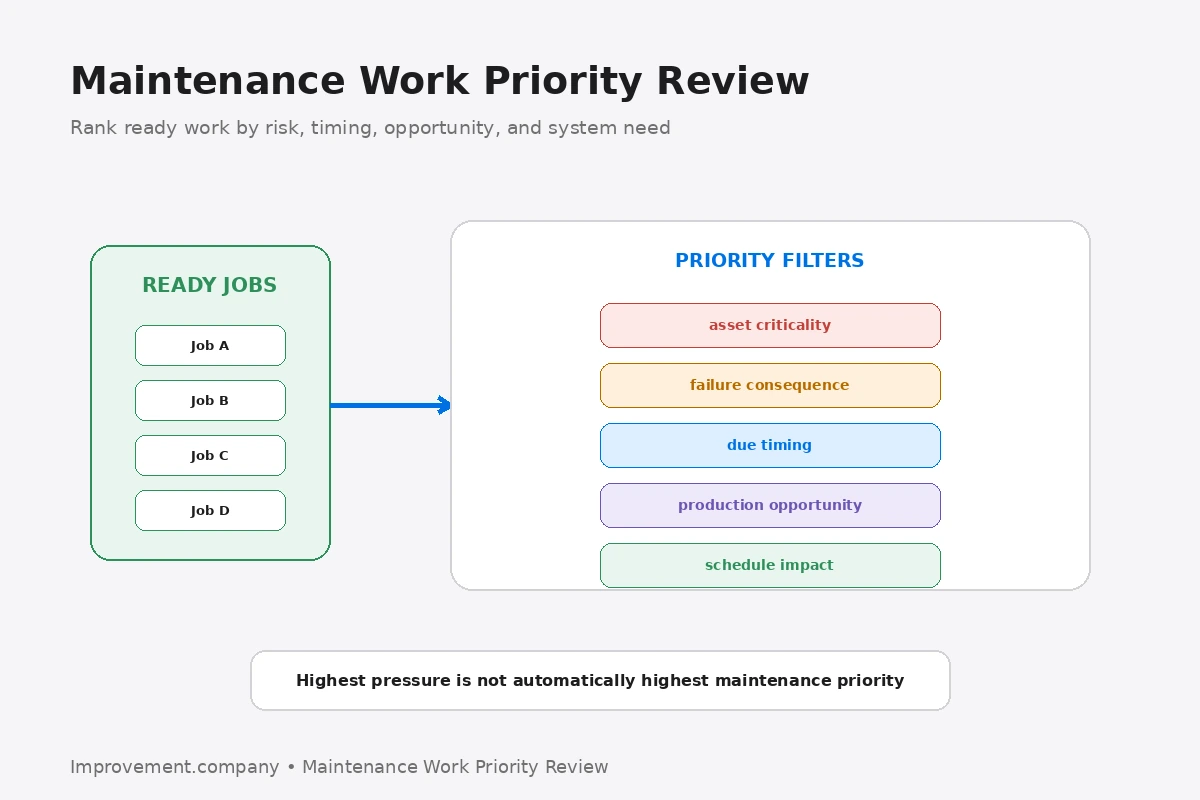
A Maintenance Work Priority Review determines which executable maintenance jobs should receive limited labor, access, and material first.
The purpose is not to create a permanent ranking for every work order.
The purpose is to make priority reflect current risk and operating need.
Start with ready work
Maintenance Ready Backlog separates jobs that can actually be scheduled from work still waiting for scope, parts, tools, permits, access, or technical information.
Priority review should not confuse an urgent request with an executable job.
Consider asset criticality
Asset Criticality Analysis helps differentiate equipment according to consequence and business impact.
A defect on a critical asset may deserve earlier action than a similar defect on a low-consequence asset.
Consider failure consequence
Review potential effects on:
- safety;
- environment;
- quality;
- throughput;
- cost.
Risk-Based Thinking helps match attention with consequence and likelihood.
Priority should reflect risk, not only requester urgency.
Consider timing
Some work has a real due point because of:
- regulatory requirement;
- known degradation;
- upcoming shutdown;
- production window.
A job with lower consequence may still need earlier execution if the opportunity will disappear.
Consider production opportunity
Maintenance Planning and Scheduling helps convert prepared work into executable commitments.
When equipment access becomes available, selecting the right ready job can improve schedule value without creating unnecessary downtime later.
Protect the weekly schedule
High-priority work should not automatically become a schedule break-in.
Maintenance Schedule Breakers helps distinguish true break-in work from avoidable disruption.
Ask whether the job can wait until the next planned opportunity without unacceptable risk.
Make overrides visible
If leadership changes maintenance priority, record:
- reason;
- risk;
- decision owner;
- effect on displaced work.
This prevents silent schedule instability.
Common mistakes
Using requester urgency as the priority system, ranking unready work as if it can execute, ignoring asset criticality, treating every overdue job as equally urgent, breaking the schedule for manageable risk, allowing production access opportunities to pass unnoticed, and changing priorities without showing the consequence are common mistakes.
Practical sequence
- confirm the job is ready.
- review asset criticality.
- assess failure consequence.
- review due timing.
- review production opportunity.
- compare competing ready work.
- protect committed schedule where practical.
- approve justified break-ins.
- record priority overrides.
- review recurring priority conflicts.
The practical lesson
A Maintenance Work Priority Review turns backlog into risk-based execution choices.
The highest-priority job is the one the system most needs to perform next, not simply the one receiving the most pressure.