
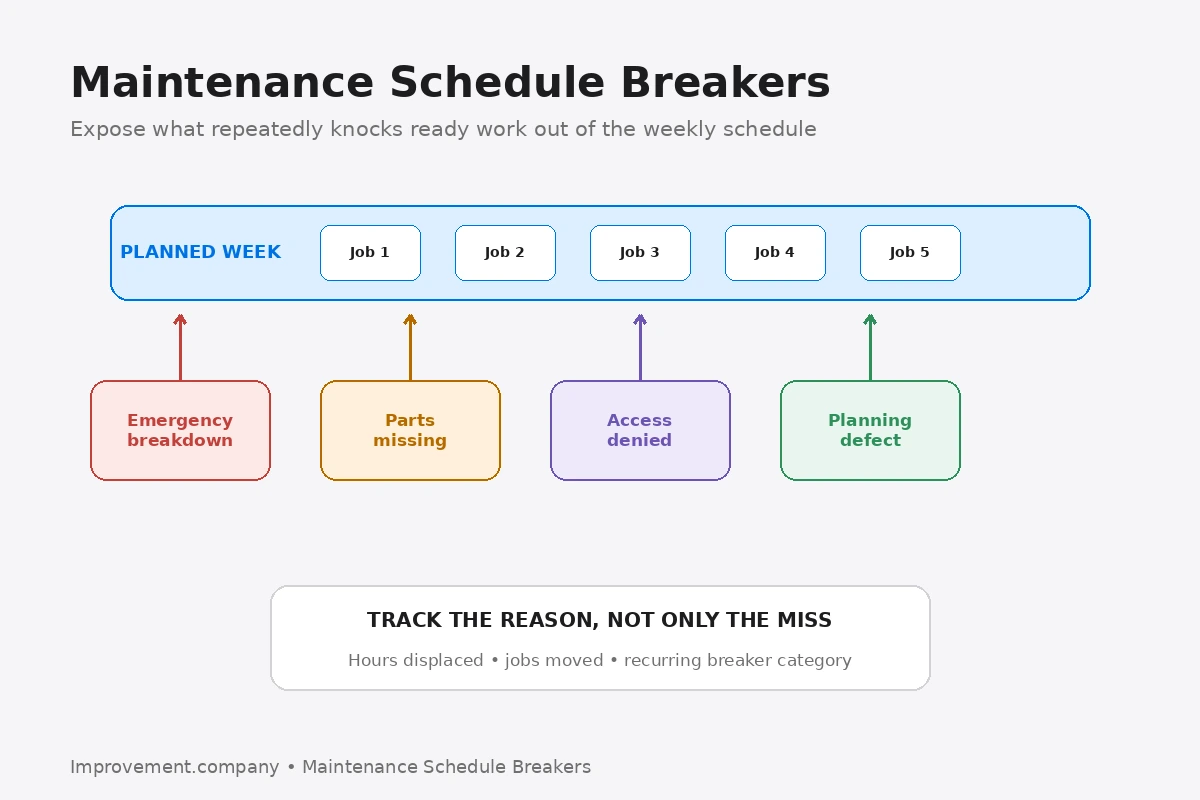
Maintenance Schedule Breakers are recurring conditions that prevent planned maintenance work from being executed as scheduled.
Examples include:
- emergency breakdowns;
- missing parts;
- equipment unavailable;
- permit delays;
- unclear job scope;
- production priority changes.
The objective is not only to measure schedule compliance.
It is to understand why the schedule is repeatedly disrupted.
Start with the planned schedule
Maintenance Planning and Scheduling creates a weekly work plan based on:
- labor;
- priority;
- parts;
- equipment access;
- job readiness.
A schedule breaker is a condition that forces the organization to deviate from that approved plan.
Classify the reason
Useful categories may include:
- emergency work;
- parts not available;
- labor unavailable;
- production access denied;
- planning defect;
- permit or safety issue;
- job took longer than planned.
Stable categories make patterns visible over several weeks.
Separate legitimate emergency work
Some schedule breaks are justified.
A critical unexpected failure may require immediate response.
The problem is not that the schedule changed.
The problem is when the same type of emergency consumes planned capacity every week.
Breakdown Analysis can help determine why recurring emergencies continue to occur.
Review job readiness
A scheduled job should ideally be ready before the week begins.
Maintenance Job Kitting helps prepare parts, materials, and tools.
Poorly prepared work should not repeatedly enter the schedule and then fail at execution time.
Review production access
Some jobs fail because equipment is not released as agreed.
This may indicate weakness in:
- weekly coordination;
- operating priorities;
- shutdown planning.
The issue should be managed cross-functionally rather than blamed on the maintenance scheduler.
Quantify the impact
Useful measures include:
- hours displaced;
- number of jobs moved;
- percentage of schedule broken;
- recurring breaker category.
PM Compliance and Schedule Compliance can show whether planned work is being executed as intended.
Schedule-breaker analysis explains the reasons behind the result.
Attack systemic causes
If missing parts are the dominant breaker, improve material readiness.
If emergency work is dominant, improve reliability.
If access is dominant, improve production-maintenance coordination.
Do not simply lower the schedule target to make performance look better.
Common mistakes
Treating every change as scheduler failure, using inconsistent breaker codes, mixing justified emergency work with planning defects, measuring compliance without analyzing reasons, scheduling jobs that are not ready, and accepting the same dominant breaker month after month are common mistakes.
Practical sequence
- freeze the agreed weekly schedule.
- record every significant deviation.
- classify the breaker.
- quantify displaced work.
- identify the dominant category.
- separate one-time events from recurrence.
- assign systemic improvement actions.
- verify whether the breaker declines.
- protect schedule quality.
- improve the planning and reliability system continuously.
The practical lesson
Maintenance Schedule Breakers explain why planned work does not stay planned.
The goal is not a rigid schedule; it is a reliable work-management system with fewer avoidable disruptions.