
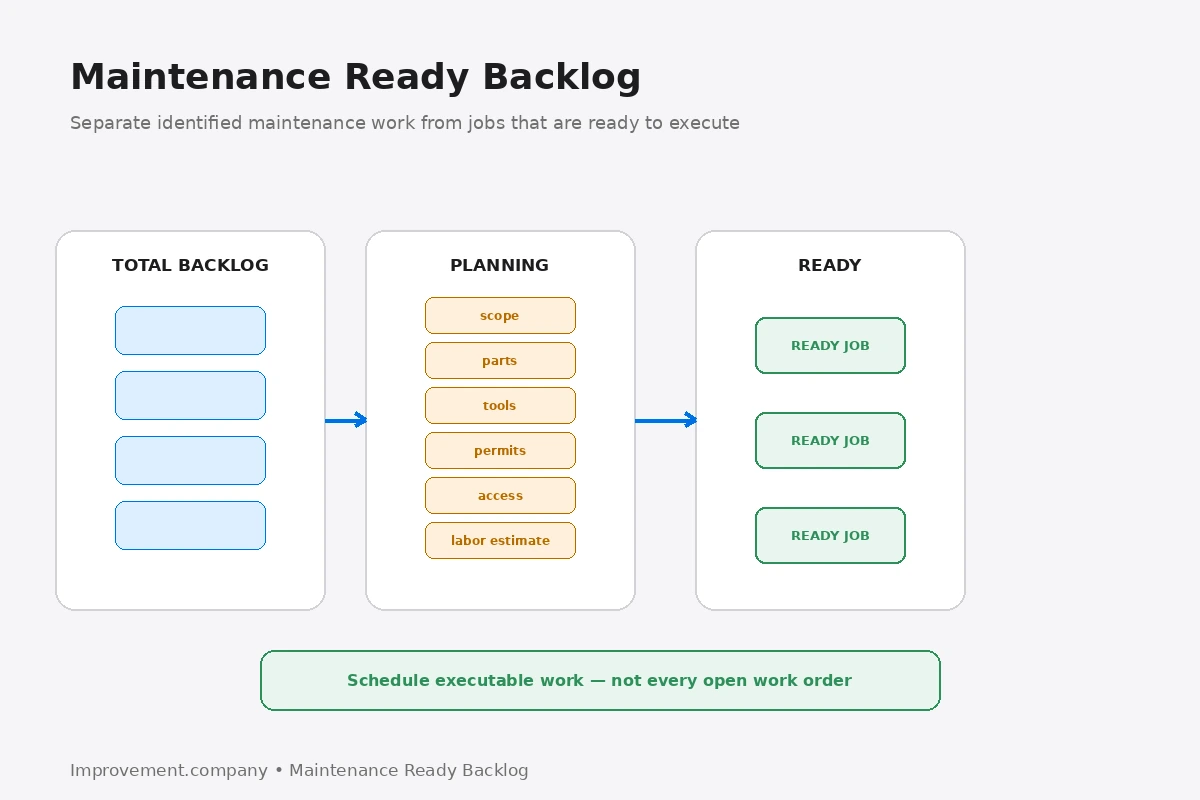
A Maintenance Ready Backlog is the portion of maintenance backlog that is sufficiently prepared to be scheduled and executed.
The distinction matters because a backlog can look large while much of the work is not actually ready. A ready job should have enough information and resources identified so the scheduling process can make a realistic commitment.
Start with the total backlog
Maintenance Backlog Management helps keep identified work visible, prioritized, aged, and controlled.
The total backlog may contain new requests, planning work, jobs waiting for material, ready work, and deferred work. Do not treat every open work order as schedulable.
Define ready criteria
Typical ready criteria include clear scope, labor estimate, parts identified, tools identified, permits understood, technical information available, and access requirements known.
Maintenance Planning and Scheduling helps convert identified work into executable, resource-ready jobs. The criteria should be practical enough for planners and supervisors to apply consistently.
Separate waiting reasons
A job may not be ready because it is waiting for parts, engineering, production access, a contractor, or approval.
Tracking waiting reasons helps improve the planning system instead of treating every delay as a scheduling problem.
Review job quality
Maintenance Work Order Quality helps improve problem description, scope, asset information, failure detail, and feedback.
Poor work-order quality often creates planning delays before the job can enter the ready backlog.
Use ready backlog for scheduling
The weekly or daily schedule should primarily draw from work that meets ready criteria.
PM Compliance and Schedule Compliance helps evaluate whether committed maintenance work is completed as planned. Scheduling unready jobs increases break-ins and schedule failure.
Protect priority logic
Ready does not mean highest priority. Asset Criticality Analysis helps differentiate equipment by consequence and business impact.
Use priority, risk, due date, and operational opportunity to select among ready jobs.
Measure backlog health
Useful measures include ready backlog labor hours, percentage of backlog ready, jobs waiting for parts, jobs waiting for engineering, and age by readiness state.
Avoid driving the ready percentage higher by marking poorly prepared jobs as ready.
Common mistakes
Treating every open work order as schedulable, defining no ready criteria, marking jobs ready without parts or scope, using readiness as the only priority rule, allowing waiting reasons to remain invisible, and blaming scheduling for work that planning never made executable are common mistakes.
Practical sequence
- define ready criteria.
- classify total backlog by readiness.
- identify missing planning elements.
- track waiting reasons.
- complete job preparation.
- move qualified jobs to ready backlog.
- prioritize ready work by risk and need.
- build the schedule from executable jobs.
- measure schedule performance.
- improve recurring readiness delays.
The practical lesson
A Maintenance Ready Backlog connects planning with scheduling. The schedule becomes more reliable when it is built from work that can actually be executed.
Related application
This topic also connects with Maintenance Work Priority Review. Use that method when the improvement requires the related operating or management discipline.