
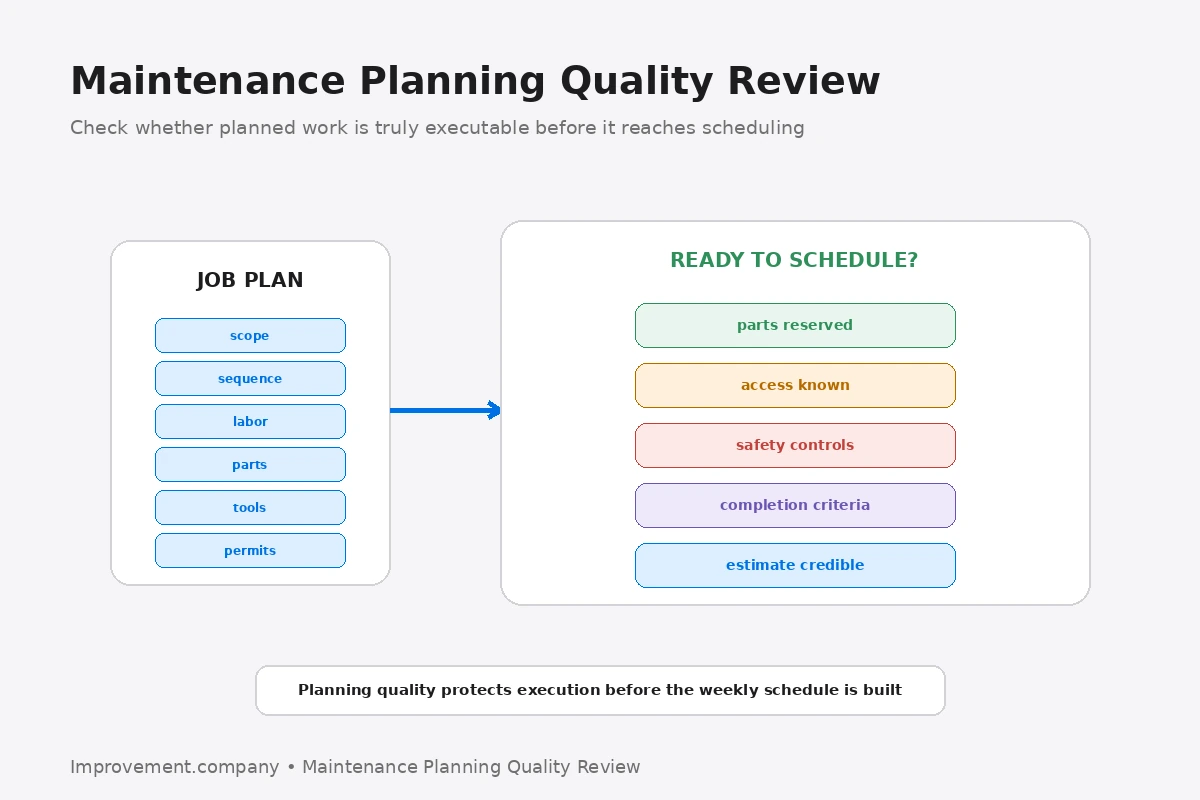
A Maintenance Planning Quality Review checks whether planned maintenance work contains enough information and preparation to execute safely and efficiently.
The purpose is not to make every work order perfect.
The purpose is to reduce avoidable delay, searching, rework, and schedule breakage caused by weak planning.
Start with job scope
The work order should explain what condition must be corrected or restored.
Maintenance Work Order Quality helps improve the information captured when work is identified.
A planner cannot create a strong job plan from an unclear problem statement.
Review the task sequence
The plan should identify the major work steps in a practical order.
Include enough detail to support:
- safe execution;
- labor estimate;
- parts preparation;
- tool selection.
Avoid turning every job plan into a maintenance manual.
Review labor estimate
The estimate should reflect:
- number of people;
- craft or skill;
- expected duration;
- special support.
Maintenance Planning and Scheduling helps convert identified work into executable commitments.
Poor labor estimates weaken weekly scheduling and capacity decisions.
Review parts and materials
Check whether required parts are:
- identified;
- available;
- reserved;
- correct for the asset.
Maintenance Job Kitting helps prepare parts, materials, tools, and information before execution.
Review tools and access
Some jobs require:
- special tools;
- lifting devices;
- scaffolding;
- isolation points;
- shutdown access.
Missing access requirements often appear only after the crew reaches the job.
Review permits and safety controls
Where applicable, confirm:
- lockout needs;
- permits;
- hazard controls;
- environmental precautions.
Planning should make predictable safety requirements visible before scheduling.
Define completion criteria
The plan should state what successful completion means.
Examples include:
- leak eliminated;
- alignment within tolerance;
- guard restored;
- functional test passed.
Maintenance Ready Backlog separates jobs that are truly ready from work still waiting on planning inputs.
Learn from execution feedback
Completed work should improve future plans.
Review:
- estimate accuracy;
- missing parts;
- unexpected tools;
- sequence issues;
- access problems.
Common mistakes
Planning vague scopes, copying old plans without checking asset condition, estimating only labor hours and not required skills, identifying parts without reserving them, ignoring permits and access, defining no completion criteria, and failing to capture execution feedback are common mistakes.
Practical sequence
- confirm job scope.
- review task sequence.
- review labor estimate.
- review required skills.
- verify parts and materials.
- verify tools and access.
- review permits and safety needs.
- define completion criteria.
- release to ready backlog.
- improve planning from execution feedback.
The practical lesson
A Maintenance Planning Quality Review protects execution before the schedule is built.
A job is well planned when the crew can arrive prepared, perform the work safely, and verify completion without preventable interruption.