
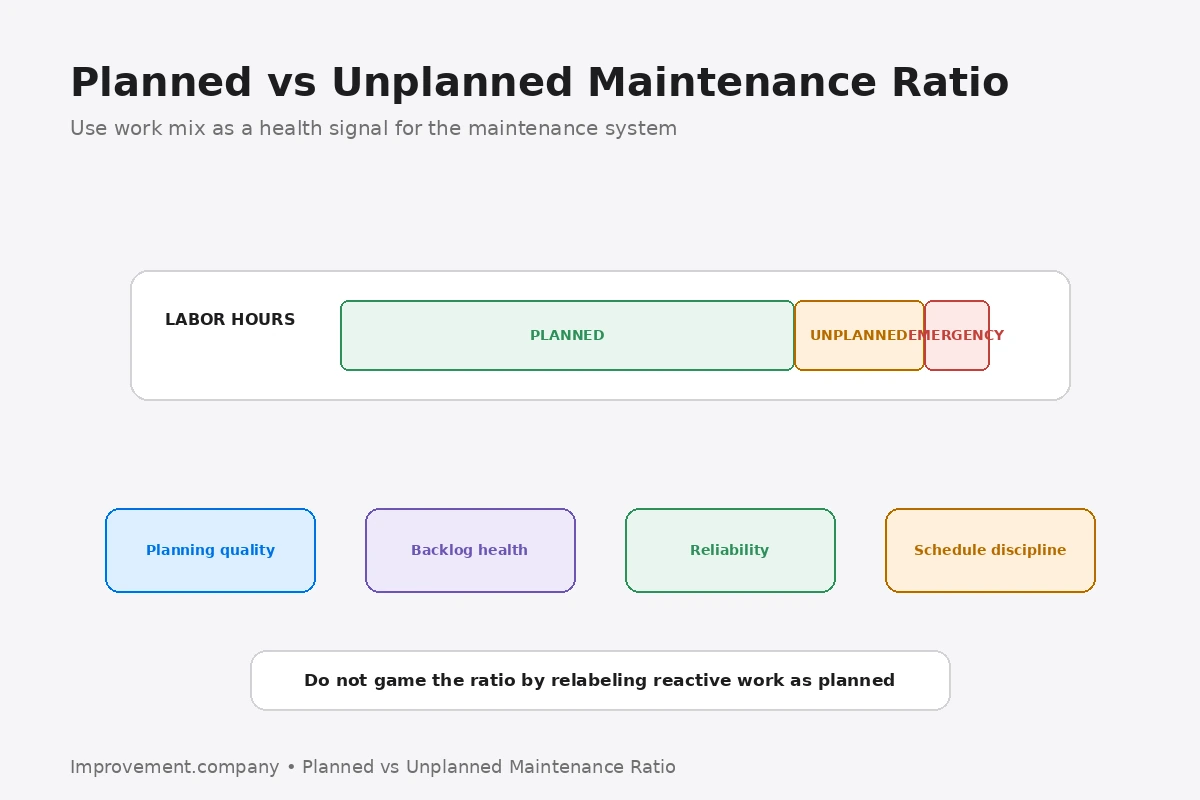
The Planned vs Unplanned Maintenance Ratio compares maintenance work completed through a prepared work-management process with work performed reactively or without sufficient planning.
The metric helps answer:
How much of maintenance capacity is being consumed by work we were able to prepare versus work that arrived unexpectedly?
The objective is not to eliminate every unplanned job.
The objective is to understand the health of the maintenance work system.
Define planned work clearly
Planned work usually has:
- defined scope;
- labor estimate;
- parts identified;
- tools identified;
- technical information ready.
Maintenance Planning and Scheduling helps convert identified work into executable, resource-ready jobs.
Do not classify a job as planned simply because it appeared on the schedule.
Define unplanned work
Unplanned work may include:
- breakdown response;
- urgent corrective work;
- emergent inspection;
- jobs started before planning was complete.
Some unplanned work is unavoidable.
Repeated unplanned work is a reliability signal.
Choose the measurement basis
The ratio can be based on:
- labor hours;
- work orders;
- maintenance cost.
Labor hours are often more informative than work-order count because job sizes differ.
Be consistent.
Separate emergency work
A useful work-mix view may distinguish:
- planned;
- unplanned but controlled;
- emergency.
Breakdown Analysis helps turn recurring failures into reliability learning rather than accepting emergency work as normal.
Review the backlog connection
Maintenance Backlog Management helps keep identified work visible and prioritized before it becomes urgent.
A growing backlog combined with high reactive work may indicate that planned work is not being executed fast enough.
Look at schedule performance
PM Compliance and Schedule Compliance helps determine whether committed preventive and scheduled work is actually completed.
A high planned ratio is less useful if planned jobs are repeatedly deferred.
Avoid gaming the definition
Teams may improve the ratio by relabeling reactive work as planned.
Use objective planning criteria.
If a job starts before scope, parts, and technical preparation are complete, it should not be classified as fully planned.
Use the metric diagnostically
A low planned ratio may indicate:
- unreliable equipment;
- weak defect identification;
- poor planning capacity;
- poor schedule discipline.
The ratio is a starting point for investigation, not a score by itself.
Common mistakes
Counting scheduled work as automatically planned, using work-order count when job sizes vary greatly, hiding emergency work inside the planned category, driving the ratio higher while important failures remain unresolved, and using the metric to blame technicians for reactive demand are common mistakes.
Practical sequence
- define planned work criteria.
- define unplanned work criteria.
- choose labor hours, work orders, or cost.
- separate emergency work.
- calculate the work mix.
- review backlog conditions.
- review schedule performance.
- investigate recurring reactive demand.
- improve planning and reliability systems.
- verify the mix improves for the right reasons.
The practical lesson
The Planned vs Unplanned Maintenance Ratio shows how maintenance capacity is being consumed.
The goal is not a perfect percentage; it is a work system with enough foresight to prepare important work before failure forces the decision.