
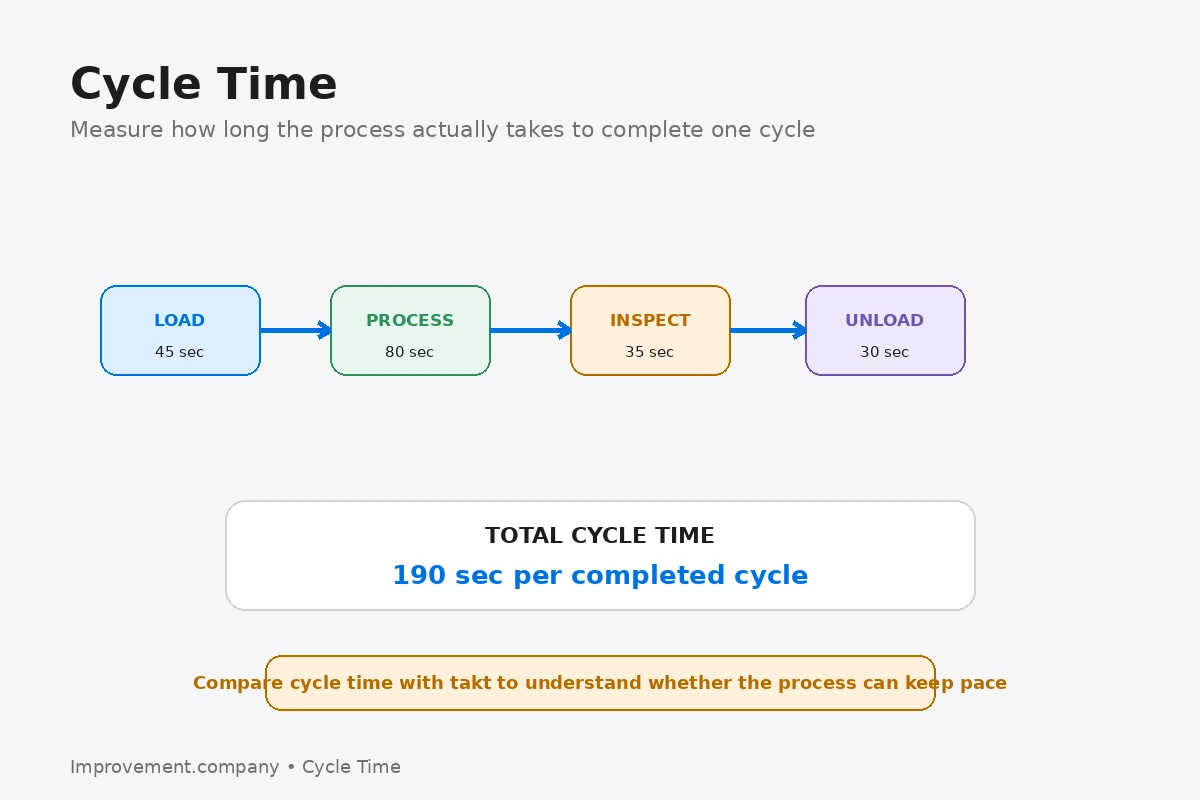
Cycle time is the elapsed time required for a process or work cycle to produce one unit or complete one defined repetition of work. It is one of the most important measurements for understanding process capacity, balance and flow.
The term sounds simple, but useful cycle-time measurement requires a clear definition of where the cycle starts and ends.
Cycle time and takt time
Cycle time describes what the process is actually capable of doing.
Takt time describes the pace required to meet customer demand.
Comparing the two helps determine whether the process can keep up with demand.
If cycle time is consistently longer than takt, the process cannot meet the required pace without additional capacity, a different method or some other change.
Cycle time and lead time
Cycle time is also different from lead time.
Lead time normally describes the total elapsed time from a defined beginning to a defined end, including waiting and queue time.
A product may have a short processing cycle but a long lead time because it spends most of its time waiting between process steps.
This distinction is important because improving cycle time alone may not materially reduce customer lead time.
Measure a stable work definition
Before comparing cycle times, make sure the measurement refers to the same work.
Different product variants, operators, machine modes, batch sizes or quality checks can produce different cycle times.
A useful study identifies the operating condition and observes enough cycles to understand normal variation.
One observation is rarely sufficient.
Manual and machine cycle time
In equipment-intensive processes, manual work and automatic machine time may overlap.
Separating the elements can help reveal whether the operator or machine constrains the cycle.
This is especially useful when designing operator-machine combinations or determining whether one person can safely support more than one machine.
Avoid using the average alone
An average can hide important instability.
A process with an acceptable average cycle time may still miss demand if some cycles are much longer because of minor stops, rework or material shortages.
Looking at the range, distribution and causes of long cycles can provide more actionable information than the average by itself.
Use cycle time to improve the process
Cycle-time analysis can support line balancing, staffing, capacity planning, Standard Work and bottleneck analysis.
The objective is not simply to make every cycle faster.
Reducing cycle time by skipping quality checks, increasing ergonomic burden or creating downstream inventory is not improvement.
The desired result is a capable, stable process that meets demand while protecting safety, quality and flow.
Cycle time becomes most useful when it is connected to the broader production system rather than treated as an isolated speed metric.
Connect this concept to the wider system
For deeper application, connect this concept with Bottleneck Analysis, Capacity Planning, and Takt Time. These methods help move from understanding the topic to managing it as part of a wider improvement system.
Related application
This topic also connects with Cycle Time vs Takt Time vs Lead Time. Use that method when the improvement requires the related operating or management discipline.