
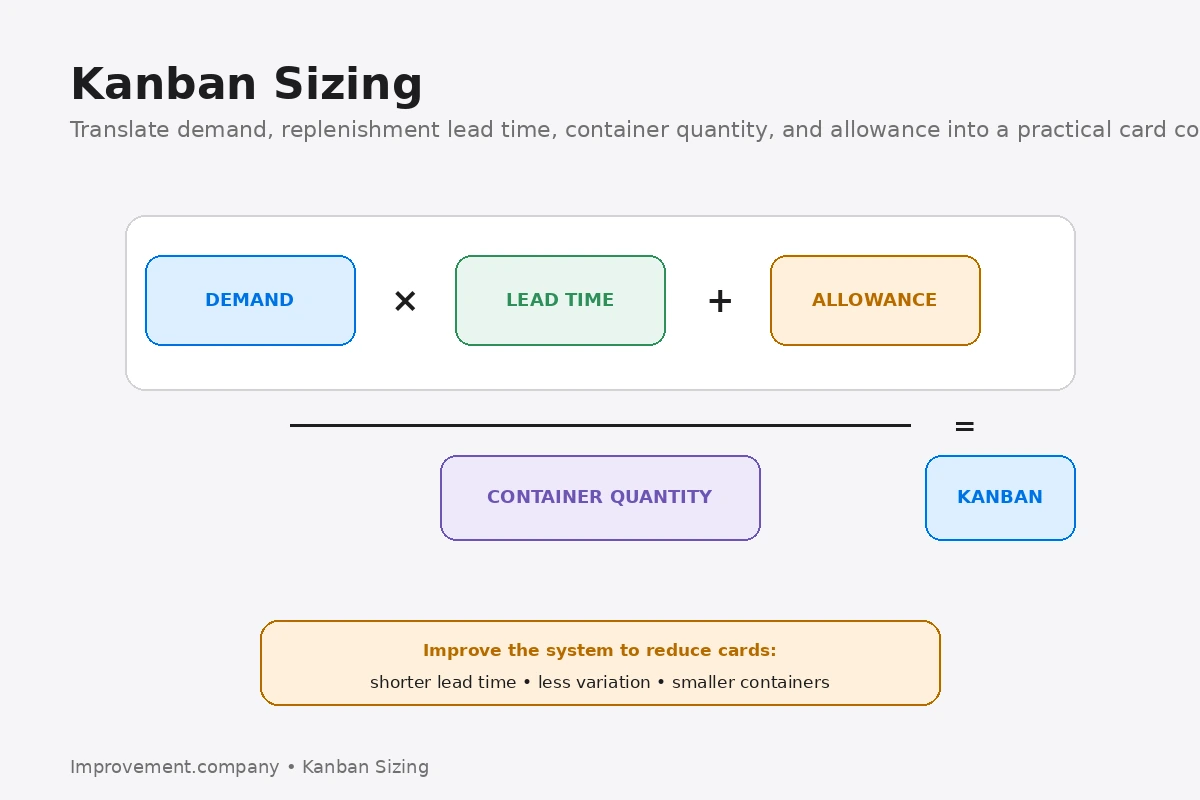
Kanban Sizing determines how much authorized inventory and how many replenishment signals are required for a pull system to operate reliably.
The objective is not to minimize cards at any cost.
The objective is to support actual demand with enough inventory to cover replenishment while making abnormal conditions visible.
Start with demand
The sizing method should use realistic consumption.
Demand may be expressed as:
- units per hour;
- units per shift;
- units per day.
Kanban provides the replenishment signal logic.
Sizing determines how much material each signal represents and how many signals the loop requires.
Understand replenishment lead time
Lead time may include:
- signal travel;
- queue;
- production;
- picking;
- transport;
- receiving;
- return to point of use.
If lead time is underestimated, the system can starve even when the formula is correct.
Observe the actual replenishment loop.
Define container quantity
Each Kanban often corresponds to a standard container quantity.
Container size should consider:
- usage rate;
- ergonomics;
- handling;
- point-of-use space;
- replenishment frequency.
Line-Side Material Presentation helps define practical container size and point-of-use conditions.
Use a transparent sizing relationship
A common conceptual relationship is:
Required inventory = demand during replenishment lead time + controlled safety allowance
The number of Kanban is then based on that required inventory divided by the standard container quantity.
Organizations may use different exact formulas.
The assumptions should be visible and consistently applied.
Treat safety allowance carefully
Safety allowance may protect against normal variation in:
- demand;
- replenishment;
- transport.
It should not hide chronic process problems.
If a supplier is repeatedly late or a process breaks down every shift, adding more cards may simply convert instability into inventory.
Pull System works best when underlying process conditions are reasonably stable.
Round deliberately
Because physical Kanban usually represent whole containers, the calculated result may need to be rounded.
The organization should define whether and how rounding occurs.
The final number should be understandable at the workplace.
Recalculate when the system changes
Review sizing when there is a significant change in:
- demand;
- lead time;
- container quantity;
- supplier performance;
- layout;
- product mix.
PFEP can maintain part-level logistics parameters that support this review.
A Kanban count should not remain fixed for years while operating conditions change.
Reduce Kanban through improvement
A lower Kanban count should come from reducing:
- lead time;
- variation;
- changeover time;
- transport delay.
SMED can reduce replenishment lead time for internally produced parts by enabling smaller, more frequent production.
Removing cards without improving the system increases shortage risk.
Common mistakes
Using forecast instead of actual consumption without reason, ignoring the full replenishment lead time, selecting container sizes only for convenience, adding excessive safety stock, reducing cards as a target without reducing lead time or variation, and failing to update sizing when demand changes are common mistakes.
Practical sequence
- define realistic demand.
- measure replenishment lead time.
- define standard container quantity.
- identify normal variation.
- calculate required inventory.
- convert inventory into whole Kanban quantities.
- validate the result at the Gemba.
- monitor shortages and excess.
- reduce lead time and variation.
- recalculate when system conditions change.
The practical lesson
Kanban Sizing converts real demand and replenishment conditions into controlled inventory.
The most effective way to reduce Kanban is to improve the system that makes inventory necessary.