
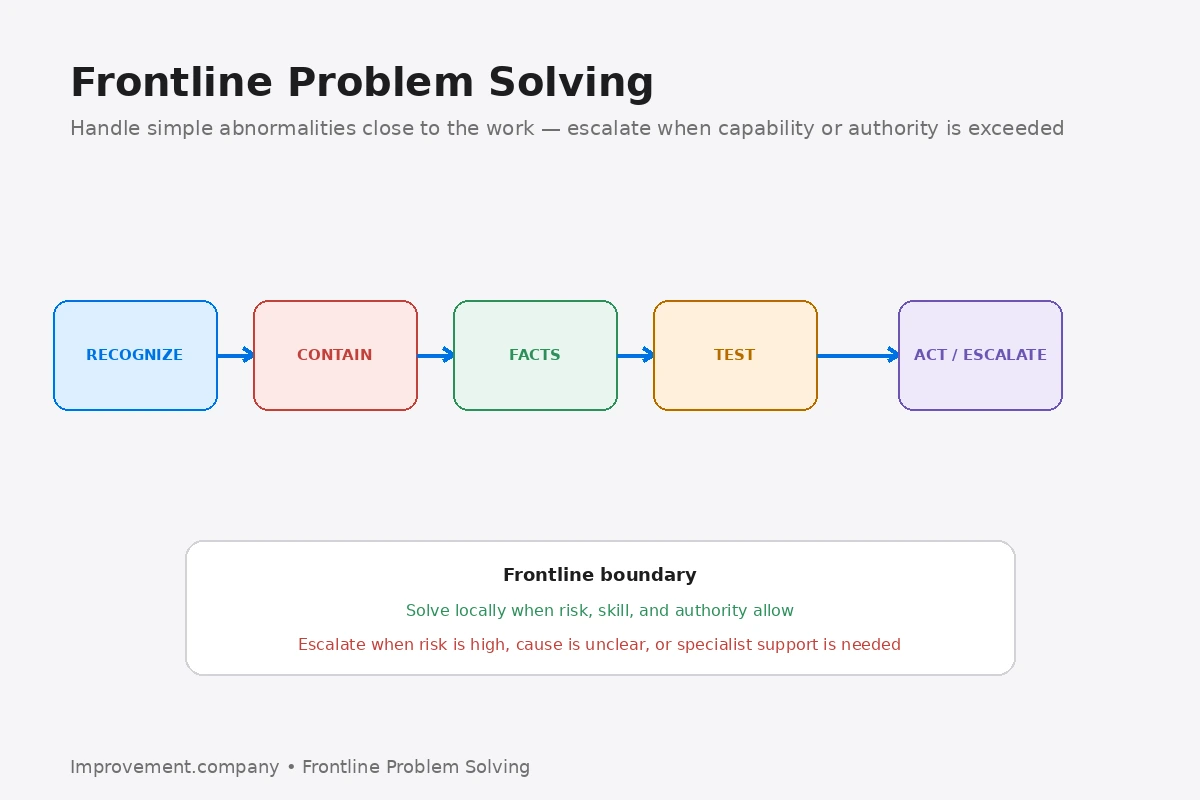
Frontline Problem Solving is a short-cycle approach for responding to abnormalities close to where the work occurs.
Its purpose is not to turn every operator into a specialist investigator.
Its purpose is to give teams a disciplined first response: recognize the abnormality, protect the customer and process, gather facts, solve what is within local capability, and escalate what is not.
Recognize the abnormality
The team must know what normal looks like.
Abnormality Management helps define expected conditions, visual signals, first response, ownership, and escalation.
Examples include a missed cycle, repeated defect, material shortage, or unusual equipment condition.
Contain immediate risk
Before investigating deeply, protect safety, customer, product, and equipment.
Containment Action helps separate temporary protection from permanent corrective action.
Containment should not be confused with solving the cause.
Go to the facts
Useful questions include what happened, where, when, on which product or machine, and what was different.
Is-Is Not Analysis can help narrow the problem using meaningful contrasts.
Frontline teams should avoid jumping directly from symptom to solution.
Use simple cause thinking
For straightforward issues, 5 Whys can help move beyond the first visible symptom.
The goal is not to force exactly five questions. The goal is to identify a cause relationship that can be supported by evidence.
Test before changing the standard
A simple local countermeasure may be appropriate when risk is low, the cause is understood, and authority exists.
For larger or recurring issues, move into a more structured method such as Toyota Problem Solving or QRQC.
Escalate when the problem exceeds local capability
Escalate when customer risk is significant, safety is involved, cause remains unclear, technical support is required, or the issue repeats.
Escalation is part of frontline problem solving, not evidence that the frontline team failed.
Capture the learning
Record enough information to prevent repeated rediscovery.
Useful information includes the condition, containment, cause evidence, action, and escalation.
The record should remain practical.
Common mistakes
Jumping directly to solutions, treating containment as root-cause correction, asking operators to solve technical problems beyond their authority, escalating everything immediately, failing to escalate repeated issues, using 5 Whys without evidence, and creating excessive paperwork for simple abnormalities are common mistakes.
Practical sequence
- recognize the abnormality.
- make the condition safe.
- contain customer or process risk.
- gather facts at the work.
- define the specific problem.
- test simple cause hypotheses.
- take an authorized local countermeasure.
- verify the immediate result.
- escalate when capability or authority is exceeded.
- capture learning for repeated problems.
The practical lesson
Frontline Problem Solving keeps simple problems close to the work while providing a disciplined path for larger problems to move upward.
The goal is fast learning with clear boundaries, not heroic troubleshooting.
Related application
This topic also connects with Problem Escalation Criteria. Use that method when the improvement requires the related operating or management discipline.