
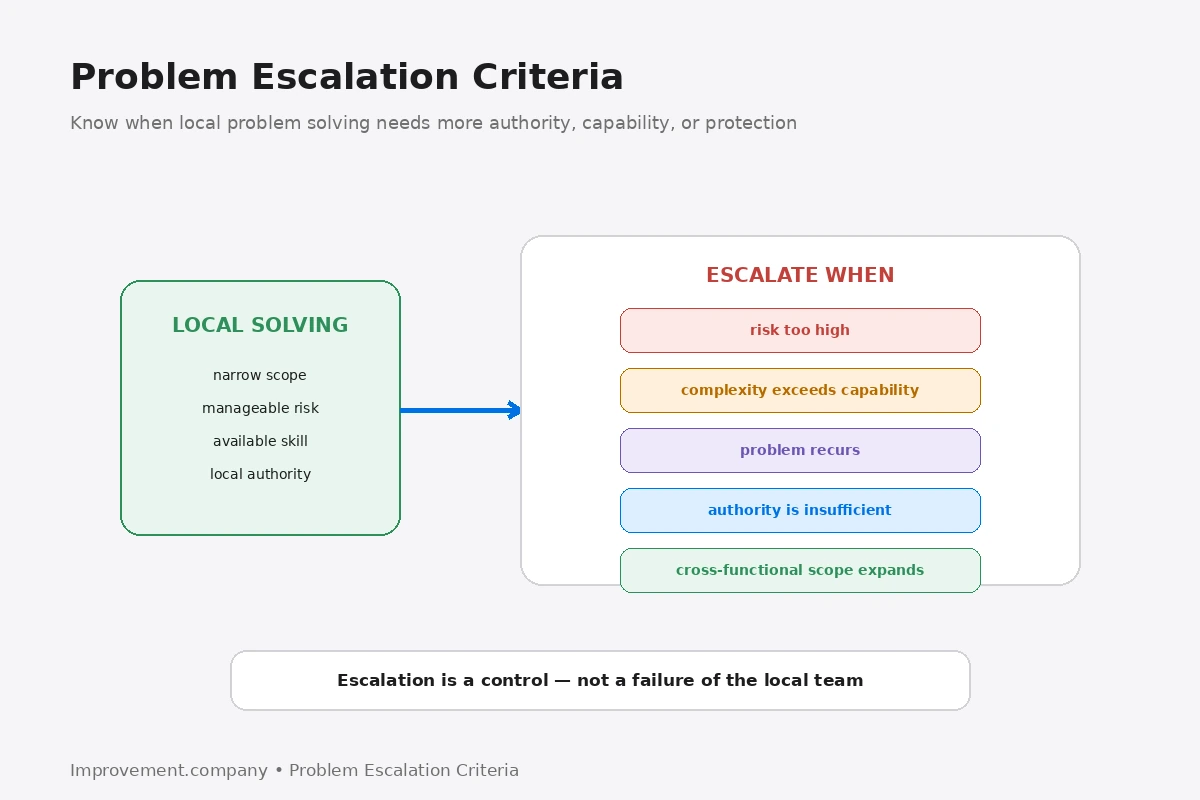
Problem Escalation Criteria define when an issue should move beyond local problem solving and receive additional expertise, authority, or management support.
The purpose is not to escalate difficult problems automatically. It is to prevent teams from spending too long on issues that exceed their capability or decision rights.
Start with risk
Escalate sooner when the problem involves safety, regulatory exposure, serious customer impact, or major equipment risk.
Risk-Based Thinking helps match the response level with consequence and likelihood. High-risk issues should not wait for local learning cycles if stronger protection is required.
Consider problem complexity
Local problem solving may be appropriate when scope is narrow, evidence is accessible, causes are testable, and local authority is sufficient.
Frontline Problem Solving helps teams recognize, contain, gather facts, test simple causes, and escalate when risk or complexity exceeds local capability.
Consider recurrence
Repeated problems may justify stronger escalation. Problem Recurrence Review helps investigate why a problem returned after previous closure.
Recurring failure may indicate weak root-cause evidence, ineffective countermeasures, or a system-level cause.
Consider capability gaps
Escalate when the team lacks required expertise such as controls engineering, reliability engineering, statistics, supplier quality, or process design.
Escalation should bring the needed capability, not only more management attention.
Consider authority limits
Some countermeasures require decisions beyond the team’s authority. Decision Rights in Improvement Work helps clarify who can decide, approve, recommend, or escalate.
Do not ask local teams to solve barriers they are not authorized to change.
Consider cross-functional scope
Cross-Functional Problem Solving helps coordinate evidence and decisions when multiple functions are required.
A problem that spans several processes may need a different owner and review structure.
Define the escalation package
When escalation occurs, provide the problem statement, current risk, containment, evidence collected, hypotheses tested, and support required.
Escalation Management helps structure the request so the receiving level can respond quickly.
Common mistakes
Escalating every difficult issue, keeping high-risk problems local too long, escalating without evidence, asking management to solve technical problems without the right specialist, failing to change ownership when scope changes, and treating escalation as failure rather than a normal control are common mistakes.
Practical sequence
- assess current risk.
- assess problem complexity.
- review recurrence.
- identify capability gaps.
- identify authority limits.
- assess cross-functional scope.
- define the support required.
- prepare the escalation package.
- transfer or retain ownership explicitly.
- review whether escalation improved progress.
The practical lesson
Problem Escalation Criteria help teams know when to keep learning locally and when to ask for stronger support. Good escalation protects time, risk, and problem-solving quality.