
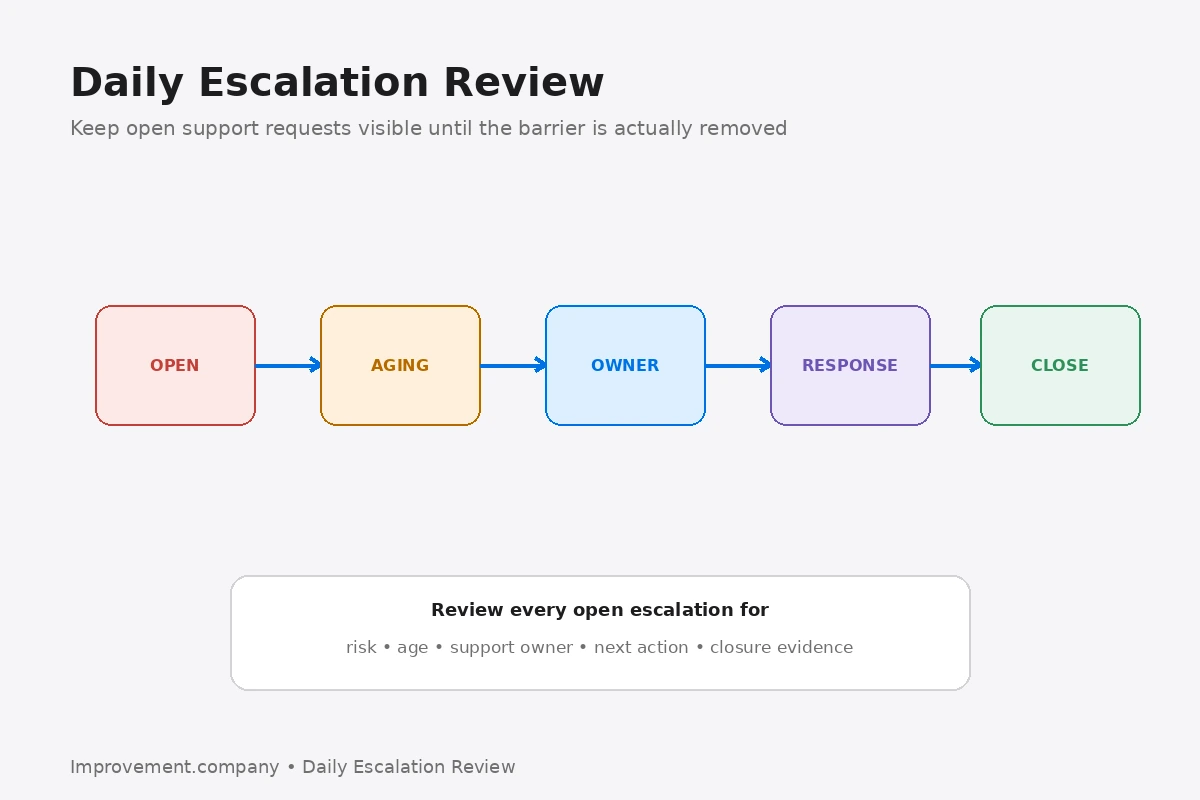
A Daily Escalation Review is a short management routine for checking important support requests that have moved beyond normal local control.
The purpose is not to repeat every conversation.
The purpose is to make sure that escalated issues remain visible until the required decision, resource, or support actually arrives.
Start with open escalations
Review only items that still require support.
Useful information includes:
- abnormal condition;
- current risk;
- requesting team;
- support owner;
- time escalated;
- expected response.
Escalation Management helps structure the original escalation around condition, impact, actions taken, support required, and timing.
The review should begin from that same factual structure.
Check risk first
Not every escalation has the same urgency.
Consider:
- safety;
- quality;
- customer;
- production;
- compliance.
High-risk items should receive attention before low-impact administrative delays.
Risk-Based Thinking helps match response intensity with consequence and likelihood.
Review aging
An escalation can be technically open while practically forgotten.
Ask:
- How long has it been waiting?
- What response was promised?
- Has the risk changed?
- Is the current owner still correct?
Action Aging Review provides useful thinking for exposing work that remains open because ownership, priority, or closure criteria are weak.
Confirm the next support action
Every open escalation should have a specific next move.
Examples include:
- engineering decision;
- maintenance support;
- material approval;
- quality disposition;
- management prioritization.
The next action should be stated clearly enough that the requesting team knows what it is waiting for.
Escalate the escalation when required
If the assigned support level cannot respond in time, move the issue upward.
Daily Management Escalation Ladder helps define which management level should respond as the issue exceeds local authority or capability.
Do not let an escalation sit indefinitely at the wrong level.
Verify the response helped
A response is not complete because someone answered.
Ask whether the support:
- removed the barrier;
- reduced the risk;
- enabled the next step.
Leader Response to Escalation helps leaders provide decisions and resources without taking ownership of the entire problem away from the team.
Close deliberately
Close the escalation when:
- requested support is delivered;
- risk is controlled;
- ownership returns to the correct level.
If deeper problem solving remains open, transfer it into the appropriate problem-solving system rather than keeping the escalation record open forever.
Common mistakes
Reviewing every issue regardless of priority, using escalation age without considering risk, allowing support owners to change informally, confusing a response with resolution, keeping escalations open after the barrier is removed, and failing to escalate further when the assigned level cannot respond are common mistakes.
Practical sequence
- review open escalations.
- confirm current risk.
- review age and promised response.
- confirm support ownership.
- define the next action.
- escalate overdue high-risk items.
- verify delivered support.
- return ownership to the right level.
- transfer deeper work to problem solving.
- close the escalation with evidence.
The practical lesson
A Daily Escalation Review prevents critical support requests from disappearing into the organization.
Escalation works only when the response is visible, timely, and connected to the barrier the operating team cannot remove alone.
Related application
This topic also connects with Escalation Response Time. Use that method when the improvement requires the related operating or management discipline.
Related application
This topic also connects with Daily Support Capacity Review. Use that method when the improvement requires the related operating or management discipline.