
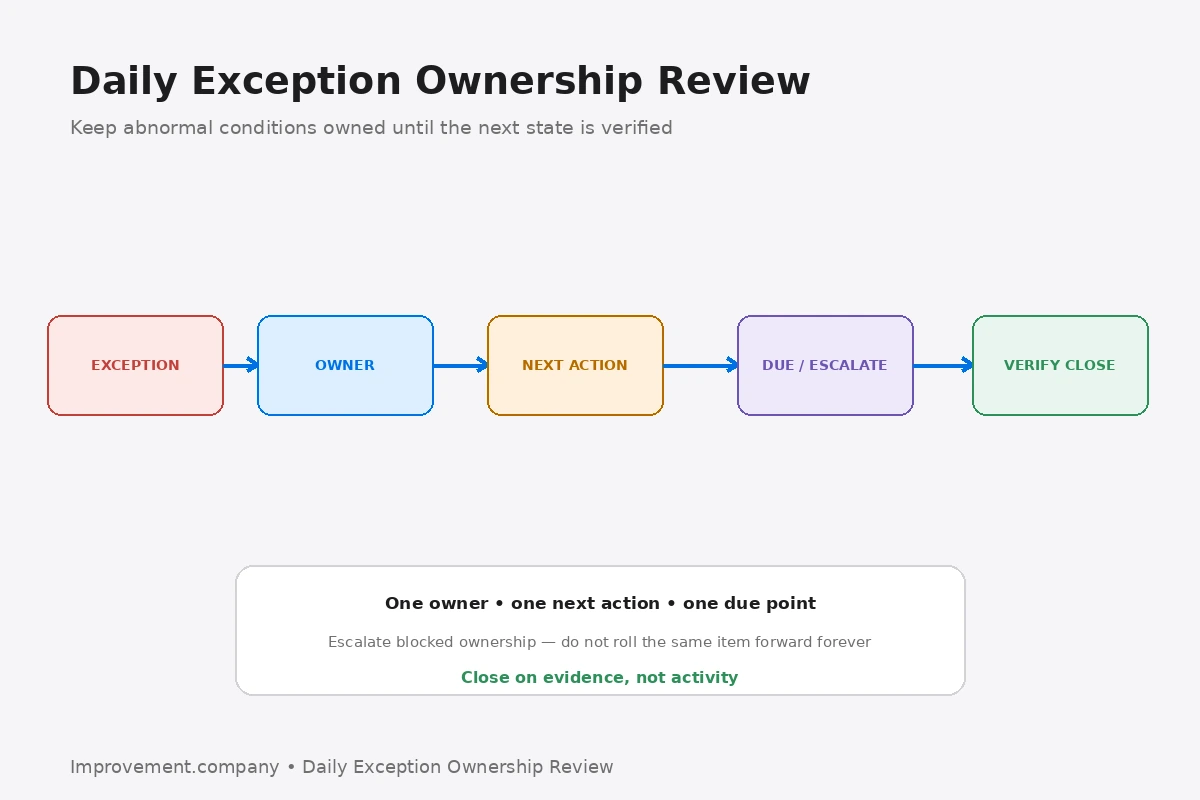
A Daily Exception Ownership Review is a short management routine for abnormal conditions that cannot be fully resolved during the normal operating cycle.
The purpose is not to create a second action list.
The purpose is to ensure every meaningful exception has:
- one accountable owner;
- a clear next action;
- due timing;
- escalation where needed;
- evidence-based closure.
Start with the exception
An exception is a condition outside the expected operating range that requires attention beyond immediate local response.
Management by Exception helps focus management attention on conditions that exceed agreed limits.
Examples include:
- unresolved quality hold;
- recurring equipment loss;
- missing material;
- delayed technical decision;
- repeated staffing gap.
Assign one owner
The owner should be the person accountable for moving the exception toward resolution.
Avoid assigning:
- departments;
- committees;
- several co-owners.
Daily Accountability Process helps connect commitments with named ownership and follow-up.
One owner does not mean one person must do all the work. The owner coordinates the response.
Define the next action
The next action should be specific enough to verify.
Examples include:
- obtain supplier confirmation;
- complete failure inspection;
- approve containment;
- confirm alternate material.
Avoid vague statements such as “monitor” or “follow up.”
Define due timing
The due point should reflect operating consequence.
Action Aging Review helps make overdue and aging commitments visible.
If the issue is safety- or customer-critical, waiting until the next daily meeting may be too slow.
Escalate blocked ownership
If the owner cannot proceed because of authority, support, or resource limits, escalate the blocker.
Daily Escalation Review helps keep escalated issues visible until the required support arrives.
Do not allow the same blocked action to roll forward day after day without escalation.
Close with evidence
Action Closure Criteria helps define what evidence is required before an action is considered complete.
Examples include:
- part released;
- repair verified;
- decision documented;
- operating condition restored.
Closure should mean the exception is controlled, not simply that someone performed an activity.
Review recurrence
If the same exception returns repeatedly, move it into structured problem solving rather than continuing daily containment.
Problem Recurrence Review helps determine whether recurrence requires deeper causal work.
Common mistakes
Assigning groups instead of owners, recording actions with no due time, rolling overdue items forward without escalation, closing on activity rather than evidence, keeping chronic problems permanently in daily management, and creating duplicate trackers are common mistakes.
Practical sequence
- identify the exception.
- define current operating impact.
- assign one owner.
- define the next action.
- set due timing.
- identify support needs.
- escalate blocked ownership.
- verify closure evidence.
- review recurrence.
- remove the item when controlled or transferred.
The practical lesson
A Daily Exception Ownership Review prevents abnormalities from drifting between meetings.
Every meaningful exception should have one person responsible for moving it to a verified next state.