
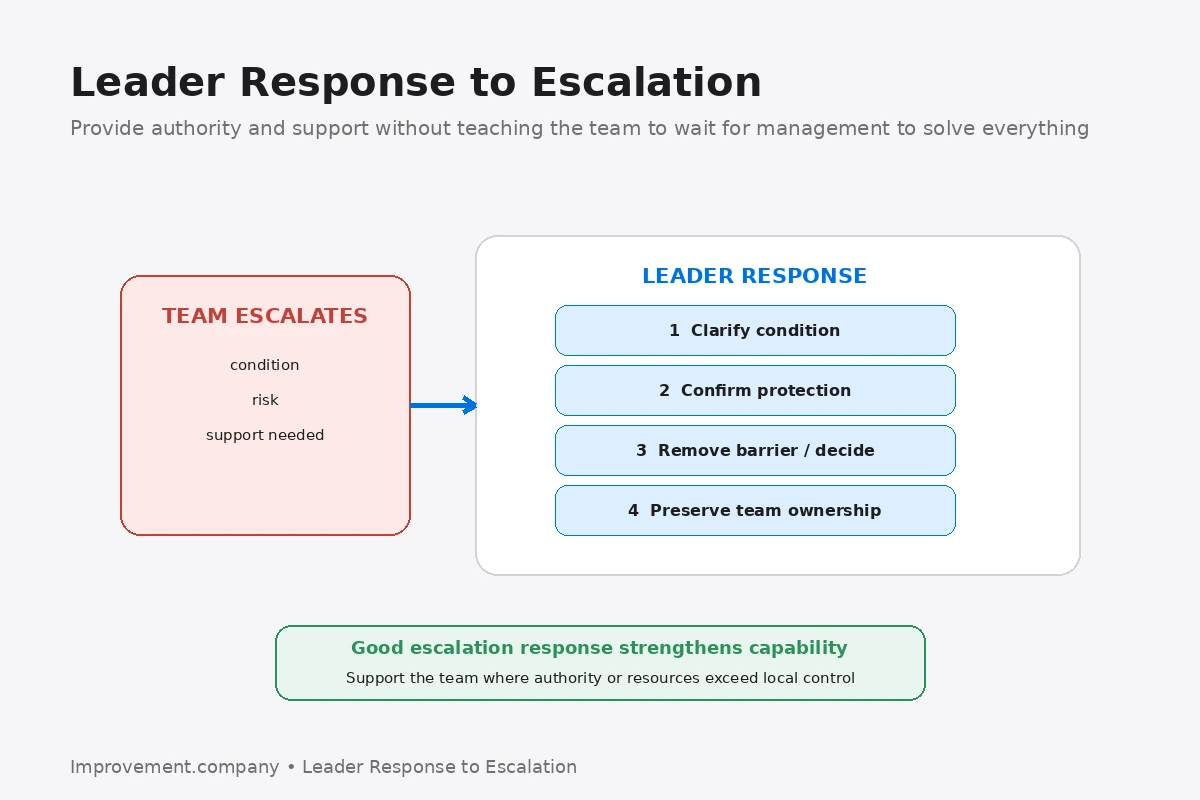
Leader Response to Escalation defines how a leader should react when a team raises an abnormal condition that exceeds local authority, resources, or capability.
A weak response often falls into one of two extremes: the leader ignores the escalation, or the leader takes over the entire problem.
The better response provides the support the team cannot provide for itself while preserving ownership where it belongs.
Clarify the condition first
Ask what is abnormal, what the current risk is, what has already been done, and what support is being requested.
Escalation Management helps structure escalation around condition, impact, actions, support required, and timing.
The leader should understand the need before offering a solution.
Confirm immediate protection
If safety, quality, customer, or equipment risk is active, confirm containment first.
Urgent protection takes priority over coaching.
The leader may need to make a rapid decision when the team lacks authority.
Remove barriers
Typical leadership support includes getting technical expertise, resolving cross-functional conflict, prioritizing scarce resources, making an approval decision, or escalating to the next level.
Daily Management Escalation Ladder helps define which level should respond as the issue exceeds local capability.
Preserve team ownership
If the team can still perform the next investigation step, do not take it away.
Coaching for Continuous Improvement emphasizes developing problem-solving capability rather than simply giving answers.
Useful questions include what the team knows, what evidence is missing, what the next step is, and what specific support is needed.
Give a clear response time
A team that escalates into silence will stop escalating.
If immediate resolution is not possible, state who owns the support action and when the team will receive an update.
This protects trust in the escalation system.
Avoid punishing escalation
Psychological Safety in Continuous Improvement helps explain why people need to raise problems without fear of blame.
If leaders react negatively to bad news, visual-management and escalation systems become unreliable.
Follow up
Leader Standard Work can include follow-up on significant escalations.
Check whether requested support arrived, the barrier was removed, risk changed, or deeper problem solving is needed.
Common mistakes
Demanding a solution before hearing the condition, taking over every problem, failing to respond after escalation, blaming the messenger, escalating further without clarifying the request, providing resources without an owner, and never following up are common mistakes.
Practical sequence
- hear the escalation.
- clarify condition and risk.
- confirm immediate protection.
- identify the exact support request.
- remove the barrier or make the decision.
- preserve local ownership where possible.
- provide a response time.
- escalate further if required.
- follow up on the outcome.
- coach the team using what was learned.
The practical lesson
Leader Response to Escalation should make the operating system stronger.
The leader provides authority and support without training the team to wait for management to solve every problem.
Related application
This topic also connects with Leader Escalation Quality Review. Use that method when the improvement requires the related operating or management discipline.