
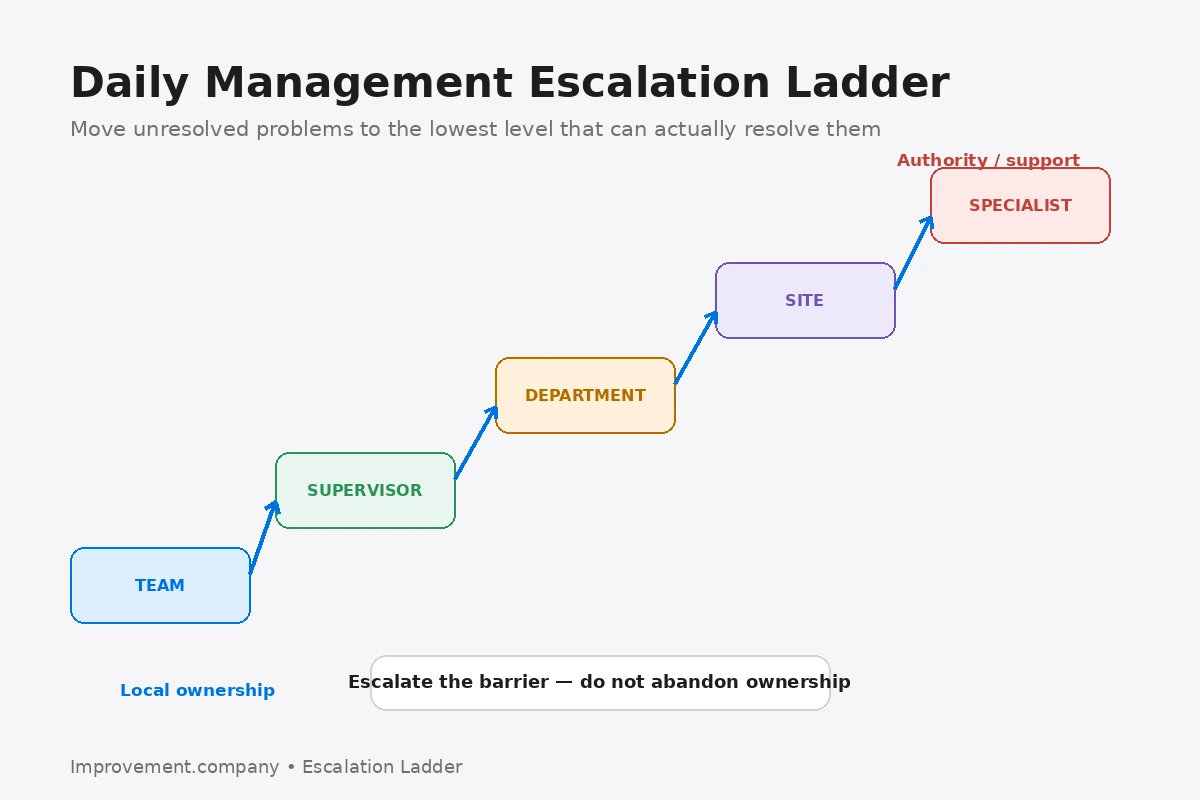
A Daily Management Escalation Ladder defines how unresolved operating problems move from the point of work to progressively higher levels of support.
The objective is not to escalate everything.
The objective is to prevent important issues from remaining stuck at a level that lacks the authority, resources, or cross-functional support to resolve them.
Start with local ownership
The first question should be:
Can the team safely and effectively resolve this within its normal authority?
If yes, keep ownership local.
Daily Management Reaction Plan helps define the immediate response when a metric or operating condition becomes abnormal.
Escalation begins when the local response is not enough.
Define escalation triggers
Typical triggers include:
- safety or customer risk;
- production interruption;
- repeated abnormality;
- resource shortage;
- cross-functional dependency;
- decision authority outside the team.
Escalation Management provides the broader discipline for moving a problem to the right decision level.
The ladder turns that principle into a daily operating rule.
Define the levels
A practical ladder may connect:
- frontline team;
- supervisor;
- department leader;
- site leadership;
- support functions.
Tiered Daily Meetings can provide the meeting structure through which unresolved issues move upward.
Each tier should know what type of issue it is expected to resolve.
Define timing
Escalation should have a time expectation.
Examples:
- immediately for safety;
- within the hour for production interruption;
- by next tier meeting for unresolved operational barriers.
If timing is undefined, escalation often becomes dependent on personal judgment.
Escalate the problem, not the entire history
A useful escalation should state:
- problem;
- current impact;
- containment;
- action already taken;
- specific help required.
Avoid sending a long narrative without a clear request.
5W1H Problem Definition can help structure the facts concisely.
Preserve ownership after escalation
Escalation does not mean handing the problem away.
The local owner should remain connected while higher levels provide:
- decision;
- resource;
- technical support;
- coordination.
This prevents escalation from becoming a dumping mechanism.
Close the loop downward
Once the issue is resolved, communicate:
- decision;
- action;
- standard change;
- lesson learned.
Daily Accountability Process helps keep actions visible until closure is verified.
Common mistakes
Escalating every small issue, waiting too long on high-risk problems, escalating without a clear request, treating escalation as loss of ownership, using hierarchy instead of expertise, and failing to communicate the resolution back to the originating team are common mistakes.
Practical sequence
- identify the abnormality.
- apply the local reaction plan.
- assess whether local authority is sufficient.
- compare the issue with escalation triggers.
- escalate to the defined level.
- state the help required.
- maintain local ownership.
- record the decision.
- verify closure.
- communicate the learning back down.
The practical lesson
A Daily Management Escalation Ladder makes support predictable.
Problems should move upward only when needed, but they should never remain trapped where they cannot be solved.