
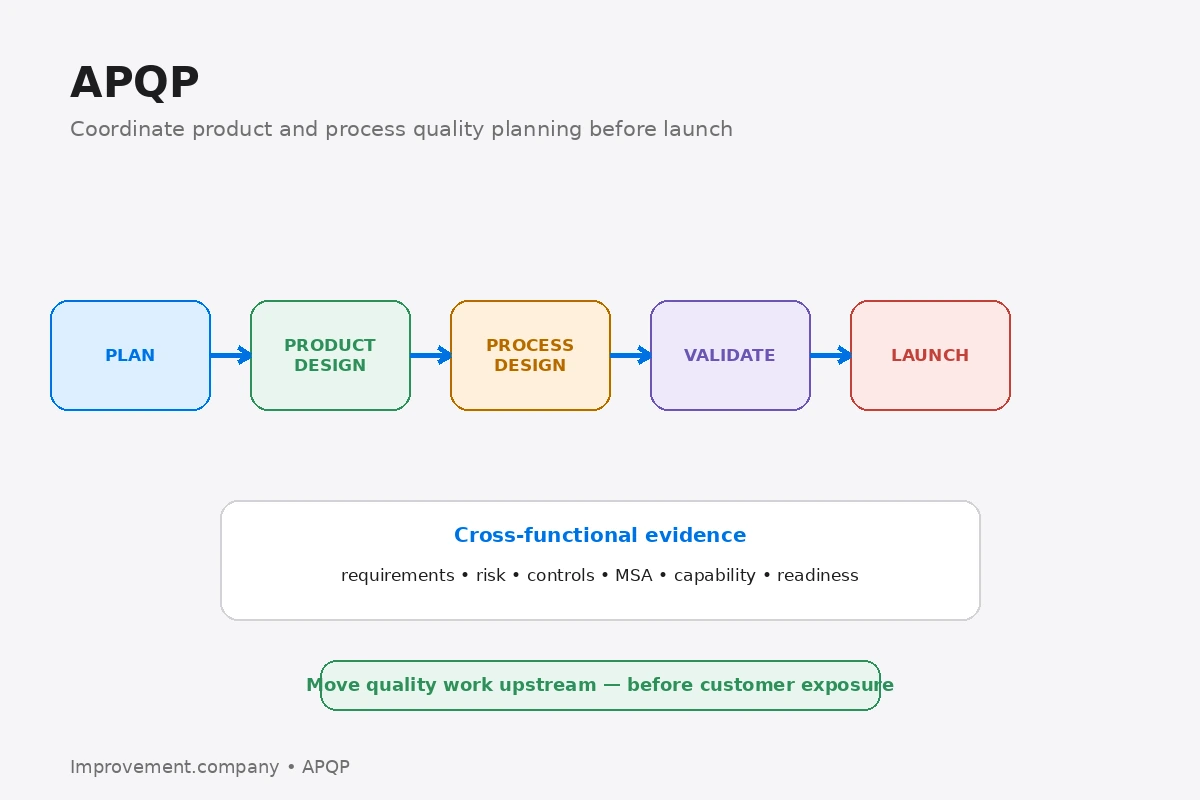
Advanced Product Quality Planning, or APQP, is a structured approach for planning product and process quality before regular production begins.
It is widely used in automotive and other manufacturing environments where launch risk, customer requirements, and cross-functional coordination are significant.
The objective is to prevent quality problems by building readiness before launch.
Start with customer requirements
Quality planning begins with understanding:
- customer specifications;
- performance requirements;
- timing;
- regulatory needs;
- special characteristics.
Voice of Customer helps translate customer needs into clear design and process priorities.
Quality Function Deployment can further connect those needs with technical characteristics.
Manage product and process risk early
Potential failures should be identified while design changes are still practical.
FMEA can be applied to:
- product design;
- manufacturing process;
- important interfaces.
The purpose is not to complete a form.
It is to reduce meaningful failure risk before launch.
Develop the manufacturing process
The process design should define:
- flow;
- equipment;
- tooling;
- material handling;
- work sequence;
- inspection;
- reaction rules.
Process Design Review helps challenge flow, maintainability, staffing, risk, and process interfaces before release.
Define the control system
Control Plan documents how important product and process characteristics will be controlled during production.
It may identify:
- characteristic;
- method;
- frequency;
- sample size;
- reaction plan.
The plan should reflect real process risk and known failure modes.
Confirm measurement capability
Inspection and process-control decisions depend on reliable measurement.
Measurement System Analysis helps determine whether gauges and appraisers can support the required decisions.
A launch should not depend on a measurement system that cannot distinguish acceptable from unacceptable variation.
Validate process readiness
Process Validation can demonstrate that the process performs consistently under intended operating conditions.
Depending on customer and industry expectations, readiness may also include:
- run at rate;
- capability evidence;
- approved work instructions;
- trained employees.
Coordinate cross-functional timing
APQP commonly requires coordination among:
- engineering;
- manufacturing;
- quality;
- purchasing;
- suppliers;
- logistics;
- customer teams.
Production Readiness Review can provide a decision point for unresolved launch risks.
Use the plan as a management system
The value of APQP comes from:
- visible deliverables;
- owners;
- timing;
- risk closure.
If the process becomes only a checklist submitted near launch, it loses much of its preventive value.
Common mistakes
Starting quality planning after the design is frozen, treating FMEA and control plans as paperwork, ignoring supplier readiness, validating only ideal conditions, failing to connect customer requirements to process controls, and closing APQP because the launch date arrived rather than because major risks are controlled are common mistakes.
Practical sequence
- define customer requirements.
- identify product and process risks.
- design the manufacturing process.
- define controls and measurement.
- develop supplier readiness.
- validate equipment and process capability.
- confirm training and work standards.
- close major launch risks.
- approve production readiness.
- capture launch learning for future programs.
The practical lesson
APQP moves quality work upstream.
A strong launch is created by planning and validating the product and process before the customer experiences the problems.