
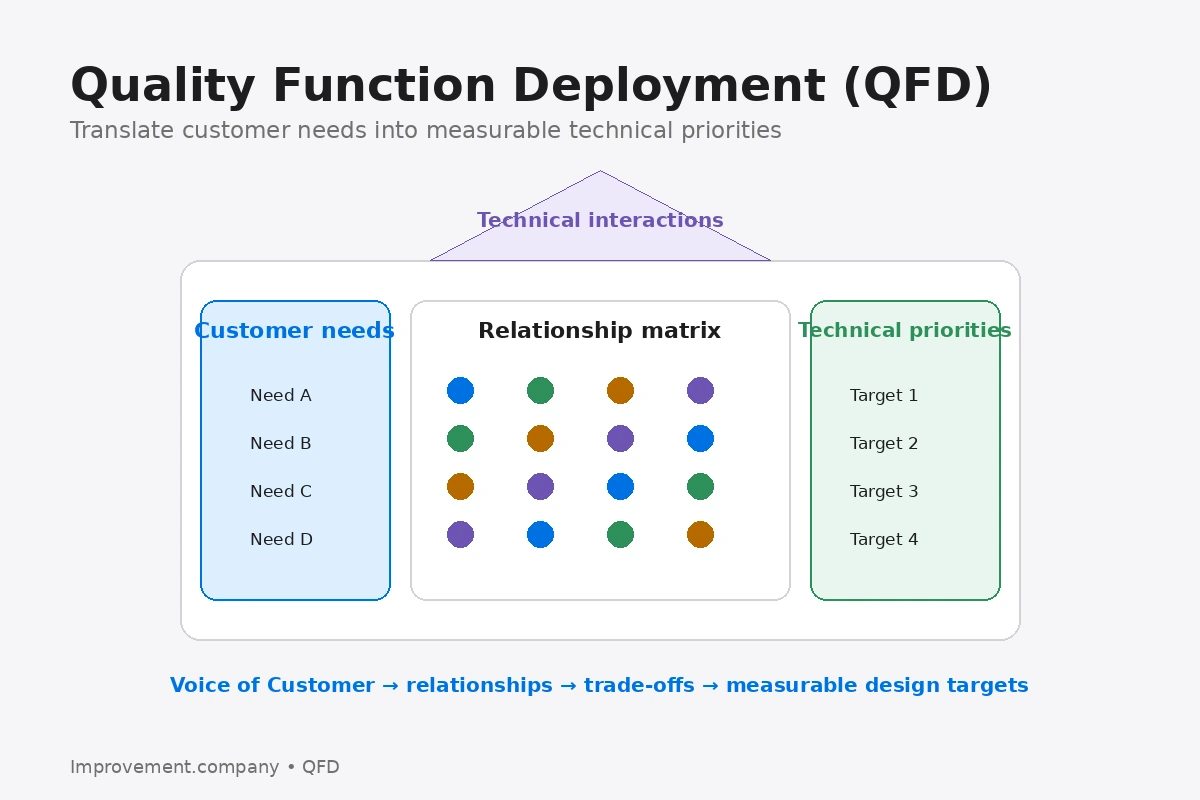
Quality Function Deployment, or QFD, is a structured method for translating customer needs into technical requirements and design priorities.
Its purpose is to prevent the Voice of the Customer from becoming diluted as work moves through engineering, operations, quality, and suppliers.
The best-known QFD matrix is often called the House of Quality.
Start with customer needs
The process begins with what customers value.
Examples include:
- easy to use;
- quiet;
- durable;
- fast delivery;
- accurate;
- easy to clean.
Voice of the Customer helps collect and organize customer expectations from interviews, complaints, surveys, field data, and observation.
Customer language should be preserved before it is translated into technical language.
Prioritize the customer needs
Not every need has equal importance.
The team may assign weights based on:
- customer importance;
- competitive gap;
- strategic priority;
- risk.
The weighting should reflect evidence rather than internal preference.
Translate needs into technical characteristics
The team asks:
What measurable technical characteristic influences this customer need?
For “quiet,” examples might include:
- sound pressure level;
- vibration;
- motor speed;
- enclosure design.
Critical to Quality provides a related approach for converting broad customer needs into measurable requirements.
Evaluate relationships
The QFD matrix links customer needs with technical characteristics.
A common relationship scale is:
- strong;
- medium;
- weak;
- none.
This helps identify which technical characteristics influence several high-priority customer needs.
The relationships should be supported by engineering and process knowledge.
Examine technical interactions
The “roof” of the House of Quality can show how technical characteristics support or conflict with one another.
For example:
- increasing stiffness may increase weight;
- reducing cycle time may increase heat;
- thicker material may improve durability but raise cost.
These trade-offs should be visible before design decisions become fixed.
Benchmark when useful
Competitive or current-product benchmarking can show how well existing alternatives satisfy customer needs.
The team should use comparable evidence where possible.
The objective is not to copy competitors.
It is to understand where technical improvement matters most.
Set technical targets
The matrix should lead toward measurable requirements.
Examples include:
- maximum noise;
- minimum strength;
- response time;
- dimensional tolerance;
- reliability target.
These requirements can then flow into:
- design;
- validation;
- process planning;
- supplier requirements.
Connect QFD to risk analysis
High-priority technical characteristics often deserve stronger risk control.
FMEA can examine how design or process failure modes might prevent those characteristics from being achieved.
QFD defines what matters.
FMEA helps understand how it could fail.
Avoid treating the House of Quality as the goal
A large matrix can become impressive but unusable.
The value comes from:
- clearer priorities;
- explicit trade-offs;
- measurable technical requirements;
- aligned decisions.
The matrix should support decisions, not become a documentation exercise.
Common mistakes
Starting with internal technical requirements instead of customer needs, using weak customer evidence, scoring relationships by opinion only, creating an oversized matrix, ignoring technical trade-offs, and completing the matrix without changing design priorities are common mistakes.
Practical sequence
- collect customer needs.
- organize and prioritize them.
- identify measurable technical characteristics.
- score customer-to-technical relationships.
- examine technical interactions.
- benchmark where useful.
- calculate relative technical priorities.
- set measurable targets.
- connect high-priority requirements to risk controls.
- carry the requirements into design and process planning.
The practical lesson
QFD protects the connection between customer value and technical decisions.
Its strength is not the shape of the matrix. Its strength is disciplined translation from what customers need to what the organization must design and control.