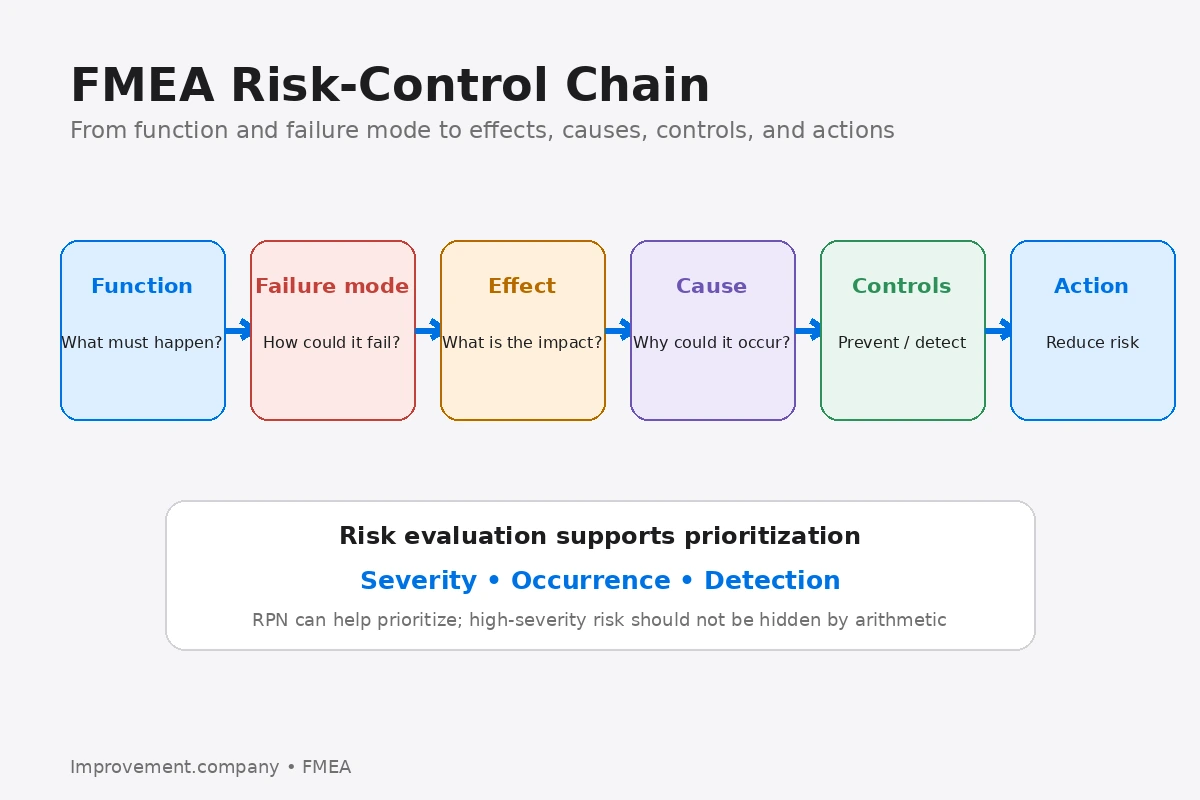
Failure Mode and Effects Analysis, or FMEA, is a structured method for identifying how a product, process or system could fail and deciding where prevention or control should be strengthened.
The key idea is proactive risk reduction.
Instead of waiting for a failure to occur, the team asks what could go wrong, why it could happen and what the consequences would be.
Failure mode
A failure mode describes how a requirement could fail.
Examples include:
- a dimension outside specification;
- a component installed incorrectly;
- a process step omitted;
- a seal leaking;
- incorrect information entered into a system.
The failure mode should describe the failure clearly, not merely label the problem as “bad quality.”
Effect
The effect describes what happens if the failure reaches the next process or customer.
Effects may involve safety, function, quality, delay, rework, downtime or customer dissatisfaction.
Cause
The cause explains why the failure mode could occur.
Useful causes are specific enough to support prevention or detection.
Controls
Current controls may prevent the cause, detect the failure or reduce the likelihood that the failure escapes.
FMEA encourages teams to evaluate whether those controls are strong enough.
Prioritization
Traditional FMEAs often consider severity, occurrence and detection ratings.
Modern practice may also use action-priority approaches rather than relying only on a multiplied risk number.
The purpose is not to create a perfect score.
The purpose is to identify meaningful risks and improve the process before failures occur.
FMEA should change the process
The document has little value if the team identifies important risks but leaves the controls unchanged.
Useful FMEA work results in action: redesigning a feature, preventing an error, improving detection, changing a maintenance practice, clarifying a requirement or strengthening a process control. After actions are implemented, the team should review the analysis again so that the documented risk reflects the revised process rather than the old one.
Begin with functions and requirements
A strong FMEA starts by understanding what the process or design is expected to do.
Failure modes should describe how a function or requirement could fail.
When teams jump directly to a list of familiar problems, the analysis can miss risks that have not occurred before.
Linking the analysis to functions and requirements makes the review more systematic.
Separate cause from effect
A failure mode, its effect and its cause represent different parts of the risk chain.
The failure mode describes what goes wrong. The effect describes what happens because of that failure. The cause describes why the failure mode could occur.
Keeping these distinctions clear helps the team choose controls that act at the correct point.
Detection is not prevention
A strong inspection system may improve detection while leaving the cause of failure unchanged.
Whenever practical, teams should prefer prevention or robust design over relying only on detection.
Detection still matters, especially where prevention is not yet feasible, but it should not be confused with eliminating the risk.
Revisit FMEA after change
FMEA should be a living analysis.
New equipment, material, software, suppliers, process parameters, lessons from defects or maintenance history can change the risk picture.
Teams should review the FMEA when meaningful changes occur and after significant failures.
This keeps the document connected to the actual process instead of becoming a historical record.
Additional connections
This topic also connects with Fault Tree Analysis and CAPA. These relationships are useful when the team needs to extend the method into a wider improvement system.