
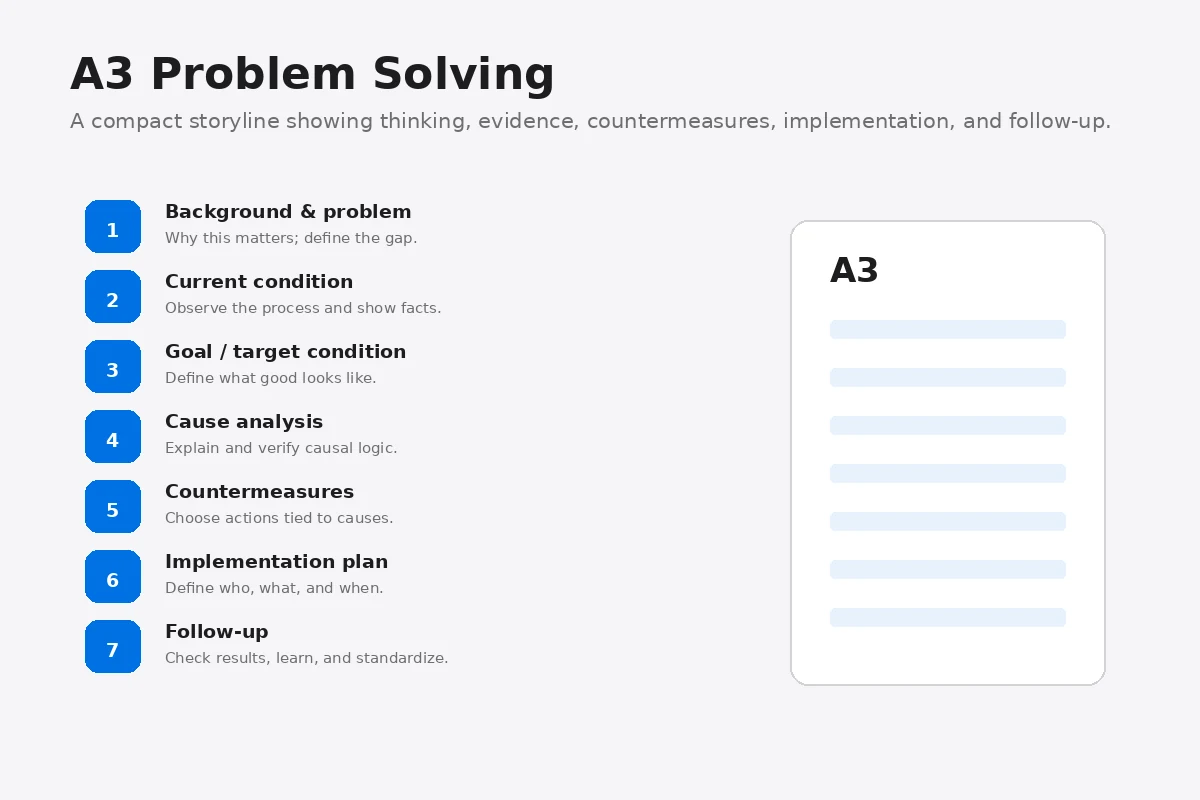
A3 Problem Solving is a structured approach for understanding and improving a problem using a concise visual story.
The name comes from the A3 paper size traditionally used to summarize the work.
The value of A3 is not the paper format itself. The value is the thinking process behind it.
Typical A3 flow
An A3 commonly includes:
- background or business context;
- current condition;
- problem statement;
- target condition;
- cause analysis;
- countermeasures;
- implementation plan;
- follow-up and results.
Different organizations may use different section names, but the logic should remain clear.
Understand before solving
A strong A3 spends meaningful effort on the current condition.
Process data, direct observation, diagrams and Gemba learning help the team understand what is actually happening.
This reduces the risk of selecting countermeasures based only on assumptions.
Countermeasures are not permanent truths
A3 uses the language of countermeasures rather than simply “solutions” because the team is responding to its current understanding of the problem.
Countermeasures should be tested and evaluated.
A3 supports coaching
A3 is also a management and development tool.
A leader can use the A3 to ask questions about the person’s reasoning instead of taking over the problem.
This makes the method useful for developing problem-solving capability across the organization.
What makes an A3 useful
A useful A3 shows the reasoning that connects the problem to the action. Data and observations should support the current condition, the cause analysis should explain the important gap, and the proposed countermeasures should address those causes. When those links are weak, the A3 may look complete while the thinking remains incomplete.
The document should also remain concise enough that another person can follow the logic without needing a separate presentation.
The A3 is a coaching mechanism
A3 thinking is particularly valuable when a leader uses the document to coach the problem solver rather than simply approve the proposed action.
Questions can test the logic: Is the problem measurable? Is the current condition based on observation? Does the cause explain the gap? Does the countermeasure address that cause? What result is expected?
This makes the A3 a development process as well as a communication format.
Keep facts and assumptions separate
Problem-solving documents become misleading when assumptions are written as established facts.
Teams should identify what has been directly observed, what the data demonstrates and what still needs verification.
This distinction is especially important in cause analysis. A plausible explanation should become a hypothesis to test rather than a conclusion to defend.
Follow-up belongs on the A3
Implementation is not the end of the problem-solving cycle.
The A3 should make it possible to compare the result with the target, capture what was learned and identify any remaining gap.
If the result is weak, the team may need to revisit the cause analysis or countermeasure.
A completed A3 should therefore show learning, not merely a history of actions taken.
Connect this concept to the wider system
For deeper application, connect this concept with Root Cause Analysis and 5 Whys. These methods help move from understanding the topic to managing it as part of a wider improvement system.
Related application
This topic also connects with Decision Matrix. Use that method when the improvement requires the related operating or management discipline.
Related application
This topic also connects with A3 Coaching. Use that method when the improvement requires the related operating or management discipline.