
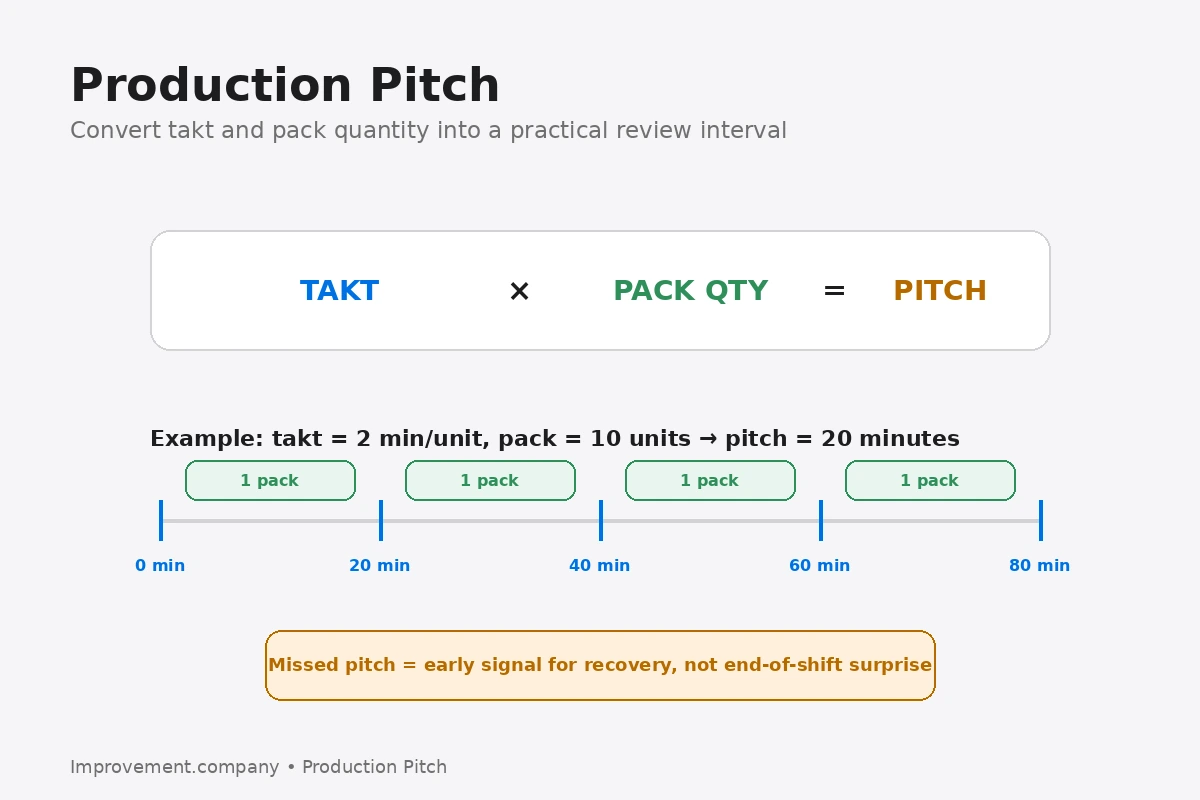
Production Pitch is a practical management interval used to translate takt time into a larger repeatable unit for planning and visual control.
A common relationship is:
Pitch = takt time × pack quantity
The pack quantity may represent:
- container;
- pallet;
- batch;
- transfer quantity.
Pitch helps the team review output at useful intervals instead of waiting until the end of the shift.
Start with takt time
Takt Time defines the demand-based rhythm required from the process.
For example:
- available production time = 420 minutes;
- customer demand = 210 units;
- takt time = 2 minutes per unit.
If the standard pack contains 10 units:
Pitch = 2 minutes × 10 units = 20 minutes
The process should therefore complete one 10-unit pack approximately every 20 minutes.
Use a practical review interval
A one-unit takt may be too short for management review.
Pitch creates a larger interval that can be displayed on:
- production board;
- schedule;
- heijunka box;
- hour-by-hour board.
Hour-by-Hour Board can use pitch or another suitable interval to compare expected versus actual output.
Connect pitch to material movement
Pitch can support:
- finished-goods pickup;
- container replenishment;
- material delivery;
- schedule release.
When the production and material systems share a consistent interval, coordination becomes easier.
Milk Run Material Delivery may use a regular delivery rhythm that aligns with production consumption.
Choose pack quantity carefully
The pack quantity should reflect the actual operating system.
A very large container creates a long pitch and hides problems longer.
A very small container may create excessive handling.
Consider:
- ergonomics;
- material presentation;
- transport frequency;
- product size;
- downstream needs.
The objective is useful operational rhythm, not a mathematically convenient number.
Use pitch to expose misses early
Suppose the process should complete one pack every 20 minutes.
If the 10:20 pitch is missed, the team can respond before the end of the shift.
Short Interval Control uses the same principle of reviewing performance frequently enough that recovery is still possible.
Distinguish pitch from cycle time
Cycle time is the actual time between completed units or cycles.
Takt is the required customer rhythm.
Pitch is a management interval derived from takt and pack quantity.
These values serve different purposes.
Use pitch in mixed-model systems carefully
For mixed-product work, different products may have different pack quantities or work content.
The production system should define a practical common rhythm.
EPEI helps determine how frequently every part in a product family can be produced when the same resource runs multiple products.
Avoid treating pitch as a rigid target when conditions are abnormal
The team should understand why pitch was missed.
Possible causes include:
- breakdown;
- quality stop;
- staffing issue;
- material shortage;
- long changeover.
The interval is a signal for management action, not a reason to pressure employees to hide abnormal conditions.
Common mistakes
Calculating pitch without valid takt, choosing pack sizes only for convenience, waiting until the end of the shift to react, confusing pitch with cycle time, ignoring product-mix complexity, and using missed pitch only as a performance-pressure mechanism are common mistakes.
Practical sequence
- calculate valid takt time.
- define the standard pack or transfer quantity.
- calculate pitch.
- confirm the interval is operationally useful.
- display expected pitch completion.
- compare actual versus plan.
- respond to misses quickly.
- align material movement where practical.
- revise pack quantity when the system changes.
- use pitch as part of daily management.
The practical lesson
Production Pitch converts demand rhythm into an interval that people can manage visually.
It makes production status easier to see early enough for the team to act.
Related application
This topic also connects with Schedule Attainment. Use that method when the improvement requires the related operating or management discipline.