
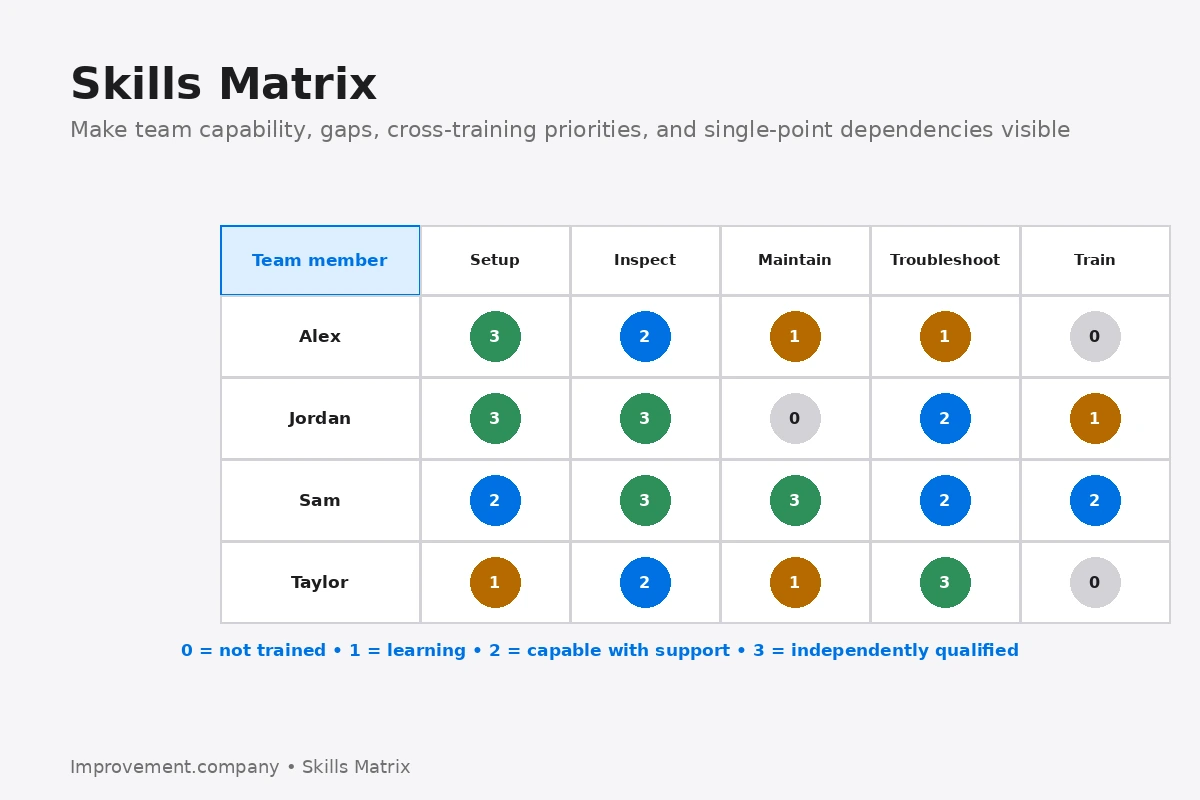
A skills matrix is a visual tool that shows which people are qualified, developing, or not yet trained for specific tasks or competencies.
Used well, it helps teams make staffing risk and development needs visible. Used poorly, it becomes a wall chart that is updated before audits and ignored during daily management.
The value comes from connecting the matrix to real qualification criteria, training plans, and operating needs.
What a skills matrix shows
A basic skills matrix places employees on one axis and required skills on the other.
Each intersection indicates the person’s current level for that skill.
Organizations use different symbols and rating scales. A common approach may distinguish between:
- not trained;
- training started;
- able to perform with support;
- qualified to perform independently;
- able to train or coach others.
The exact symbols matter less than having clear definitions.
A rating should represent demonstrated capability, not how long someone has worked in the department.
Start with the work requirements
Before rating people, identify the capabilities the process actually needs.
These can include equipment operation, setup, inspection, troubleshooting, material handling, documentation, safety-critical tasks, maintenance activities, or leadership routines.
The list should be specific enough to guide action.
For example, “Packaging” may be too broad. “Run labeler,” “complete format changeover,” and “perform first-piece inspection” provide more useful information.
The matrix should align with Standard Work and the actual responsibilities of the role.
Define qualification criteria
A skills matrix becomes subjective when managers rate people according to general impressions.
Define what evidence is required for each level.
Qualification may include:
- observed performance;
- completion of structured training;
- demonstration of critical steps;
- successful execution across several cycles;
- knowledge of abnormal conditions;
- ability to explain reaction plans;
- formal certification where required.
For repeatable operational work, Training Within Industry can provide a disciplined method for teaching and confirming the job.
Use the matrix to expose operational risk
The strongest use of a skills matrix is not simply showing who knows what. It reveals where the process is vulnerable.
Imagine a critical machine has only one qualified operator.
The department may appear fully staffed, but it has a capability bottleneck. Vacation, absence, turnover, or reassignment could immediately affect output.
A matrix can expose:
- single-point skill dependencies;
- weak shift coverage;
- insufficient backup for critical roles;
- excessive reliance on one expert;
- training needs before new equipment starts;
- gaps created by promotions or transfers.
These are operational risks, not merely HR statistics.
Turn gaps into a development plan
Once gaps are visible, prioritize them.
Not every missing skill has the same urgency.
A practical sequence is:
- identify critical skills;
- identify minimum coverage needed by shift or area;
- compare current capability with that need;
- select people for development;
- assign training and practice;
- verify qualification;
- update the matrix.
The plan should balance business continuity with employee development.
Connect the matrix to Daily Management
A skills matrix can support Daily Management when leaders use it to make staffing and training decisions.
For example, a supervisor can review capability before scheduling a complex changeover or assigning a team to a critical process.
Leader Standard Work can include periodic review of qualification gaps and overdue training actions.
The matrix should not replace direct observation, coaching, or performance conversations. It makes capability visible so those activities can be better targeted.
Avoid using the matrix as a ranking system
A skills matrix should support development, not become a public scoreboard of employee worth.
If people believe the tool is designed to embarrass or rank them, they may resist honest assessment.
A healthy implementation explains:
- why the matrix exists;
- how ratings are determined;
- how people can progress;
- what training support will be provided;
- how the information will be used.
Respect matters as much as the visual format.
Common mistakes
Too many skills
A matrix with hundreds of vague competencies becomes difficult to maintain.
Start with capabilities that matter to process performance and risk.
Unclear rating definitions
If one supervisor interprets “qualified” differently from another, the matrix loses credibility.
Rating by tenure
Experience can contribute to capability, but time served is not proof of skill.
No training response
Displaying gaps without a plan to close them turns the tool into decoration.
No maintenance
Skills change as people transfer, equipment changes, and standards improve.
What good looks like
A useful skills matrix is current, understandable, evidence-based, and connected to action.
Leaders can use it to answer practical questions:
- Do we have enough qualified people for this shift?
- Where are our single-point dependencies?
- Who is ready for the next development opportunity?
- Which training action will reduce the most risk?
- Has qualification kept pace with process changes?
When those questions become easier to answer, the matrix is doing its job.
Related application
This topic also connects with Training Needs Analysis. Use that method when the improvement requires the related operating or management discipline.