
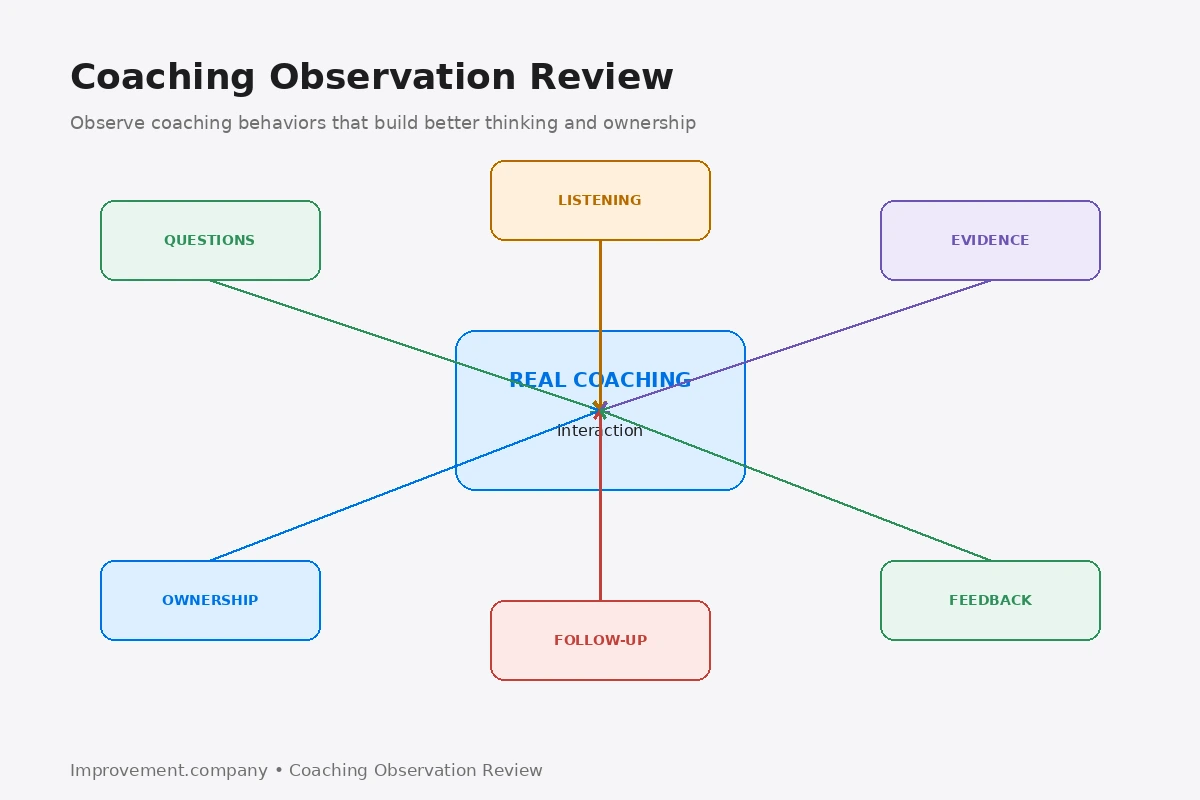
A Coaching Observation Review is a structured reflection on how a leader coaches an employee or team during real improvement work.
The purpose is not to score personality. It is to improve coaching behaviors that help people think clearly, use evidence, own the next step, and develop problem-solving capability.
Observe a real interaction
Use an actual coaching conversation where possible. Coaching for Continuous Improvement helps leaders guide learning without taking over the problem.
Observe what the leader actually does rather than relying only on self-report. A short Gemba conversation can provide more useful evidence than a formal classroom exercise.
Review question quality
Useful coaching questions help the learner explain the current condition, target condition, evidence, next experiment, and obstacle. Gemba Coaching Questions provides question patterns that keep the conversation connected to the real process.
Avoid questions that simply lead the employee toward the leader’s preferred answer.
Review listening
Ask whether the leader allowed thinking time, listened for evidence, explored uncertainty, and avoided interrupting too quickly.
Coaching quality drops when the leader turns the interaction into a lecture.
Review ownership
The learner should leave with clear ownership of the next thinking or action step. A3 Coaching helps develop problem-solving thinking by asking questions about logic, evidence, and learning.
The leader may provide support without becoming the problem owner.
Review evidence use
Strong coaching repeatedly returns to facts. Ask whether the conversation distinguished observation, assumption, and interpretation.
Hypothesis-Driven Problem Solving helps teams convert assumptions into testable explanations.
Review follow-up
Good coaching creates continuity. Coaching Action Follow-Up helps confirm whether the learner completed the agreed next step and what was learned from it.
Without follow-up, coaching becomes a series of disconnected conversations.
Give behavior-specific feedback
Useful feedback sounds like: You asked three questions before offering an answer, or the conversation moved to countermeasures before the current condition was clear.
Avoid broad labels such as good coach or poor listener.
Common mistakes
Reviewing only formal coaching sessions, scoring style instead of behavior, rewarding fast answers, ignoring whether the learner retained ownership, giving vague feedback, focusing on questions without listening, and failing to observe whether coaching improves capability over time are common mistakes.
Practical sequence
- observe a real coaching interaction.
- identify the purpose of the conversation.
- review question quality and listening.
- review use of evidence.
- check learner ownership.
- review the agreed next step.
- provide specific feedback.
- observe follow-up.
- repeat until coaching behaviors become routine.
The practical lesson
A Coaching Observation Review helps leaders improve how they develop others. The strongest coaching leaves the learner with better thinking, not just a better answer.