
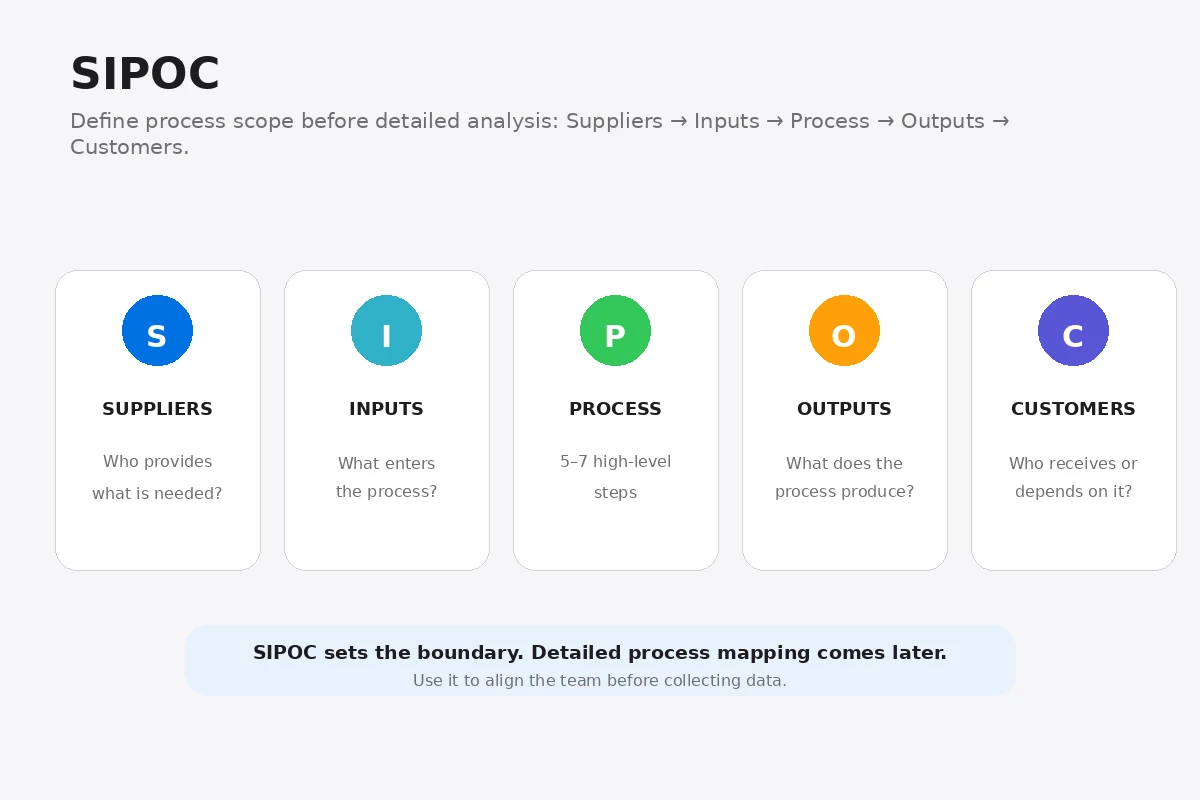
SIPOC is a high-level process view used to clarify scope before a team dives into detailed analysis.
The acronym stands for Suppliers, Inputs, Process, Outputs, and Customers.
A SIPOC does not replace a detailed process map. Its value is different: it creates shared understanding of where the process begins and ends, what enters it, what it produces, and who depends on those outputs.
The five elements
Suppliers
Suppliers provide the inputs required by the process. They may be external vendors, internal departments, information systems, customers, or upstream operations.
Inputs
Inputs are the materials, information, specifications, requests, data, or resources the process needs.
Process
The process is usually described in a small number of high-level steps. A SIPOC should stay high level. Five to seven steps are often enough.
Outputs
Outputs are the products, services, decisions, information, or completed work created by the process.
Customers
Customers receive or depend on the outputs. They may be external customers or internal users.
Why SIPOC is useful early
Improvement teams often begin with different mental models of the process.
One person thinks the process starts when an order is entered. Another thinks it starts when a customer makes contact. Someone else includes forecasting and purchasing.
If scope is not clarified, teams can spend hours analyzing different processes while believing they are discussing the same one.
A SIPOC creates a common boundary before detailed work begins.
SIPOC in DMAIC
SIPOC is especially common in the Define phase of DMAIC.
At that stage, the team needs to understand the problem, customer, process scope, and major inputs and outputs without getting lost in detail.
Later phases can use process maps, data collection plans, process capability analysis, cause analysis, and control methods.
SIPOC sets the frame.
A simple example
Consider a maintenance work-order process.
Suppliers might include production, maintenance planners, stores, and the computerized maintenance management system.
Inputs might include a work request, asset information, priority, parts availability, and maintenance standards.
The process might be summarized as:
receive request → prioritize → plan → schedule → execute → close.
Outputs might include completed work, updated equipment history, and follow-up actions.
Customers might include production, maintenance leadership, reliability engineering, and EHS.
This high-level view helps the team decide what part of the workflow should be analyzed in detail.
Start with the process, then expand outward
Teams often find it easier to build SIPOC in this order:
- define the process boundaries;
- list the major process steps;
- identify outputs;
- identify customers;
- identify required inputs;
- identify suppliers.
This order helps prevent the exercise from becoming a disconnected list.
Common mistakes
One mistake is making the process column too detailed. If the SIPOC contains dozens of steps, it is becoming a process map.
Another is listing only external suppliers and customers. Internal handoffs are often critical.
A third mistake is using vague outputs such as “good service.” Outputs should be specific enough to connect to customer requirements.
A fourth is treating SIPOC as a one-time workshop artifact. If scope changes during the project, the SIPOC should be updated.
When SIPOC is most useful
SIPOC is particularly useful when process ownership is unclear, multiple functions are involved, customer requirements are not well connected to outputs, or the improvement team needs alignment before data collection begins.
It is less useful when the team already has a clearly defined process boundary and the real need is detailed operational analysis.
The key question
A good SIPOC answers:
What process are we actually improving, what must enter it, what does it produce, and who depends on the result?
When those questions are clear, the rest of the improvement effort has a much stronger starting point.