
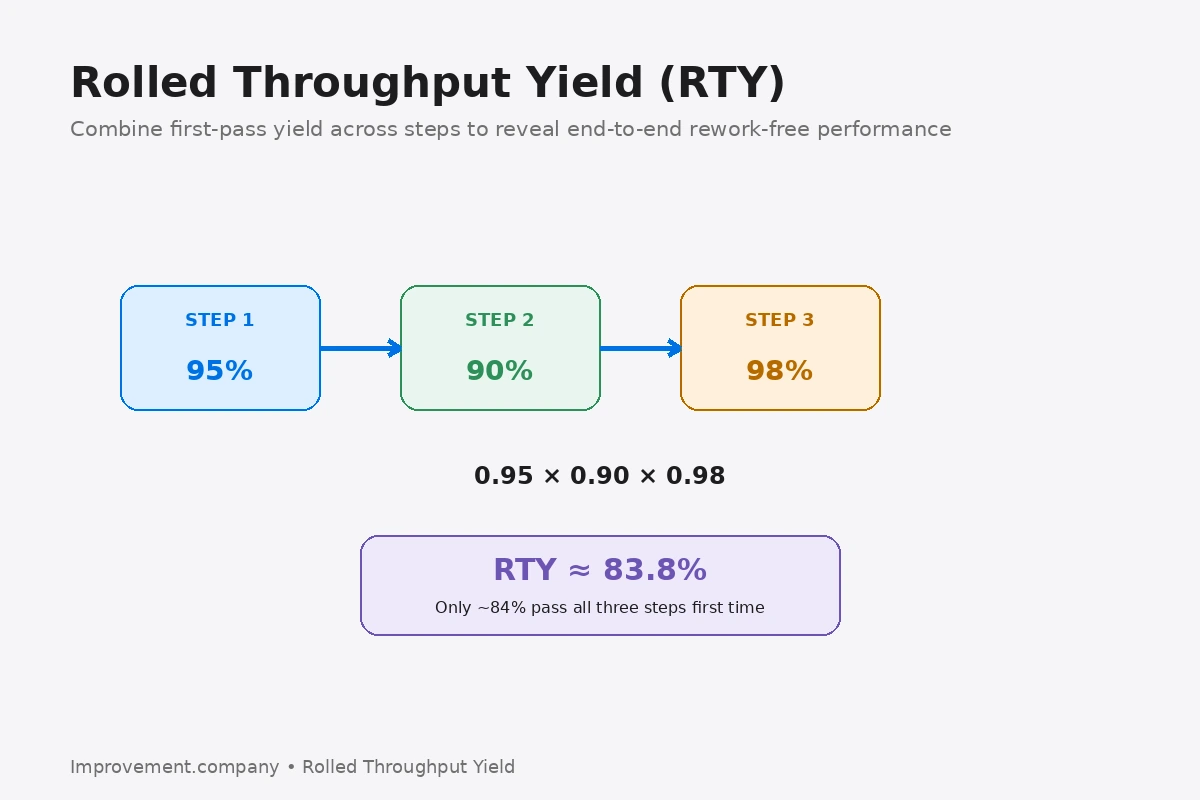
Rolled Throughput Yield, or RTY, measures the probability that a unit will pass through multiple process steps correctly the first time without defect or rework.
It combines the first-pass yield of each step into one end-to-end measure.
Why final yield can be misleading
A process can achieve a high final acceptance rate while still creating substantial hidden rework.
Suppose 100 units start, 20 require rework, and all 100 eventually pass. Final yield may appear to be 100%, but the process did not perform correctly the first time.
First Pass Yield exposes this loss at an individual process step.
Calculate RTY across multiple steps
Suppose a three-step process has first-pass yields of:
- Step 1 = 95%;
- Step 2 = 90%;
- Step 3 = 98%.
RTY is:
0.95 × 0.90 × 0.98 = 0.8379
So the rolled throughput yield is about 83.8%.
That means only about 84% of units would be expected to complete all three steps without first-pass failure.
Use consistent definitions
Each step should define what counts as a unit, what counts as first-pass success, how rework is treated, and what time period is measured.
Operational Definition helps keep those rules consistent.
If one department excludes minor rework while another includes it, the rolled result becomes misleading.
Identify hidden complexity
RTY becomes especially useful when many steps each have apparently high yield.
Five steps at 95% first-pass yield produce:
0.95⁵ ≈ 77.4% RTY
Small losses multiply across the value stream.
Connect RTY with cost
Repeated defects create labor, delay, inspection, scrap, and customer risk.
Cost of Poor Quality can translate low first-pass performance into financial impact.
RTY helps show how local quality losses accumulate across the process.
Use RTY to prioritize improvement
The weakest step often deserves attention, but the team should consider defect frequency, consequence, rework burden, and customer impact.
Pareto Analysis can help identify which defect categories account for most of the first-pass loss.
Distinguish RTY from capability
RTY describes actual pass performance across multiple process stages.
Process Capability compares stable process variation with specification limits.
Both are useful, but they answer different questions.
Common mistakes
Using final yield as a substitute for first-pass performance, multiplying inconsistent definitions, ignoring rework loops, using RTY without understanding which step drives the loss, confusing RTY with process capability, and reporting a rolled percentage without connecting it to actual defects are common mistakes.
Practical sequence
- define the end-to-end process.
- identify the major steps.
- define first-pass success at each step.
- measure first-pass yield.
- multiply the step yields.
- identify the largest losses.
- translate loss into quality or cost impact.
- improve the strongest causes.
- recalculate RTY.
- monitor whether end-to-end first-pass success improves.
The practical lesson
RTY reveals how small quality losses compound across a process.
A process with acceptable-looking local yields can still have poor end-to-end first-pass performance.