
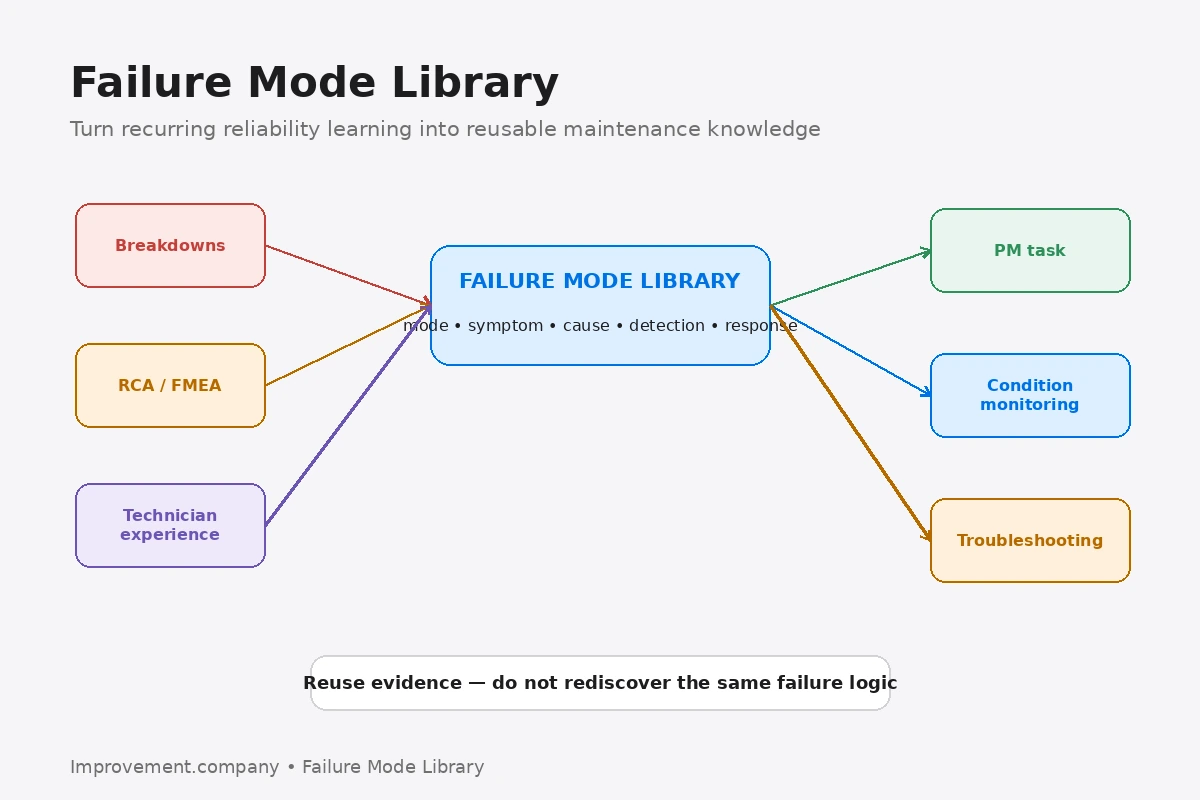
A Failure Mode Library is a structured collection of known equipment failure modes and the knowledge associated with them.
It may capture:
- failure mechanism;
- symptoms;
- likely causes;
- detection methods;
- consequences;
- preventive actions.
The objective is to reuse reliability knowledge instead of rediscovering the same failure logic on every asset.
Define failure modes consistently
A failure mode describes how a function is lost or degraded.
Examples include:
- bearing seizure;
- seal leakage;
- electrical open circuit;
- belt slip;
- pump cavitation.
Avoid vague entries such as:
machine failed.
FMEA provides useful structure for linking failure modes with effects, causes, and controls.
Separate mode from cause
The failure mode may be:
bearing overheats.
Possible causes may include:
- contamination;
- over-lubrication;
- misalignment;
- excessive load.
The library should not collapse mode and cause into one field.
Capture observable symptoms
Useful symptoms include:
- vibration pattern;
- temperature rise;
- noise;
- pressure change;
- leakage;
- current increase.
These help technicians recognize developing failures earlier.
P-F Curve helps explain the interval between detectable deterioration and functional failure.
Link to detection methods
The library may identify:
- vibration analysis;
- oil analysis;
- thermography;
- inspection;
- functional test.
Predictive Maintenance can use this failure knowledge to select appropriate condition-monitoring methods.
Link to preventive actions
Possible actions include:
- lubrication task;
- alignment standard;
- replacement interval;
- inspection;
- design change.
The action should connect to the actual failure mechanism.
Build from real history
Good sources include:
- breakdown analysis;
- RCA;
- technician experience;
- OEM information;
- similar assets.
Bad Actor Analysis helps identify recurring assets and failures worth capturing systematically.
Reuse carefully across similar assets
A failure mode from one asset may apply to another only if the:
- function;
- design;
- operating environment;
are sufficiently similar.
Do not blindly copy maintenance tasks between different applications.
Maintain the library
Update the library when:
- a new failure mode appears;
- a cause is disproved;
- a better detection method is found;
- a control is shown ineffective.
The library should reflect current reliability learning.
Common mistakes
Recording vague failure descriptions, mixing mode and cause, copying OEM lists without plant evidence, creating a library no one uses, applying the same task to every similar-looking asset, failing to capture symptoms, and never updating entries after new learning are common mistakes.
Practical sequence
- define the asset function.
- identify recurring failure modes.
- separate mode, effect, and cause.
- capture observable symptoms.
- identify detection methods.
- link appropriate controls.
- validate against real history.
- reuse across genuinely similar assets.
- update after breakdown analysis.
- use the library in maintenance strategy reviews.
The practical lesson
A Failure Mode Library turns reliability experience into reusable organizational knowledge.
The value is not the database itself; it is faster, better maintenance decisions based on accumulated evidence.