
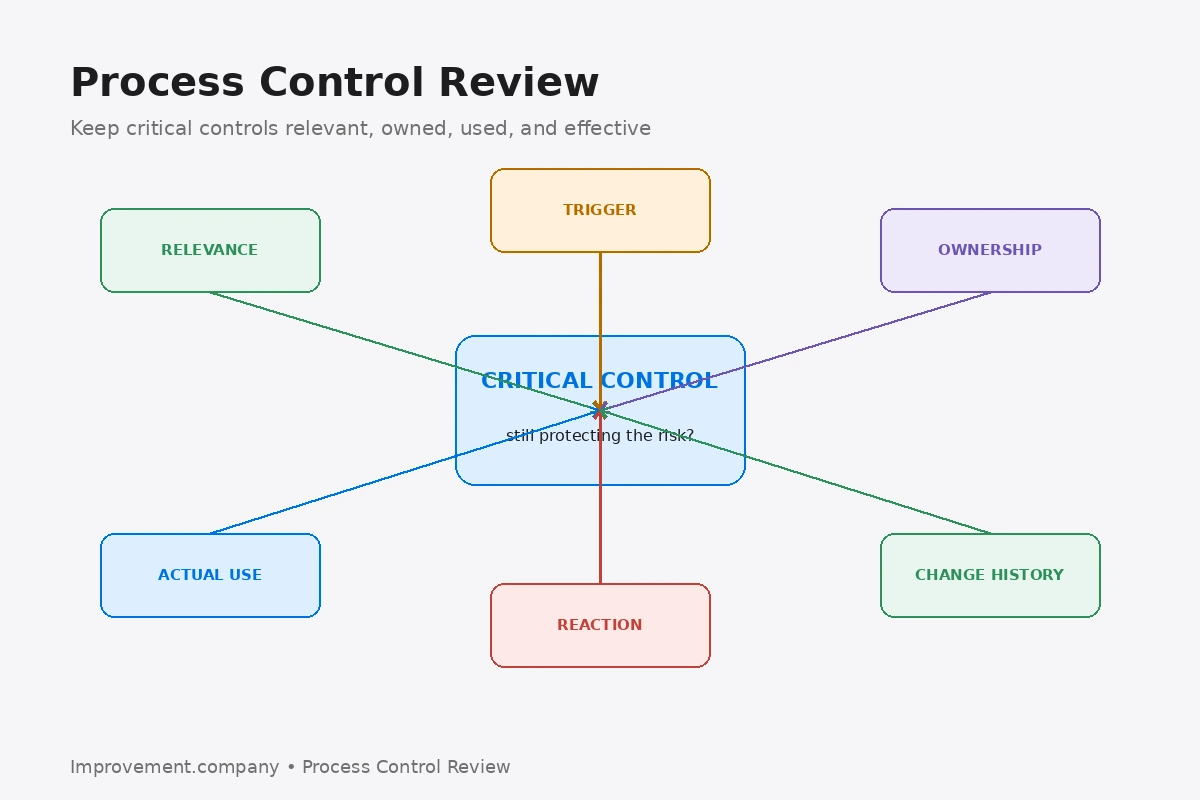
A Process Control Review is a periodic evaluation of the controls used to keep an important process within its intended condition.
The review asks whether the current controls are still:
- relevant;
- understood;
- used;
- effective.
The objective is not to create more controls.
The objective is to make sure existing controls still protect the risks they were designed to manage.
Start with critical controls
Examples include:
- parameter limits;
- inspection;
- automated interlock;
- approval gate;
- alarm;
- reaction plan.
Process Control Strategy helps connect critical process risks with prevention, detection, and response.
Focus the review on controls that matter to process performance or risk.
Confirm ownership
Process Control Ownership clarifies who monitors, reacts, changes, verifies, and maintains the control.
Ask whether current ownership still reflects:
- staffing;
- process responsibility;
- system changes.
A control with unclear ownership becomes unreliable even when the technical method is sound.
Review trigger quality
Ask whether the control activates at the right condition.
Possible problems include:
- threshold too sensitive;
- threshold too late;
- alarm ignored;
- repeated false signals.
Daily Management Trigger Rules provides useful thinking for linking thresholds, timing, owners, and reaction.
Review reaction effectiveness
When the control identifies an abnormality, does the defined reaction actually protect the process?
Daily Management Reaction Plan helps define containment, first response, escalation, and recovery.
A control that detects correctly but triggers weak action is only partially effective.
Review control use
Check whether people actually follow the control under normal operating pressure.
Process Confirmation helps verify the difference between documented process and actual practice.
Look for:
- skipped checks;
- informal workarounds;
- disabled alarms;
- delayed reactions.
Review change history
Material, product, equipment, software, or process changes may make an old control obsolete.
Management of Change provides stronger governance when process changes can alter risk or control requirements.
The control review should verify that important changes were reflected in the control system.
Remove controls that no longer add value
Controls can become obsolete or redundant.
Removing a control should be deliberate and risk-based.
Do not preserve unnecessary inspection simply because it has existed for years.
Common mistakes
Reviewing documents without observing actual use, adding controls after every problem without removing obsolete ones, leaving alarm thresholds unchanged after process changes, assigning no control owner, measuring control completion instead of control effectiveness, and keeping unnecessary controls because removal feels risky are common mistakes.
Practical sequence
- identify critical controls.
- confirm the risk each control protects.
- verify ownership.
- review trigger quality.
- review reaction effectiveness.
- observe actual use.
- review recent process changes.
- identify redundant or weak controls.
- update the control system.
- verify effectiveness after changes.
The practical lesson
A Process Control Review keeps controls connected to real process risk.
The best control system is not the one with the most checks; it is the one that detects meaningful abnormality and produces the right response.
Related application
This topic also connects with Process Control Exception Log. Use that method when the improvement requires the related operating or management discipline.