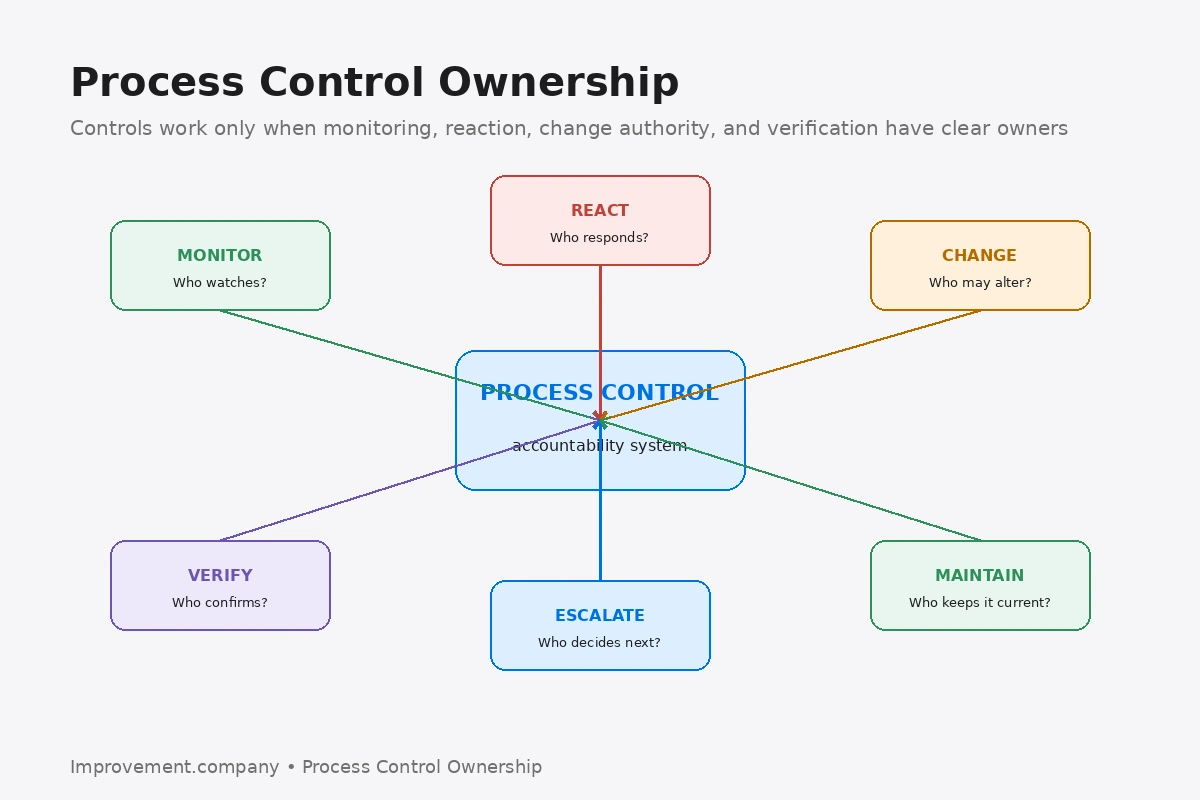
Process Control Ownership defines who is accountable for maintaining the controls that keep a process within its intended operating condition.
A process may have good control methods and still perform poorly when no one clearly owns monitoring, reaction, change approval, or follow-up.
Start with process ownership
Process Ownership defines accountability for end-to-end process performance.
Process control ownership is more specific. It clarifies who is responsible for the mechanisms that detect and respond to variation or abnormality.
Identify critical controls
Controls may include parameter limits, inspection, automated interlock, standard work, approval gate, alarm, or reaction plan.
Process Control Strategy helps connect important risks and process characteristics with prevention, detection, and response.
Not every routine check needs separate governance.
Assign monitoring responsibility
Define who reviews measurements, alarms, exceptions, control-chart signals, and missed checks.
The monitor may be an operator, technician, quality role, supervisor, or system.
Responsibility should match the required response time.
Assign reaction responsibility
Daily Management Reaction Plan helps define what should happen when a performance or process condition crosses a trigger.
The person who detects the abnormality should know the first action, containment, and escalation path.
Clarify authority to change controls
Changes to a limit, inspection, parameter, or interlock should not happen informally.
Process Governance helps establish decision rights and ownership for important process changes.
Higher-risk controls may require engineering, quality, or management approval.
Verify the control remains effective
Process Confirmation helps determine whether the defined process is actually being followed under real operating conditions.
Periodic review should ask whether the control is being used, whether it detects the intended condition, whether reactions are timely, and whether the control remains necessary.
Connect with formal control plans where used
Control Plan provides a structured method for documenting product and process characteristics, control methods, frequency, reaction plans, and responsibilities.
Ownership should be consistent with the documented plan.
Common mistakes
Assuming process ownership automatically defines every control owner, assigning monitoring without reaction authority, changing limits informally, maintaining controls that no longer address meaningful risk, creating reaction plans with no named owner, and auditing documents without checking actual control behavior are common mistakes.
Practical sequence
- identify critical process controls.
- assign monitoring ownership.
- define abnormal conditions.
- assign first-response ownership.
- define escalation authority.
- define who may change the control.
- document the reaction where required.
- confirm actual use at the process.
- review control effectiveness.
- update ownership when process responsibilities change.
The practical lesson
Process Control Ownership turns a control method into an accountable operating system.
A limit or reaction plan protects the process only when someone is clearly responsible for watching, responding, and maintaining it.
Related application
This topic also connects with Process Control Review. Use that method when the improvement requires the related operating or management discipline.