
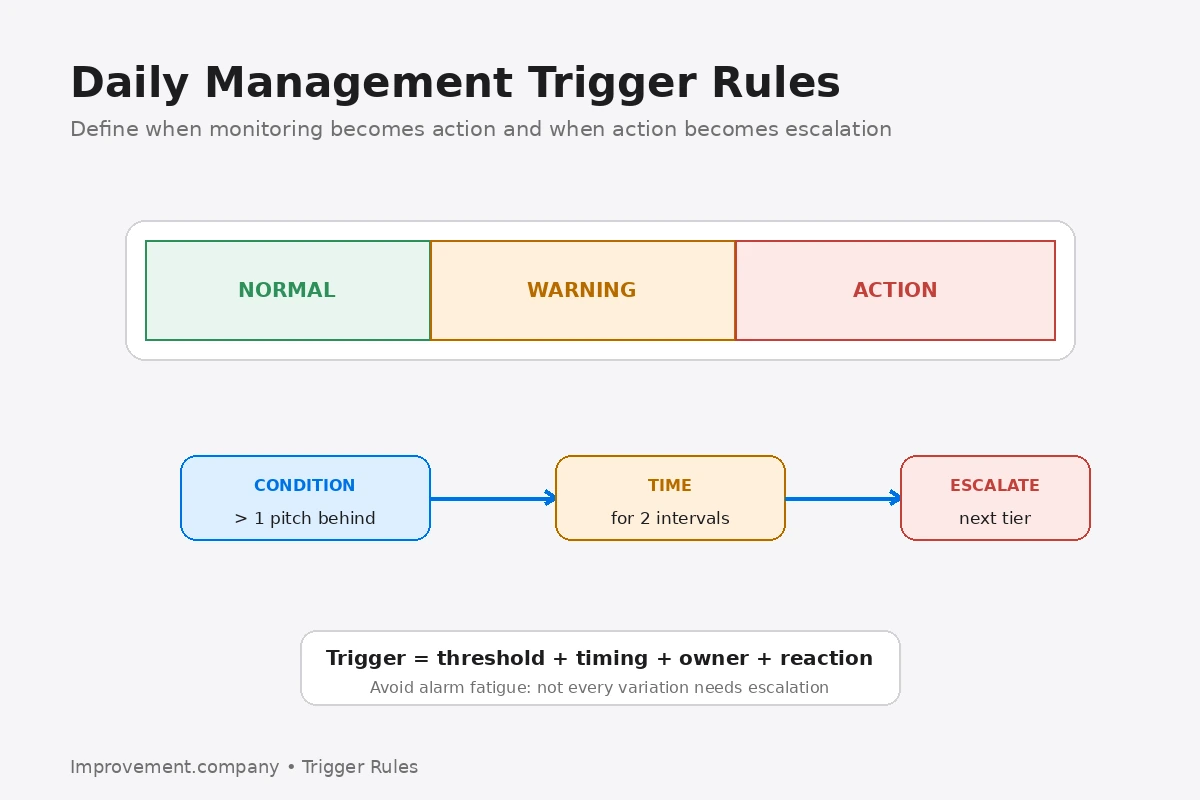
Daily Management Trigger Rules define the conditions that require action when process performance becomes abnormal.
A dashboard can show red, yellow, and green.
A trigger rule explains what those conditions mean operationally.
The objective is to prevent teams from watching abnormal performance without knowing when intervention is required.
Start with a defined normal condition
The trigger must be connected to an expected operating condition.
Examples include:
- output by hour;
- maximum queue;
- defect rate;
- temperature range;
- downtime duration.
Operational Definition helps ensure the measure and threshold are interpreted consistently.
A trigger is weak if the underlying metric is vague.
Distinguish warning from action
Not every variation requires the same response.
A practical rule may contain:
- normal range;
- warning threshold;
- action threshold;
- escalation threshold.
Management by Exception helps focus attention on meaningful deviation rather than treating every movement as equally important.
Use time as part of the rule
Some abnormalities depend on duration.
Examples:
- machine stopped more than 10 minutes;
- order at risk within four hours;
- action overdue more than seven days.
The trigger should specify both condition and timing where relevant.
Define the first response
Daily Management Reaction Plan converts a trigger into a standard immediate response.
For example:
If output is more than one pitch behind plan, identify the loss, assign recovery action, and escalate if the gap remains after the next interval.
This is more actionable than simply coloring the metric red.
Define ownership
The rule should identify who reacts first.
Possible owners include:
- operator;
- team leader;
- supervisor;
- maintenance;
- quality.
Ownership should sit as close to the process as practical.
Define escalation
Daily Management Escalation Ladder helps connect the trigger with higher support when the local team cannot restore the expected condition.
The escalation rule should state what level receives the problem and when.
Avoid over-triggering
Too many triggers can create alarm fatigue.
If every small deviation generates escalation, people begin ignoring the system.
Use risk, customer impact, and process behavior to set meaningful thresholds.
Review trigger performance
A trigger rule should be improved when it repeatedly produces:
- false alarms;
- late response;
- unclear ownership;
- unnecessary escalation.
The rule is part of the operating system and should evolve with process knowledge.
Common mistakes
Using colors without reaction rules, creating thresholds with no operational definition, triggering on normal noise, defining no owner, escalating every deviation, setting a rule once and never reviewing it, and allowing different shifts to interpret the same threshold differently are common mistakes.
Practical sequence
- define the normal condition.
- identify meaningful deviation.
- set warning and action thresholds.
- add timing where relevant.
- assign first-response ownership.
- define the immediate reaction.
- define escalation criteria.
- test the rule in actual operation.
- adjust false or late triggers.
- document the rule in daily management.
The practical lesson
Daily Management Trigger Rules turn visual performance into action.
A metric is only useful when people know exactly what condition requires a response.