
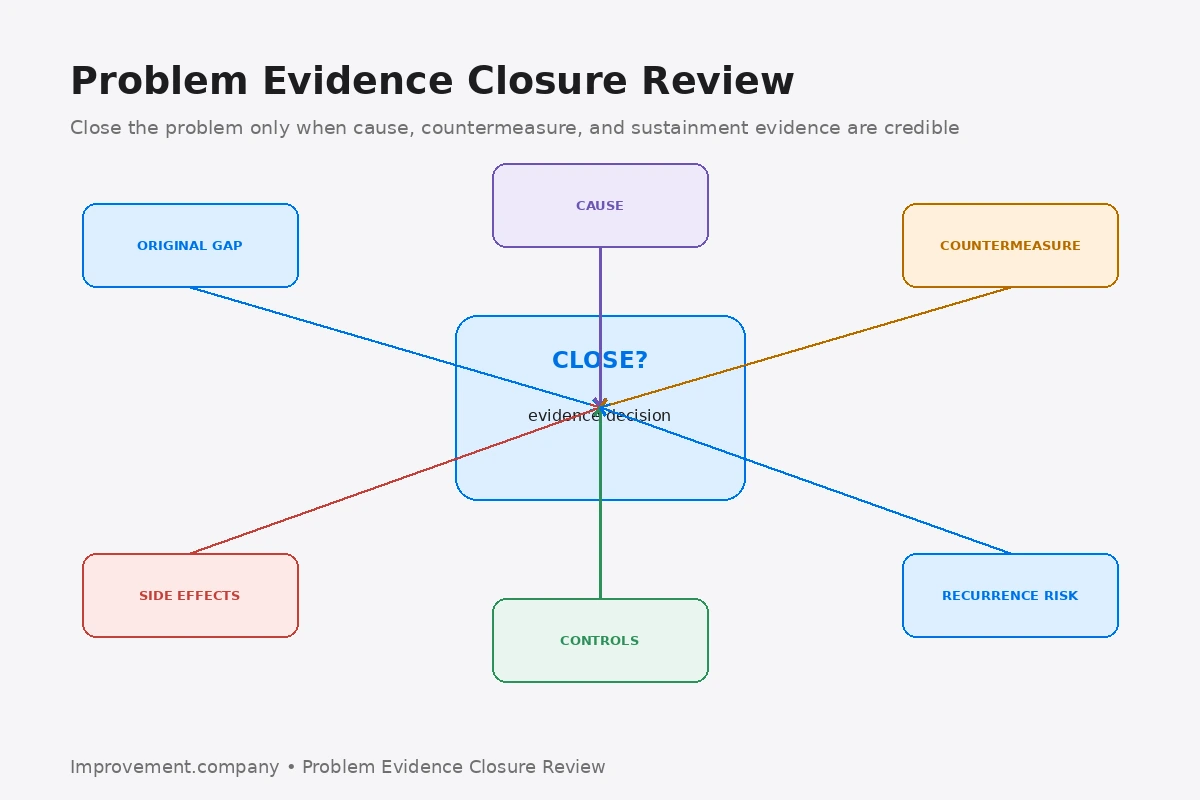
A Problem Evidence Closure Review is the final evidence check before a problem is declared closed.
The purpose is not to demand perfect certainty.
The purpose is to ensure the organization has enough evidence to believe the problem is understood, controlled, and unlikely to recur for the same reason.
Review the original problem
Start with the condition that triggered the work.
Problem Statement helps define the gap using a clear, observable condition.
Compare closure evidence with the original problem, not with a rewritten version that became easier to solve.
Review causal evidence
Cause Verification helps test whether suspected causes actually influence the problem.
Ask:
- Was the root cause demonstrated?
- Were competing explanations considered?
- Was the evidence strong enough for the risk?
Root Cause Evidence Standard helps scale proof requirements to consequence and decision risk.
Review countermeasure effect
Countermeasure Verification Plan helps define what evidence will show whether the countermeasure worked.
Closure should show:
- expected measure changed;
- enough time or cycles were observed;
- effect was not only temporary containment.
Review side effects
Countermeasure Side-Effect Review helps check whether the fix created new safety, quality, flow, cost, workload, maintenance, or customer risks.
A countermeasure should not be considered successful if it simply moved the problem.
Review control changes
Ask what prevents recurrence.
Examples include:
- standard work updated;
- control plan changed;
- visual control added;
- maintenance task revised;
- training completed.
Standardization After Improvement helps convert a successful change into normal operating practice.
Review ownership
The process owner should understand:
- new controls;
- required monitoring;
- escalation triggers;
- remaining risk.
Problem closure should transfer responsibility back into normal management.
Review recurrence risk
If observation time is limited, state the residual risk and required follow-up.
Do not close a problem by ignoring the fact that recurrence has not yet been tested under representative conditions.
Common mistakes
Closing when actions are complete, accepting plausible root causes without verification, using short-term containment as proof of effectiveness, ignoring side effects, updating no controls, leaving sustainment owner unclear, and declaring zero recurrence after too little observation are common mistakes.
Practical sequence
- restate the original problem.
- review causal evidence.
- review countermeasure evidence.
- review side effects.
- verify control changes.
- confirm training or communication.
- confirm process ownership.
- assess residual recurrence risk.
- define any follow-up.
- close only when the evidence supports closure.
The practical lesson
A Problem Evidence Closure Review makes closure an evidence decision.
A problem is closed because the causal mechanism, countermeasure effect, and sustainment controls are credible, not because the action list is empty.