
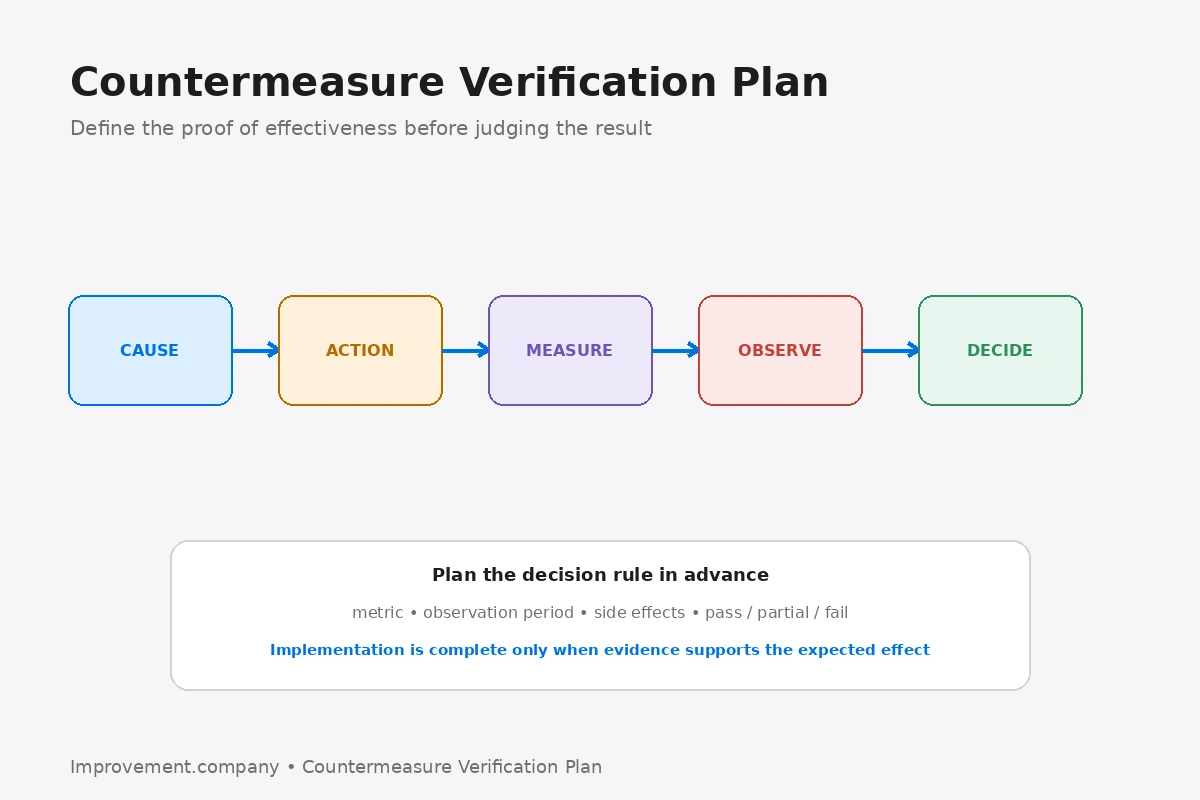
A Countermeasure Verification Plan defines how the team will determine whether an implemented action actually controls the verified cause and improves the problem condition.
The plan should be created before the team declares success.
Its purpose is to answer:
What evidence will convince us that the countermeasure worked?
Start with the verified cause
The countermeasure should address a cause that has evidence behind it.
Cause Verification helps confirm that changing a suspected cause changes the problem.
If the cause is still uncertain, the team may be verifying the wrong action.
Define the expected effect
State what should improve if the countermeasure works.
Examples include:
- defect rate decreases;
- failure stops recurring;
- cycle time returns to target;
- queue disappears.
Countermeasure Management helps connect cause, action, owner, and follow-up.
Verification should test the expected cause-and-effect relationship.
Select the verification measure
The measure should be close to the problem.
Possible measures include:
- defect count;
- downtime minutes;
- process parameter;
- repeat occurrence;
- first-pass yield.
Avoid using a distant financial measure as the only technical verification.
Define the observation period
One good shift may not be enough.
Choose a period that reflects:
- problem frequency;
- operating cycle;
- product mix;
- risk.
A low-frequency failure may require a longer observation window than a high-frequency defect.
Define the decision rule
Before reviewing the result, define what outcome means:
- effective;
- partially effective;
- ineffective.
This prevents the team from changing success criteria after seeing the data.
Improvement Effectiveness Review helps distinguish implemented, effective, and sustained changes.
Check for side effects
A countermeasure may solve one problem while creating another.
Review effects on:
- safety;
- quality;
- cycle time;
- ergonomics;
- downstream process.
The verification plan should identify critical side effects before implementation.
Verify the new method is actually used
If the countermeasure depends on changed work, confirm adoption.
Process Confirmation helps verify whether the defined process is being followed under real operating conditions.
An unused countermeasure cannot be judged technically effective.
Decide the next step
Possible outcomes include:
- standardize the countermeasure;
- adjust it;
- reject it;
- return to cause analysis.
Do not protect an ineffective action because significant effort was spent implementing it.
Common mistakes
Verifying only task completion, defining no observation period, changing success criteria after implementation, measuring a result too far from the problem, ignoring side effects, failing to verify actual use, and keeping an ineffective countermeasure because it was expensive are common mistakes.
Practical sequence
- confirm the verified cause.
- define the expected effect.
- select the measure.
- define the observation period.
- define the decision rule.
- identify side effects to watch.
- verify implementation.
- collect the result.
- decide effective, partial, or ineffective.
- standardize or revise based on evidence.
The practical lesson
A Countermeasure Verification Plan separates implementation from proof.
A fix is not successful because it was installed; it is successful when evidence shows the problem condition changed as expected.