
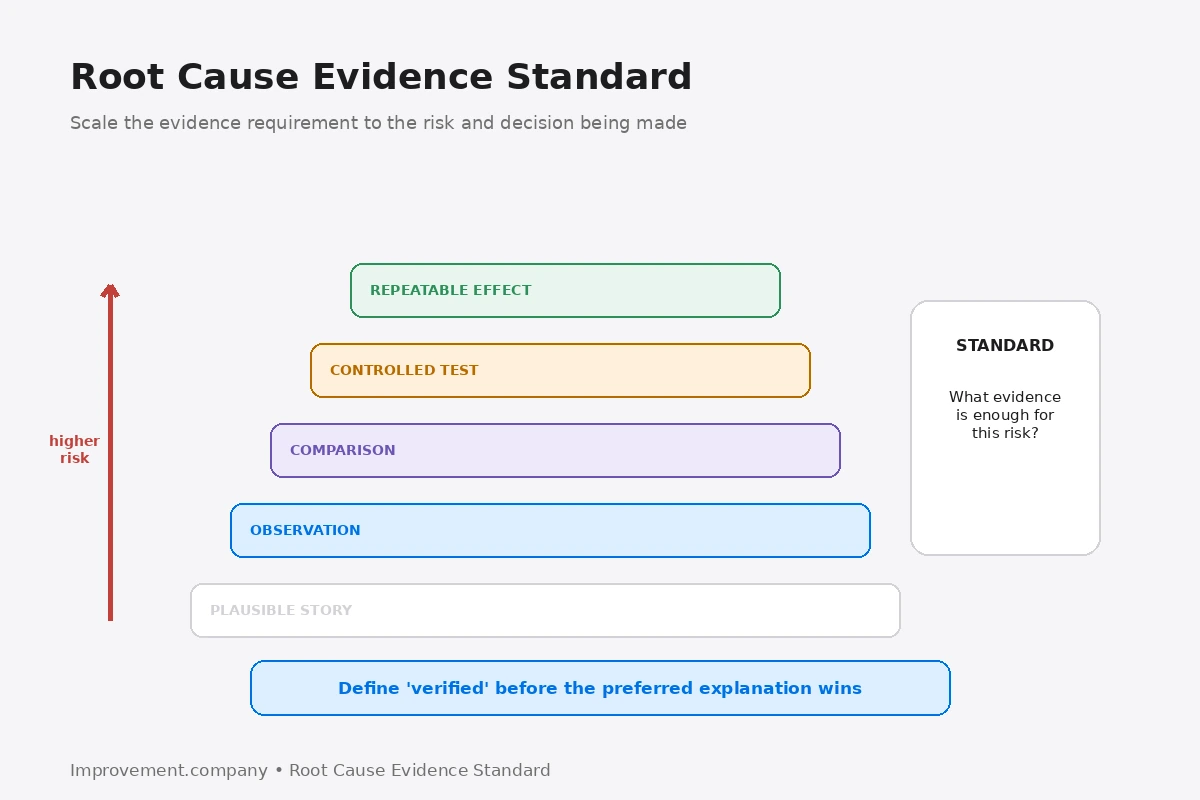
A Root Cause Evidence Standard defines what level of evidence is considered sufficient before a team treats a suspected cause as confirmed.
The purpose is not to demand laboratory proof for every problem. It is to avoid declaring root cause based only on opinion, correlation, experience, or a plausible story.
Match evidence strength to risk
A simple low-risk issue may need modest evidence. A high-risk or recurring failure may require stronger measurement, controlled testing, repeatability, or independent review.
Risk-Based Thinking helps match effort and control intensity with consequence and likelihood. The evidence standard should scale with the decision being made.
Start with direct observation
The strongest starting point is often the real process. Genchi Genbutsu emphasizes learning from the actual place and actual condition.
Look for evidence that connects the suspected cause with the problem under real operating conditions.
Use comparison
Compare good versus bad, before versus after, affected versus unaffected, or one machine versus another.
Is / Is Not Analysis helps identify meaningful contrasts that sharpen causal reasoning. A cause should help explain the difference between problem and non-problem conditions.
Test when practical
Cause Verification helps determine whether changing the suspected cause changes the problem.
Useful tests may remove the cause, change a parameter, compare controlled settings, or reproduce the condition safely. Do not perform unsafe experiments simply to strengthen evidence.
Look for repeatability
One successful trial may not be enough. Ask whether the relationship holds across several cycles, relevant product mix, and normal operating variation.
The observation period should reflect the frequency of the problem.
Record contradictory evidence
A good standard requires teams to document facts that weaken the explanation. Problem Hypothesis Review helps compare suspected causes using supporting and contradictory evidence before choosing the next test.
Contradictions may show that the hypothesis is incomplete.
Define the acceptance rule
Before finalizing the cause, decide what evidence is sufficient. Examples include a defect disappearing when the parameter is corrected across repeated cycles or a repeatable test reproducing the failure.
This prevents standards from changing after the result is known.
Common mistakes
Treating experience as proof, demanding the same evidence for every risk level, accepting correlation as causation, ignoring contradictory data, using one successful trial as final proof, and refusing reasonable evidence because perfect certainty is impossible are common mistakes.
Practical sequence
- assess problem risk.
- define the evidence expectation.
- observe the real condition.
- compare problem and non-problem cases.
- review contradictions.
- test the suspected cause when practical.
- repeat enough to judge consistency.
- record the evidence.
- decide whether the standard is met.
The practical lesson
A Root Cause Evidence Standard makes causal decisions more consistent. The team should know what verified means before it becomes attached to a preferred explanation.