
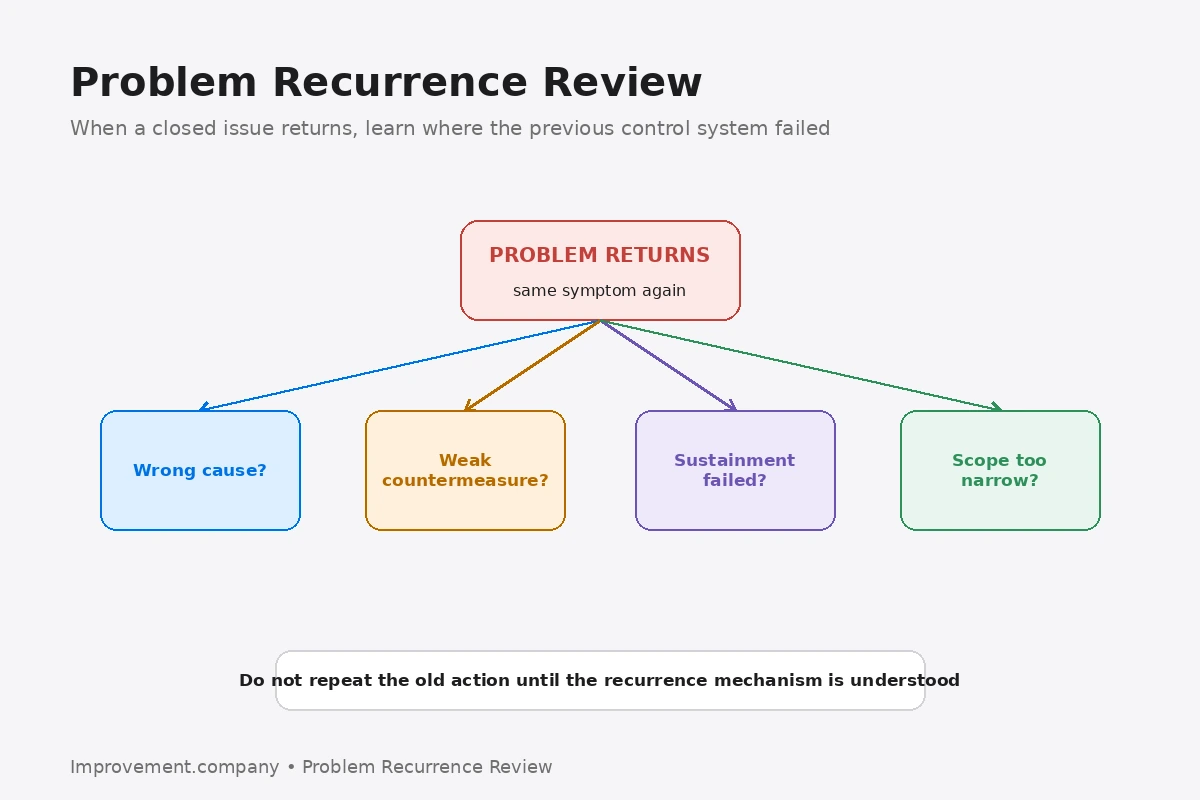
A Problem Recurrence Review is a structured examination performed when an issue returns after the organization believed it had been controlled.
Recurrence is important evidence. It may indicate that the wrong cause was selected, the countermeasure did not control the cause, the standard was not sustained, or the problem was broader than originally defined.
The objective is not to blame the previous team. The objective is to learn why the control system failed.
Confirm it is truly the same problem
Before calling the event a recurrence, compare symptom, location, timing, product, and failure mechanism.
Is-Is Not Analysis can help determine whether the new event matches the original pattern.
A similar symptom can come from a different cause.
Review the original problem definition
Ask whether the original scope was too narrow.
Problem Statement helps clarify the expected condition, actual condition, scope, timing, and impact.
If the original investigation covered only one machine while the same mechanism existed across several, recurrence may reveal incomplete scope.
Review the cause evidence
Examine what evidence supported the original root cause.
Cause Verification emphasizes testing whether a suspected cause actually changes the problem.
If the original cause was accepted mainly through agreement or plausibility, recurrence may indicate weak verification.
Review the countermeasure
Ask whether the action controlled the verified cause, whether it was temporary or permanent, and whether the control was technically capable.
Countermeasure Management helps connect verified causes with actions, owners, and follow-up.
A good root cause with a weak countermeasure can still produce recurrence.
Review sustainment
The technical fix may have worked initially and later degraded.
Check whether the standard was updated, training completed, inspection active, ownership clear, and the control still used.
Improvement Sustainment Plan helps define how improved conditions are maintained after implementation.
Check effectiveness evidence
Improvement Effectiveness Review helps distinguish installed, effective, and sustained changes.
A problem may have been closed too early because only task completion was verified.
Decide the next path
Possible decisions include reopening the original investigation, expanding the scope, testing a new cause, strengthening the control, or improving sustainment.
Do not automatically repeat the previous action.
Common mistakes
Assuming every similar symptom is the same problem, blaming operators immediately, repeating the old countermeasure, ignoring weak original cause evidence, closing again after task completion, and failing to update standards after new learning are common mistakes.
Practical sequence
- confirm whether the issue truly recurred.
- compare the new and original conditions.
- review the original problem scope.
- review cause-verification evidence.
- review the countermeasure logic.
- review sustainment controls.
- identify where the previous control system failed.
- define the next investigation step.
- update the standard and learning.
- verify that recurrence is actually prevented.
The practical lesson
Problem recurrence is not just another failure.
It is evidence about the quality of the previous problem-solving and sustainment system.