
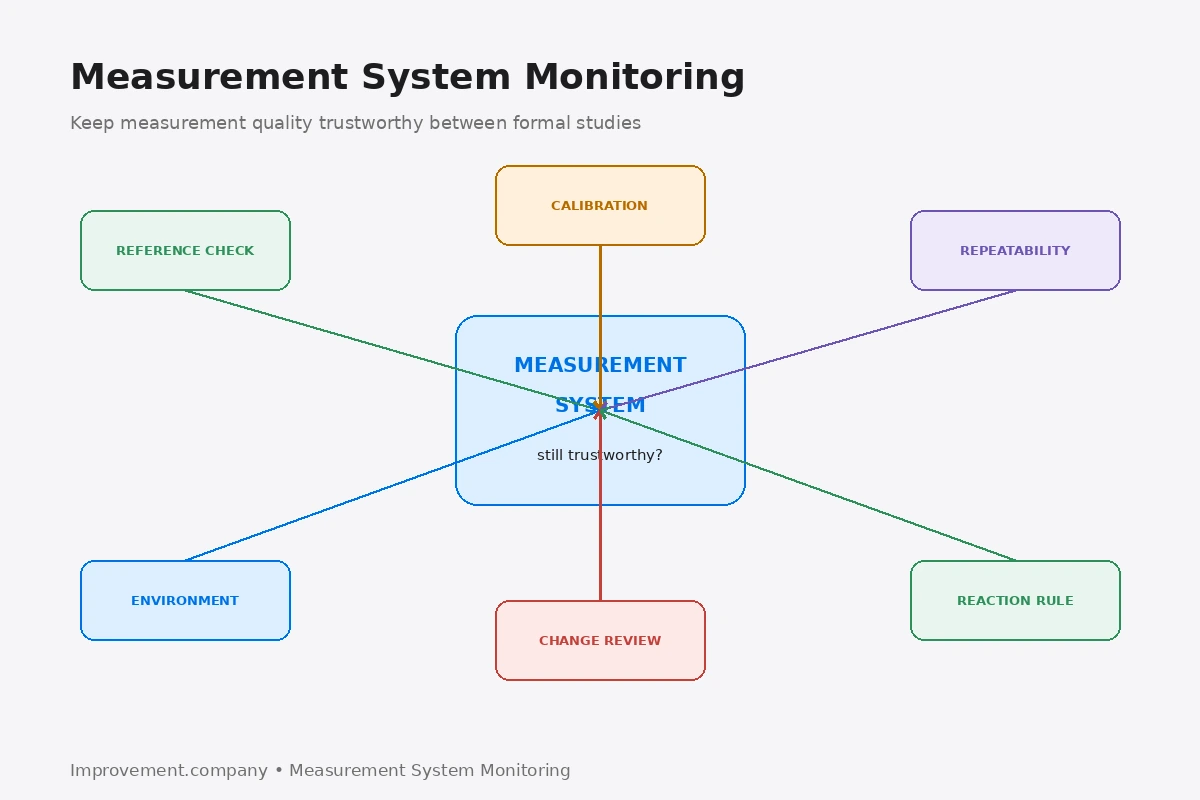
Measurement System Monitoring is the ongoing control of measurement performance after the system has been approved for use.
A measurement system can deteriorate over time because of wear, contamination, damage, environment, operator method, software changes, or setup changes. The purpose is to detect loss of measurement quality before bad data drives bad decisions.
Start with the critical measurement
Not every measurement needs the same monitoring intensity. Focus on characteristics that influence product acceptance, process adjustment, capability decisions, safety, or compliance.
Measurement System Analysis helps evaluate whether the measurement process is adequate for the intended use. Monitoring keeps that adequacy from silently degrading.
Use reference checks
A known reference can help detect bias shift, instability, or sudden measurement change.
The reference should be appropriate for the instrument and characteristic. Do not treat a reference check as a substitute for required calibration.
Monitor calibration status
Calibration confirms traceability and performance against defined requirements. Monitoring should verify that calibration is current, overdue equipment is controlled, and out-of-tolerance findings trigger review.
A calibration sticker alone does not prove the measurement process is stable between calibration events.
Watch repeatability signals
Repeated measurements of a stable reference can expose increasing variation.
Gage R&R helps quantify repeatability and reproducibility when a fuller study is required. Trend changes may justify investigation before the next scheduled study.
Control environmental influences
Measurement can shift with temperature, humidity, vibration, cleanliness, or fixture condition.
Operational Definition helps standardize what is measured and how the result is obtained. The monitoring plan should include environmental conditions that materially affect the result.
Define reaction rules
If a monitoring check fails, define what happens next. Possible actions include stopping use, quarantining product decisions, verifying with a reference system, or investigating affected results.
Control of Nonconforming Output helps manage product or process decisions when measurement integrity is uncertain.
Review changes
Reassess the measurement system after a new operator method, fixture replacement, software change, new tolerance, or new product family.
Do not assume the original MSA remains valid after significant change.
Common mistakes
Relying only on annual calibration, monitoring low-risk measurements while ignoring critical ones, using no reference checks, ignoring repeatability trends, failing to control environmental effects, continuing to use suspect equipment after a failed check, and assuming old MSA results remain valid after major changes are common mistakes.
Practical sequence
- identify critical measurements.
- confirm the intended use.
- define reference checks.
- monitor calibration status.
- monitor repeatability signals.
- control important environmental factors.
- define reaction rules.
- investigate failed checks.
- reassess after significant change.
- update the monitoring plan from evidence.
The practical lesson
Measurement System Monitoring protects the quality of the data used to control the process. A measurement system should remain trustworthy between formal studies, not only on the day it was approved.
Related application
This topic also connects with Measurement System Change Control. Use that method when the improvement requires the related operating or management discipline.