
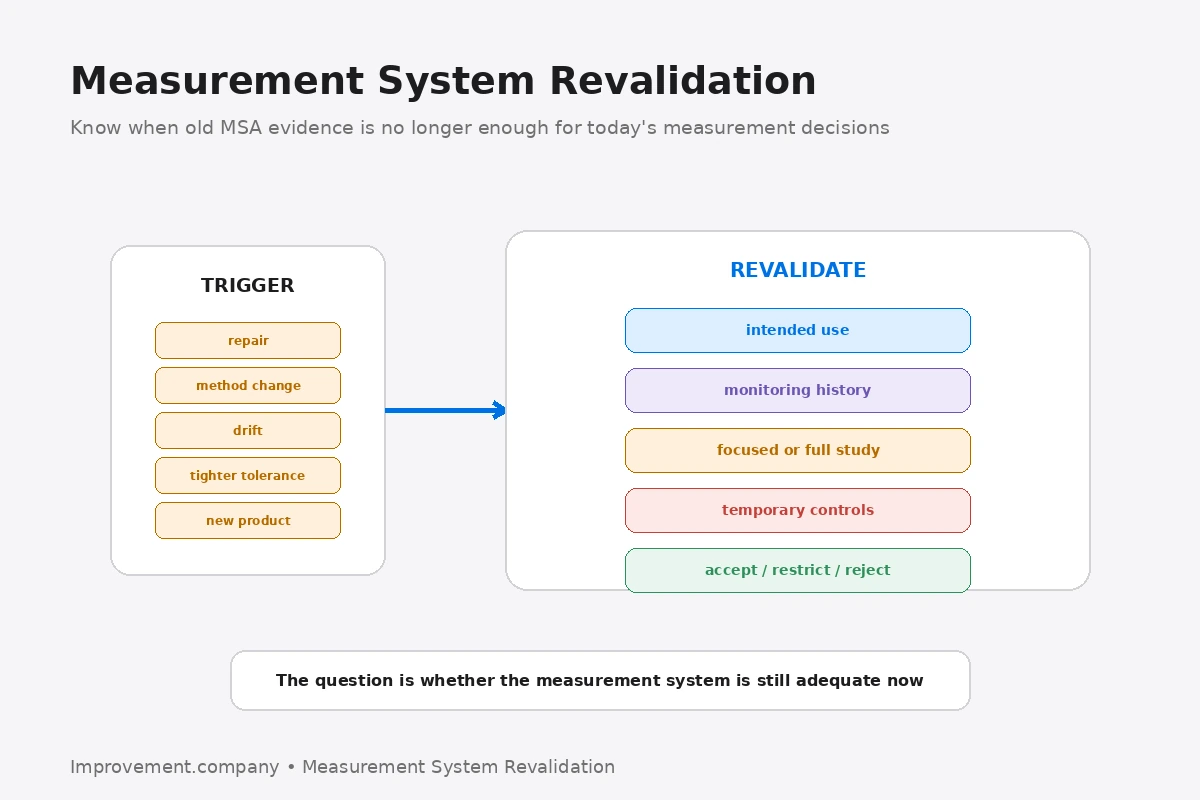
Measurement System Revalidation determines when previous evidence of measurement adequacy is no longer sufficient for current use.
A measurement system may have passed an earlier study.
That does not guarantee it remains adequate after meaningful change.
Identify revalidation triggers
Typical triggers include:
- gage repair;
- fixture redesign;
- software change;
- new operator method;
- tighter tolerance;
- new product family;
- repeated measurement disagreement.
Measurement System Change Control helps evaluate changes that can affect gages, fixtures, methods, software, operators, environment, or specifications.
Review monitoring signals
Measurement System Monitoring helps detect drift through reference checks, calibration status, repeatability signals, environmental controls, and reaction rules.
Revalidation may be justified when monitoring shows:
- bias shift;
- increasing variation;
- repeated failed checks.
Match the study to the change
Not every trigger requires a full Gage R&R.
Possible evidence includes:
- reference study;
- bias check;
- linearity check;
- repeatability test;
- focused Gage R&R;
- full MSA.
Measurement System Analysis provides the broader framework for evaluating measurement adequacy for intended use.
Revisit intended use
A system acceptable for process monitoring may not be adequate for:
- tight product acceptance;
- capability analysis;
- regulatory decision.
Operational Definition helps define exactly what is measured and how the result is obtained.
Revalidation should reflect the decision the data now supports.
Consider tolerance changes
A measurement system that was acceptable for a wide tolerance may become inadequate after the specification narrows.
Resolution and measurement variation should be reconsidered.
Control use during revalidation
If measurement integrity is uncertain, define temporary controls such as:
- alternate gage;
- additional verification;
- restricted use;
- product review.
Do not continue making high-consequence decisions with suspect measurement data simply because a study is scheduled.
Close with an explicit decision
Record whether the system is:
- accepted;
- accepted with restriction;
- requires correction;
- rejected for the intended use.
Common mistakes
Assuming old MSA remains valid forever, repeating full studies when a focused check is sufficient, ignoring tolerance change, responding to monitoring failures with calibration alone, using suspect data during revalidation without temporary controls, and approving the system without reconnecting the study to intended use are common mistakes.
Practical sequence
- identify the revalidation trigger.
- review intended measurement use.
- review monitoring history.
- assess what changed.
- select the appropriate study.
- control measurement use during uncertainty.
- perform the study.
- review the evidence.
- make an explicit acceptance decision.
- update monitoring and documentation.
The practical lesson
Measurement System Revalidation keeps MSA evidence current.
The question is not whether the measurement system passed once, but whether it is still adequate for the decisions being made now.