
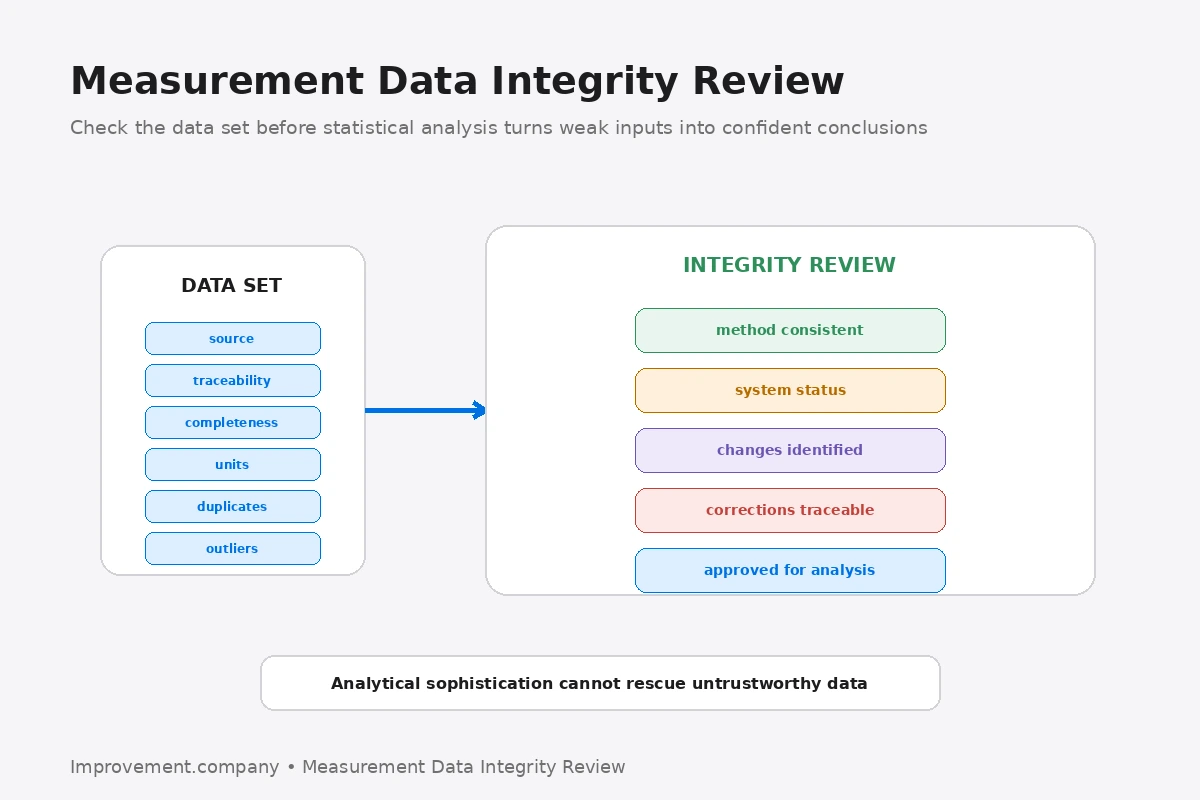
A Measurement Data Integrity Review checks whether collected measurement data can be trusted before it is used for analysis or decision making.
The purpose is not to repeat the entire Measurement System Analysis.
The purpose is to verify that the data set itself has not been compromised by collection, handling, transcription, or system changes.
Confirm data source
Identify where the data came from.
Examples include:
- gage export;
- inspection record;
- machine historian;
- manual check sheet;
- laboratory system.
Data Collection Plan helps define what data will be collected, how, by whom, and at what frequency.
The review should confirm the actual data matches the planned source.
Check traceability
Where needed, data should connect to:
- part or lot;
- time;
- equipment;
- operator;
- method;
- product family.
Missing traceability can make patterns impossible to interpret.
Check completeness
Look for:
- missing records;
- blank fields;
- skipped intervals;
- duplicate rows;
- unexplained gaps.
Do not silently remove missing data without understanding why it is absent.
Check units and definitions
Operational Definition helps standardize what is measured and how results are interpreted.
Confirm:
- units are consistent;
- decimal conventions are correct;
- coding rules did not change;
- categories mean the same thing throughout the data set.
Review abnormal values
Extreme values may represent:
- real process events;
- entry errors;
- wrong units;
- sensor failure.
Do not delete outliers automatically.
First determine whether the value is valid and relevant.
Review measurement-system status
Measurement System Monitoring helps detect drift through reference checks, calibration status, repeatability signals, environmental controls, and reaction rules.
If the measurement system was unstable during data collection, otherwise clean data may still be unreliable.
Review system changes
Measurement System Change Control helps evaluate changes to gages, software, fixtures, methods, operators, environment, or specifications.
A data set that crosses a method change may require separation or comparison.
Document corrections
If data errors are corrected, preserve:
- original value;
- corrected value;
- reason;
- approver where needed.
Avoid invisible data cleaning.
Common mistakes
Assuming exported data is automatically correct, ignoring missing values, mixing units, deleting outliers without investigation, combining data across method changes, overlooking duplicate records, and correcting values without preserving traceability are common mistakes.
Practical sequence
- confirm the intended data source.
- check traceability fields.
- check completeness.
- check duplicates.
- verify units and definitions.
- investigate abnormal values.
- review measurement-system status.
- identify method or system changes.
- document corrections.
- approve the data set for analysis.
The practical lesson
A Measurement Data Integrity Review protects decisions before statistics begin.
Analytical sophistication cannot rescue a data set whose source, meaning, or handling cannot be trusted.