
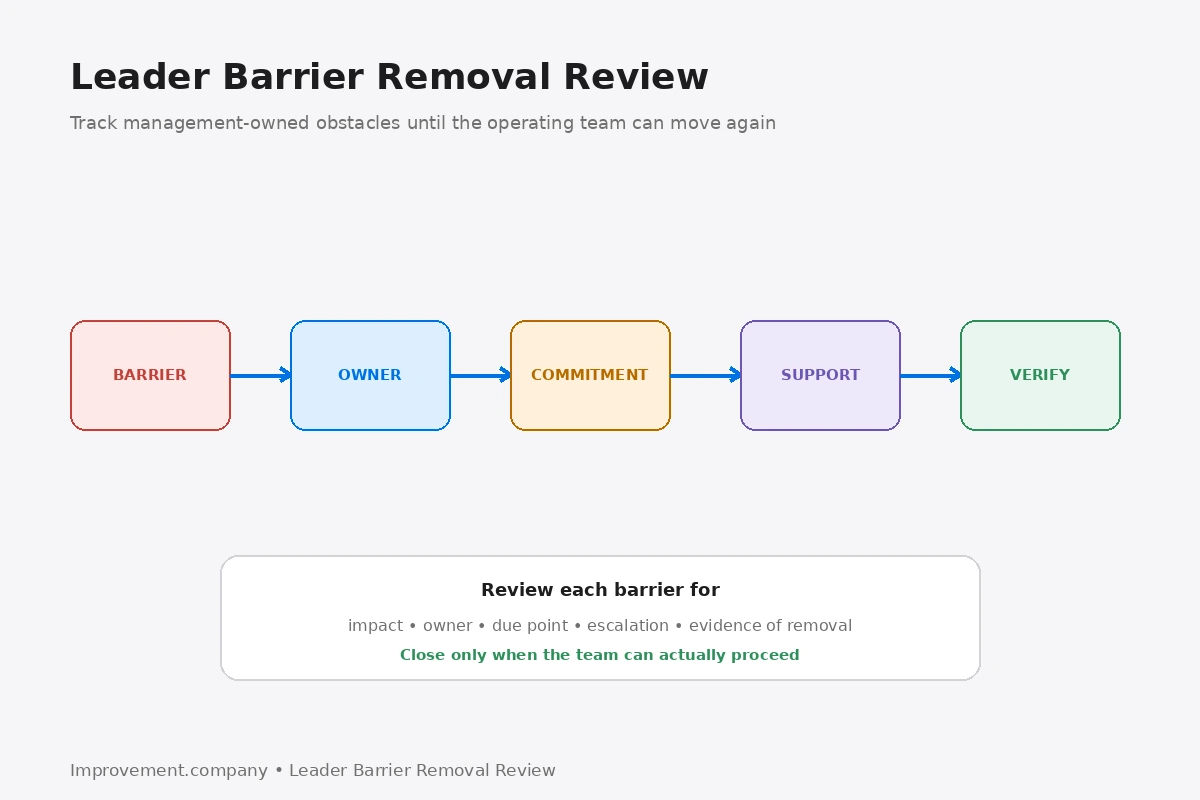
A Leader Barrier Removal Review is a short management routine for checking obstacles that operating teams cannot remove within their own authority or resources.
Examples include approval delays, cross-functional conflicts, missing specialist support, capital decisions, or policy constraints. The purpose is not to pull every team problem upward. It is to make management-owned barriers visible until the required decision or support is delivered.
Start with a valid barrier
The item should represent something the team cannot reasonably resolve locally. Leader Response to Escalation helps leaders distinguish between support they should provide and problem ownership that should remain with the team.
Ask what is blocked, why the team cannot remove it, and what support is required. A problem that can be solved locally should stay with the local team.
Assign one leader owner
Each barrier should have one accountable leader owner. Leader Follow-Up Discipline helps turn commitments into dependable action through ownership, timing, evidence, and closure.
Avoid vague ownership such as management, leadership team, or engineering. The person accepting the barrier should understand exactly what must be provided.
Define the next commitment
A useful commitment states the action, due point, and expected result. Examples include approving tooling by 14:00, resolving a priority conflict before tier three, or securing engineering support for tomorrow’s trial.
The review should not accept working on it as a sufficient update.
Review age and risk
Some barriers become more damaging as they wait. Action Aging Review helps expose work that remains open because ownership, priority, resources, or closure criteria are weak.
Combine age with current risk rather than treating the oldest item automatically as the most important.
Escalate leadership blockers
The assigned leader may also be blocked by senior approval, budget authority, or external supplier decisions. Escalation Management helps structure the condition, impact, actions taken, support required, and timing.
Leadership-owned barriers should escalate rather than disappear.
Verify the barrier was removed
A decision is not enough if the team still cannot proceed. Confirm whether the support restored flow, reduced risk, or enabled the next action.
Close the barrier only when the operating effect is visible.
Common mistakes
Escalating problems the team can solve locally, assigning barriers to groups instead of people, repeatedly changing dates without escalation, accepting activity updates instead of results, closing barriers when a decision is made but the constraint remains, and using the review as a substitute for normal leadership work are common mistakes.
Practical sequence
- confirm the item is truly a leadership barrier.
- state the operating impact.
- assign one leader owner.
- define the next commitment.
- review current risk and age.
- escalate leadership blockers.
- deliver the support or decision.
- verify the operating barrier is removed.
- close with evidence.
The practical lesson
A Leader Barrier Removal Review makes management support accountable. Teams should be able to see whether the organization is actually removing the obstacles it asks them to escalate.