
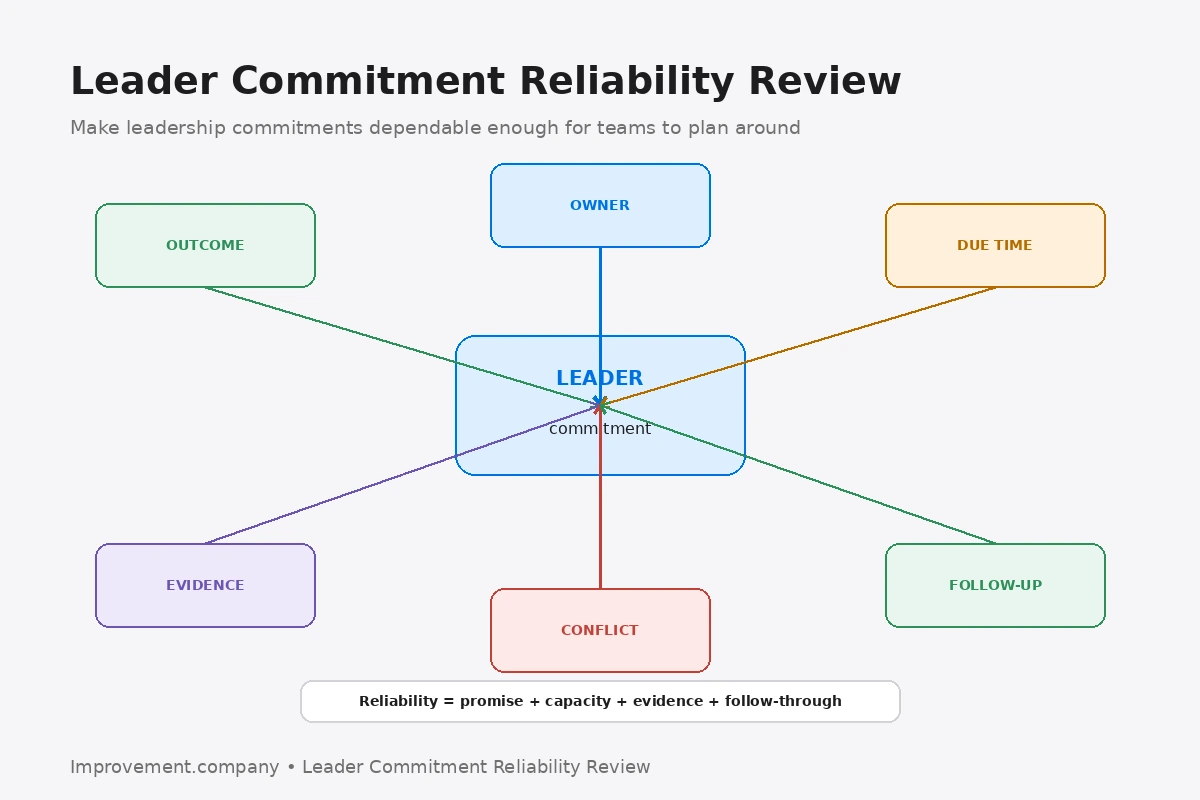
A Leader Commitment Reliability Review checks whether leaders consistently deliver the commitments they make to teams, peers, and the operating system.
The purpose is not to create a scorecard of personalities.
The purpose is to make leadership promises dependable enough that teams can plan around them.
Identify meaningful commitments
Focus on commitments that affect:
- resource availability;
- barrier removal;
- decisions;
- approvals;
- escalation support;
- cross-functional coordination.
Leader Follow-Up Discipline helps make commitments reliable through ownership, timing, evidence, escalation, and closure.
Make the promise specific
A useful commitment answers:
- what will be done;
- who will do it;
- by when;
- what evidence will show completion.
Statements such as “I will support the team” are too broad to verify.
Review due timing
Leadership commitments should be reviewed at the cadence required by the work.
For urgent operating issues, Escalation Response Time helps distinguish fast acknowledgement from useful support.
A commitment delivered after the decision window closes may be technically complete but operationally ineffective.
Review completion evidence
Examples include:
- decision issued;
- resource reassigned;
- barrier removed;
- approval completed;
- supplier contacted.
Do not close the commitment merely because the leader attended a meeting or sent a message.
Review repeated misses
Repeated missed commitments may indicate:
- overload;
- unclear priority;
- insufficient authority;
- weak delegation;
- too many simultaneous initiatives.
Leader Standard Work helps create repeatable routines for important management responsibilities.
The review should improve the leader’s operating system, not simply generate reminders.
Escalate conflicts early
A leader may have competing commitments that cannot all be met.
Daily Priority Conflict Review helps make tradeoffs explicit when resources or decisions compete.
Changing a commitment is better than silently missing it, provided the affected people are informed.
Protect trust
Leadership reliability affects whether employees believe escalation and improvement systems are worth using.
When leaders repeatedly promise support without delivering it, teams adapt by working around leadership instead of using the intended management system.
Common mistakes
Tracking trivial promises, using vague wording, setting no due point, closing commitments on activity, hiding overload until the due date passes, treating repeated misses as personal failure instead of a system signal, and making commitments without checking capacity are common mistakes.
Practical sequence
- identify meaningful leader commitments.
- define the promised outcome.
- assign one accountable leader.
- set due timing.
- record required evidence.
- review progress at the right cadence.
- expose conflicts early.
- replan or escalate when necessary.
- verify completion.
- review patterns in missed commitments.
The practical lesson
A Leader Commitment Reliability Review turns leadership promises into dependable operating inputs.
Teams should be able to trust that a management commitment means something specific will happen by an agreed point.