
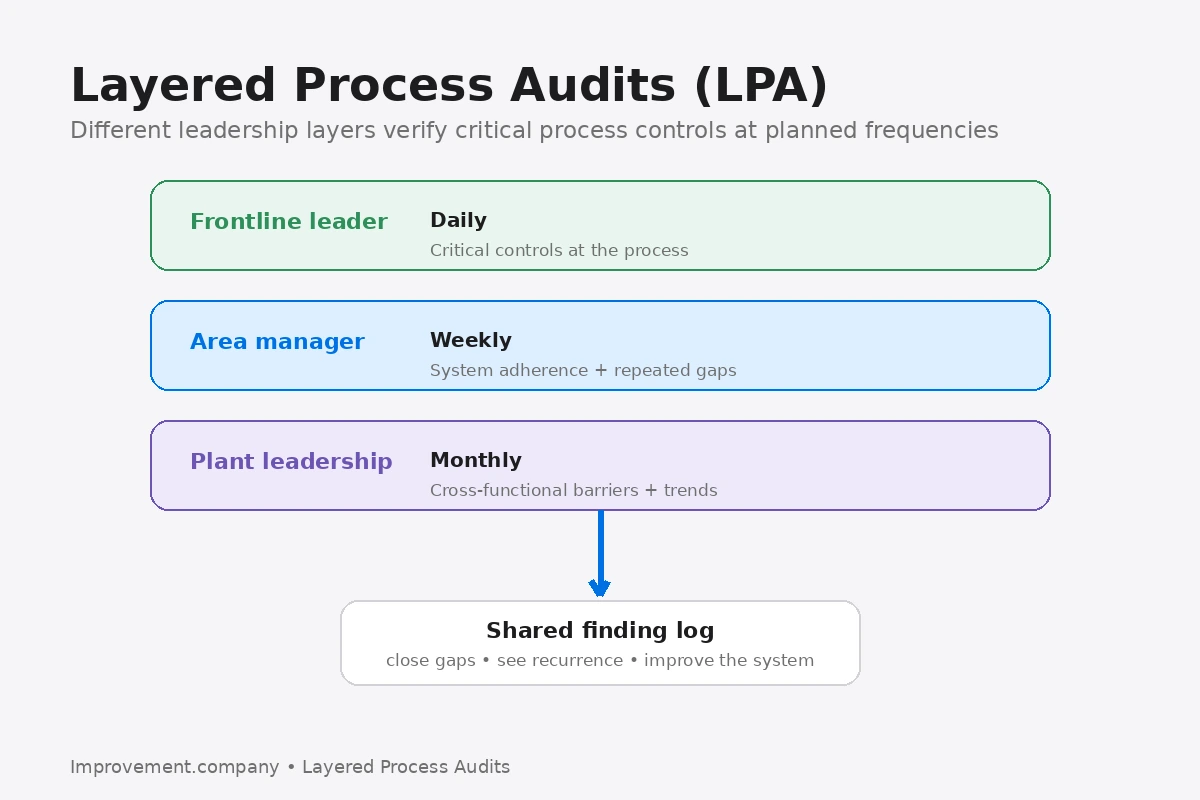
Layered Process Audits, often called LPAs, are short, focused checks performed by different levels of the organization to verify that critical process controls are being followed.
The purpose is not to inspect every detail of the operation. The purpose is to confirm that the few process conditions most important to safety, quality, delivery, or risk are actually in place.
Why “layered”?
The word layered refers to multiple levels of leadership participating in the audit process.
For example, team leaders, supervisors, managers, and plant leaders may each audit at a different frequency.
This creates repeated attention to the same critical controls and reinforces leadership ownership of the process.
LPAs are not product inspection
A Layered Process Audit asks whether the process conditions required for good output are present.
Examples include correct fixture use, correct torque program, inspection frequency, material identification, reaction-plan understanding, and availability of the current standard.
Product inspection checks the output. LPAs check the system that should produce the output correctly.
Start with risk
An LPA should not become a long checklist of everything that could possibly be checked.
Select questions from meaningful risk. Useful sources include FMEA, customer complaints, internal defects, audit findings, safety risks, critical characteristics, recent corrective actions, and recurring breakdowns.
The questions should target conditions where failure would matter.
Keep audits short
An effective LPA is usually brief.
A focused audit might contain 5 to 15 high-value checks. Questions should be clear and observable.
Avoid vague questions such as “Is the process being followed correctly?”
A stronger question is: “Is the torque tool loaded with program 42 for Product X?”
Specific questions improve consistency.
Use findings immediately
An LPA should trigger action.
If a critical control is not being followed, correct the immediate condition, contain risk if necessary, understand why the control failed, assign follow-up, and verify completion.
Repeated findings are especially important. If the same audit question fails repeatedly, the problem may be the system rather than employee discipline.
Connect LPAs to the Control Plan
A Control Plan identifies the critical characteristics and controls required to sustain performance.
LPAs can verify that those controls are actually being applied.
Leadership behavior matters
LPAs are most useful when leaders treat them as learning opportunities.
A stronger approach asks what made the standard difficult to follow, whether the requirement is clear, whether the required tool is available, and whether the process changed.
This is consistent with Respect for People.
Common mistakes
Turning the LPA into a giant checklist, auditing paperwork instead of the process, measuring completion only, ignoring repeat findings, and using audits to blame operators all weaken the method.
Practical sequence
- Identify the highest-risk process controls.
- Convert them into clear observable questions.
- Assign audit layers and frequency.
- Keep the audit short.
- Correct immediate abnormalities.
- Record meaningful findings.
- Escalate repeated failures.
- Update questions when risk changes.
- Review trends.
- Confirm that corrective actions reduce recurrence.
The practical lesson
Layered Process Audits help keep important controls visible after the project or launch is over.
Done well, they reinforce process discipline without turning the workplace into an inspection bureaucracy.