
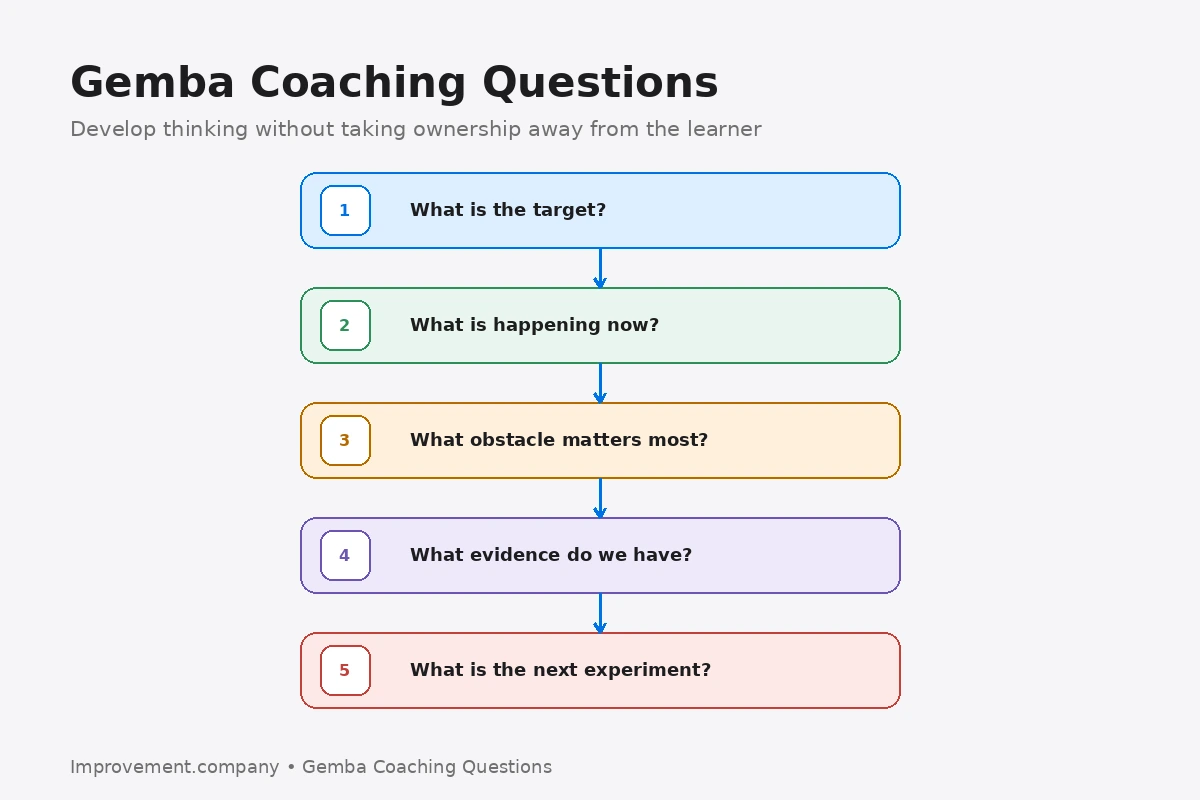
Gemba Coaching Questions are questions leaders use at the point of work to help employees think through problems without immediately giving them the answer.
The objective is to develop capability while still supporting safe and effective operations.
Good coaching creates thinking.
Poor coaching turns the Gemba into an inspection or a command session.
Start with the target
Useful questions include:
- What should be happening?
- What is the target condition?
- What does good look like?
Toyota Kata uses a structured coaching approach built around target condition, current condition, obstacles, and the next step.
The target provides direction for the conversation.
Understand the current condition
Ask:
- What is happening now?
- What evidence do we have?
- Where is the gap?
Gemba Walk emphasizes direct observation rather than relying only on reports.
The conversation should stay close to facts visible in the process.
Explore the obstacle
Instead of asking:
Why did you not fix this?
ask:
What is preventing the process from reaching the target?
This separates the process problem from personal blame.
Psychological Safety in Continuous Improvement supports an environment where employees can surface problems without fear.
Ask about evidence
Useful questions include:
- How do we know?
- What did you observe?
- What data supports that?
- What would disprove this idea?
Hypothesis-Driven Problem Solving helps turn assumptions into testable statements.
Ask for the next small step
The leader can ask:
- What is the next experiment?
- What do you expect to happen?
- When will we know?
Small Tests of Change helps teams learn quickly without overcommitting to an unverified solution.
Avoid disguised commands
A question such as:
Don’t you think you should change the fixture?
is often a command disguised as coaching.
If the leader already knows that a safety or compliance action is required, say so clearly.
Coaching is not appropriate when immediate direction is necessary.
Adjust the level of support
A beginner may need more guidance.
An experienced problem solver may need only a few questions.
A3 Coaching provides a deeper approach for developing reasoning through the problem-solving process.
Close with commitment
Ask:
- What will you do next?
- By when?
- What support do you need?
The learner should leave with a clear next step.
Common mistakes
Turning coaching into interrogation, asking questions when immediate direction is required, giving the answer after the first pause, focusing on the person instead of the process, accepting opinions without evidence, and asking so many questions that the conversation becomes artificial are common mistakes.
Practical sequence
- clarify the target.
- observe the current condition.
- identify the obstacle.
- ask for evidence.
- explore the learner’s thinking.
- define the next experiment.
- clarify expected result.
- identify required support.
- agree on follow-up.
- reflect on what was learned.
The practical lesson
Gemba Coaching Questions help leaders develop problem solvers instead of becoming the person who solves every problem.
The best question moves thinking forward without taking ownership away.