
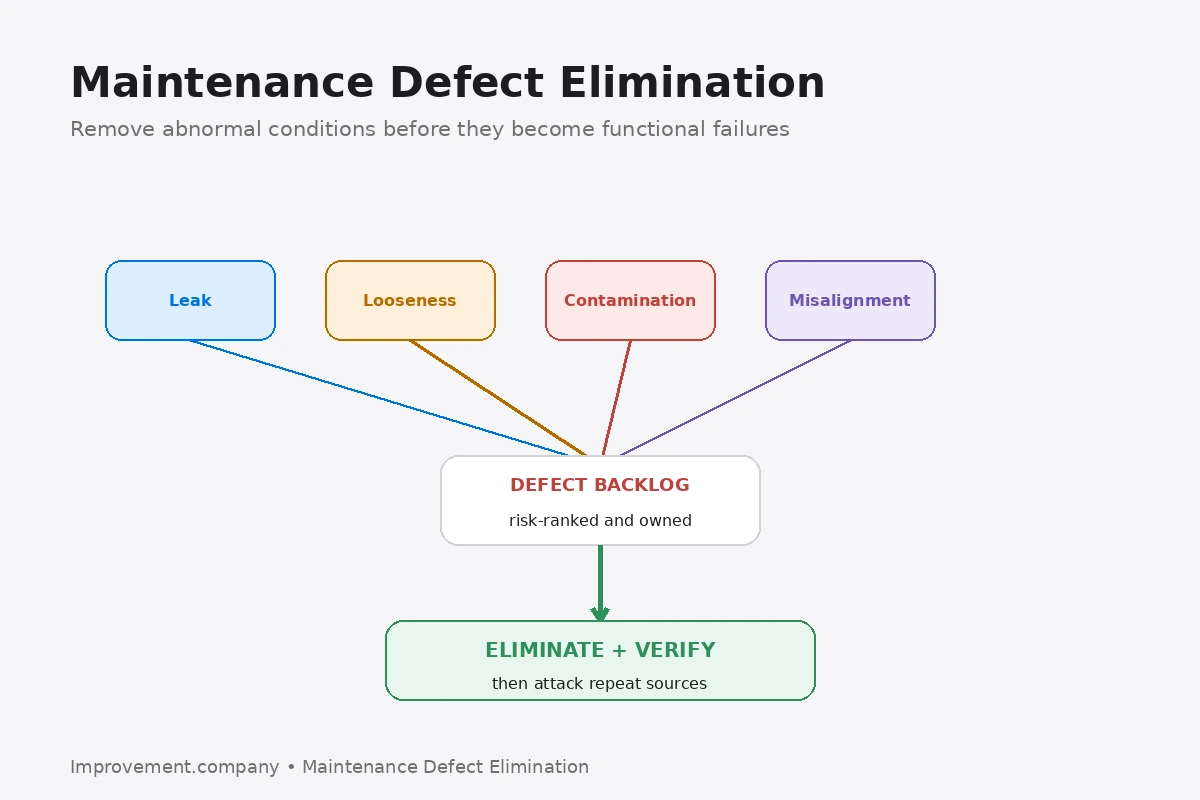
Maintenance Defect Elimination is the systematic removal of equipment conditions that increase the probability of future failure.
Examples include:
- leaks;
- looseness;
- contamination;
- misalignment;
- damaged guards;
- poor cable routing;
- incorrect fasteners;
- deteriorated seals.
The objective is to remove defects before they develop into functional failures.
Define an equipment defect
An equipment defect is a condition outside the desired technical state even if the asset is still operating.
Examples:
- oil leak;
- loose terminal;
- missing bolt;
- abnormal vibration;
- clogged breather.
Precision Maintenance helps prevent new defects from being introduced during maintenance work.
Defect elimination focuses on finding and removing the conditions already present.
Make defects visible
Useful sources include:
- operator inspections;
- maintenance rounds;
- predictive technologies;
- cleaning;
- planned work;
- breakdown follow-up.
Autonomous Maintenance can help operators identify basic abnormalities early through cleaning, inspection, and condition awareness.
Classify the defect
A simple classification might include:
- safety;
- function;
- contamination;
- fastening;
- lubrication;
- alignment;
- protection.
Consistent categories help reveal systemic patterns.
Prioritize by risk
Not every defect requires the same urgency.
Consider:
- safety;
- asset criticality;
- failure consequence;
- deterioration rate;
- constraint impact.
Asset Criticality Analysis helps align response with business and operational risk.
Remove the defect correctly
Do not simply hide the symptom.
Examples:
- replacing absorbent under a leak is not eliminating the leak;
- tightening a repeatedly loose bolt without understanding why it loosens may not be permanent.
Breakdown Analysis may be appropriate when defects repeatedly return or connect to a significant failure mechanism.
Prevent recurrence
Recurring defect types may indicate weakness in:
- installation;
- lubrication;
- design;
- work quality;
- environmental protection.
Bad Actor Analysis can identify assets or components consuming repeated maintenance attention.
The organization should remove the systemic source, not only clear the current backlog.
Integrate defects into work management
Defects should enter a controlled workflow with:
- owner;
- priority;
- due date;
- completion evidence.
Maintenance Work Order Quality helps ensure the defect is described clearly enough for planning and future history.
Measure progress
Useful measures may include:
- defects found;
- defects eliminated;
- overdue high-risk defects;
- repeat defects.
Do not reward only the number found.
The objective is a healthier asset condition.
Common mistakes
Treating defects as cosmetic, allowing small abnormalities to remain indefinitely, closing leaks with temporary containment, removing symptoms without recurrence analysis, generating more defects than maintenance capacity can eliminate, and measuring inspection activity without measuring actual elimination are common mistakes.
Practical sequence
- define equipment defect standards.
- identify defects routinely.
- record location and condition.
- classify and prioritize risk.
- plan the corrective work.
- eliminate the physical defect.
- verify the condition after repair.
- investigate repeat defects.
- remove systemic sources.
- track backlog and recurrence.
The practical lesson
Maintenance Defect Elimination shifts attention from repairing failures to improving equipment condition.
Small defects are often early warnings of larger reliability losses.