
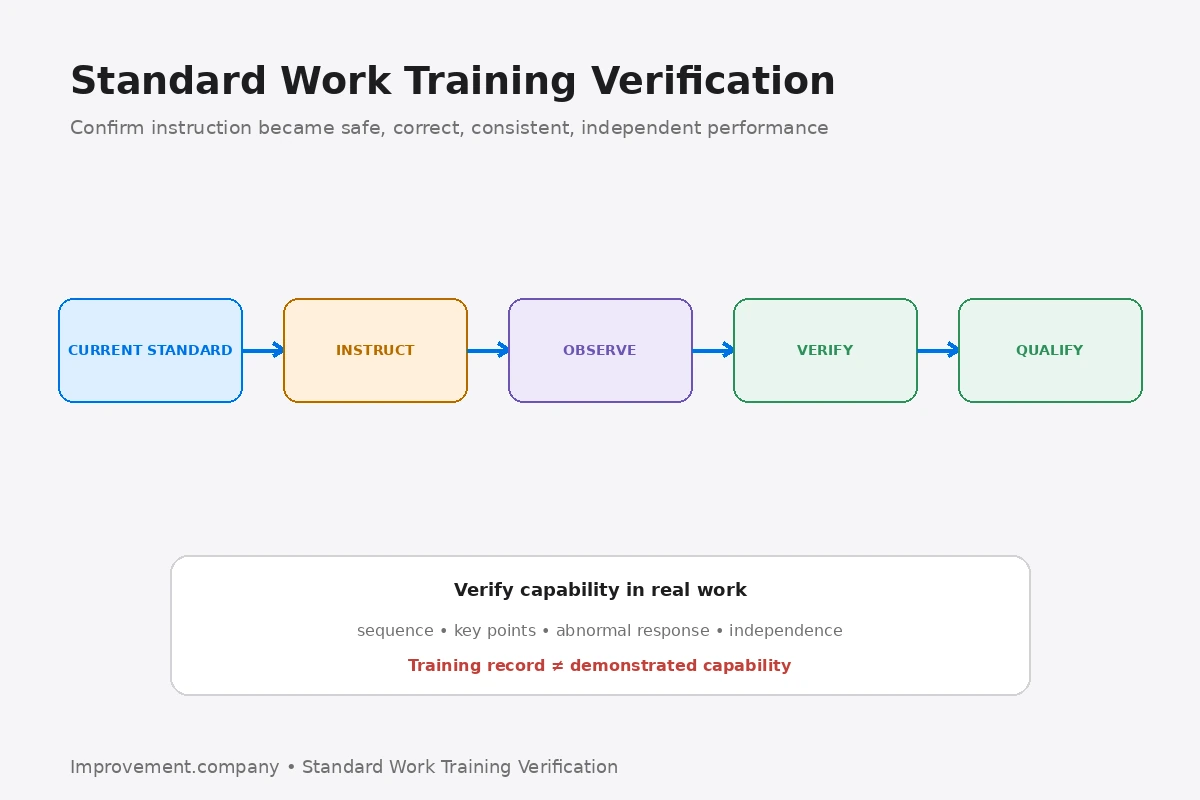
Standard Work Training Verification confirms that an employee can perform the defined method correctly after training.
The purpose is not to confirm attendance.
The purpose is to verify capability in the real work.
Start with the current standard
Standard Work defines the best-known sequence, timing, and important operating conditions for repeatable work.
Training verification should use the current approved method.
If the standard is outdated, training compliance does not protect the process.
Verify critical steps
Identify steps where error could affect:
- safety;
- quality;
- equipment;
- flow.
TWI Job Instruction helps teach important steps, key points, and reasons in a structured way.
The employee should understand not only what to do, but why important points matter.
Observe actual performance
Ask the employee to perform the job under normal conditions.
Look for:
- correct sequence;
- correct key points;
- correct use of tools;
- correct quality checks;
- safe response to normal variation.
Do not coach every step during the verification itself.
Check abnormality response
Capability includes knowing what to do when normal work cannot continue.
Standard Work Abnormality Response helps define detection, safe first action, containment, escalation, and restart.
Ask the employee to explain or demonstrate the expected response to a relevant abnormal condition.
Check independence
The employee should be able to perform the work without continuous prompting.
Competency-Based Qualification helps connect qualification with demonstrated capability rather than attendance alone.
The required level of independence should match the role and risk.
Record gaps specifically
Examples include:
- missed key point;
- incorrect sequence;
- uncertainty about escalation;
- inconsistent measurement method.
Avoid vague labels such as “needs more training.”
Specific gaps make retraining more effective.
Reverify after correction
If the employee needs additional instruction, repeat the verification after practice.
Also consider reverification after:
- standard change;
- long absence;
- recurring defect;
- transfer to a different model or process.
Common mistakes
Treating sign-off as proof of capability, verifying only knowledge questions, coaching continuously during the test, ignoring abnormality response, using an outdated standard, failing to distinguish training gaps from poor work design, and never reverifying after major change are common mistakes.
Practical sequence
- confirm the current standard.
- identify critical steps and key points.
- complete structured instruction.
- observe real performance.
- verify sequence and key points.
- verify abnormality response.
- assess independence.
- record specific gaps.
- retrain where needed.
- reverify before qualification is complete.
The practical lesson
Standard Work Training Verification confirms that instruction became capability.
A training record matters only when the person can perform the method safely, correctly, and consistently in the real process.