
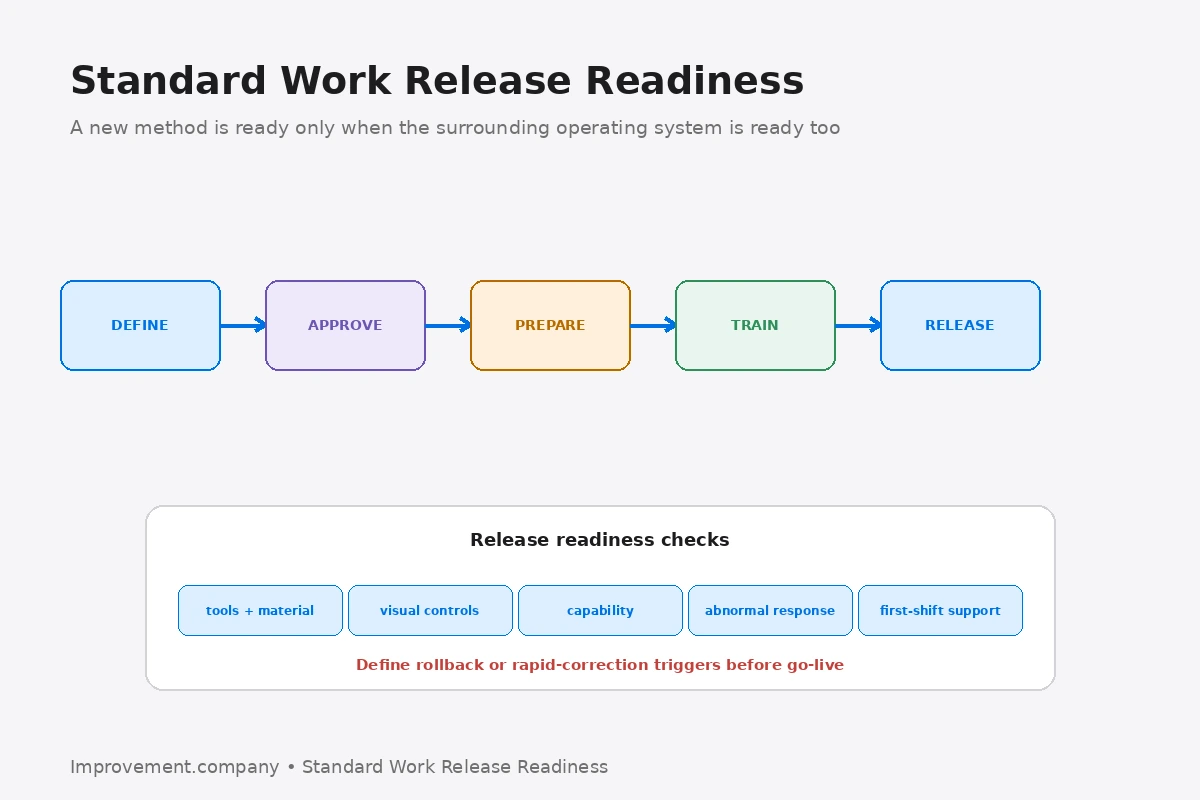
Standard Work Release Readiness checks whether a new or revised method is truly ready to become the controlled standard.
The purpose is not to slow improvement with paperwork.
The purpose is to prevent a technically good method from failing because the operating system around it is incomplete.
Confirm the method is defined
Standard Work Documentation helps capture the sequence, timing, key points, and other information needed to perform repeatable work.
Before release, confirm:
- sequence is clear;
- key points are visible;
- timing is realistic;
- current revision is identified.
Confirm change approval
Standard Work Change Control helps evaluate, approve, document, train, and verify deliberate changes.
The new standard should have a clear approval path, especially when changes affect:
- safety;
- quality;
- tooling;
- process parameters.
Confirm workplace readiness
Check whether the work area supports the new method.
Examples include:
- tools are available;
- material presentation is correct;
- fixtures are ready;
- visual controls are updated.
A standard that depends on unavailable conditions is not ready for release.
Confirm training
TWI Job Instruction helps teach important steps, key points, and reasons in a structured way.
Training should occur before the old method is withdrawn where practical.
Standard Work Training Verification helps confirm that instruction became demonstrated capability.
Confirm abnormality response
Standard Work Abnormality Response defines what people should do when normal work cannot continue.
The release should include:
- detection;
- safe first action;
- containment;
- escalation;
- restart rules.
Confirm ownership
Identify who owns:
- document control;
- training completion;
- first-shift support;
- post-release verification.
Avoid assuming “operations” will handle everything after launch.
Verify after release
Standard Work Observation helps compare defined and actual work at the Gemba.
Plan an early observation after release to confirm the method works under real conditions.
Also define what would trigger a rollback or rapid correction during the first operating period. A release plan is stronger when the team knows not only how to start the new method, but how to respond if the expected safety, quality, or flow conditions do not appear.
Common mistakes
Releasing before tools or materials are ready, updating documents after launch, training only by email, failing to verify capability, leaving abnormality response unchanged, switching revisions without clear ownership, and assuming first-day compliance proves the method is stable are common mistakes.
Practical sequence
- confirm the method is defined.
- confirm approval.
- confirm tools and materials.
- confirm visual controls.
- complete training.
- verify capability.
- confirm abnormality response.
- define release ownership.
- launch the new standard.
- verify actual use shortly after release.
The practical lesson
Standard Work Release Readiness protects the transition from improvement to normal work.
A new method is ready when the people, workplace, controls, and support system are ready with it.