
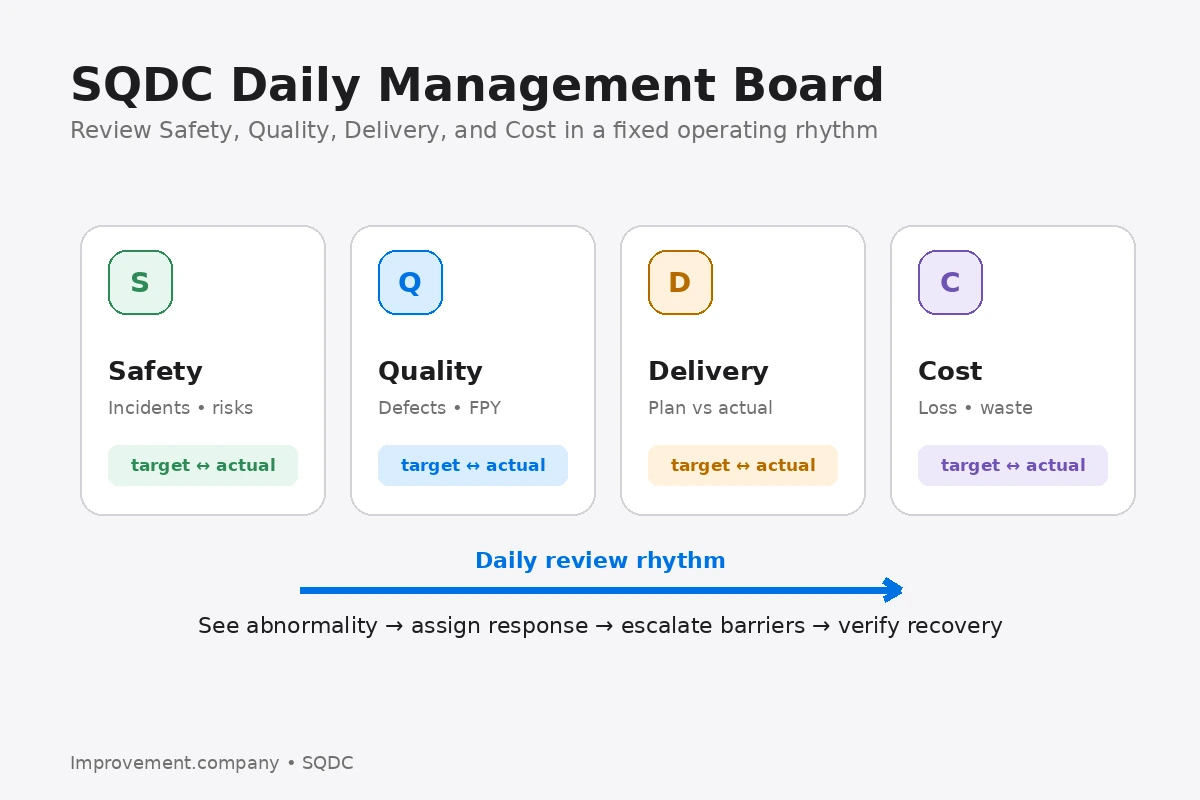
SQDC is a common Daily Management framework that organizes performance around Safety, Quality, Delivery and Cost. Many organizations add People, creating SQDCP, or use other variations that reflect their priorities.
The purpose is not the acronym itself.
The value is in reviewing performance through multiple dimensions so that improvement in one area does not hide damage in another.
Safety
Safety is commonly placed first because production performance should not be achieved by increasing risk.
Daily measures may include incidents, near misses, hazards, safety observations or completion of critical actions.
The specific measure should fit the work.
The objective is timely visibility and response.
Quality
Quality measures show whether the process is creating acceptable output.
First-pass yield, defects, rework, customer complaints, process deviations or other measures may be useful.
The team should distinguish between lagging outcomes and process conditions that can be influenced during the day.
Delivery
Delivery reflects whether the process is meeting the required timing or quantity.
Plan versus actual output, schedule attainment, on-time completion, backlog or lead time may be relevant depending on the environment.
A delivery miss often exposes problems elsewhere in the system, such as equipment reliability or material availability.
Cost
Cost should support good operational decisions rather than encourage local optimization.
Scrap, overtime, labor productivity, material loss, energy or other process-level measures may be useful.
The team should avoid cost actions that create safety, quality or delivery problems.
This is one reason the balanced SQDC view matters.
People
SQDCP adds a people dimension.
Measures may relate to staffing, skills, training, engagement, attendance or improvement participation.
People measures should be selected carefully so that they support capability rather than become superficial scorekeeping.
Use the framework to expose trade-offs
A process can improve output while quality deteriorates.
It can reduce maintenance cost while breakdown risk increases.
Reviewing the categories together helps the team see these relationships.
The framework encourages system thinking instead of chasing one metric.
Connect SQDC to action
A Daily Management board should make target versus actual condition visible.
When a category is abnormal, the team should identify containment, ownership, escalation or problem-solving needs.
The meeting should focus on the gap and response, not simply report the color of each box.
Avoid metric overload
Each category does not require many measures.
Too many KPIs make the board difficult to maintain and weaken attention.
A small number of meaningful measures is usually stronger than a wall of charts.
SQDC is effective when it creates a balanced, visible view of performance and helps teams decide where action is needed today.
Connect this concept to the wider system
For deeper application, connect this concept with Daily Management System, Visual Management, and Leader Standard Work. These methods help move from understanding the topic to managing it as part of a wider improvement system.